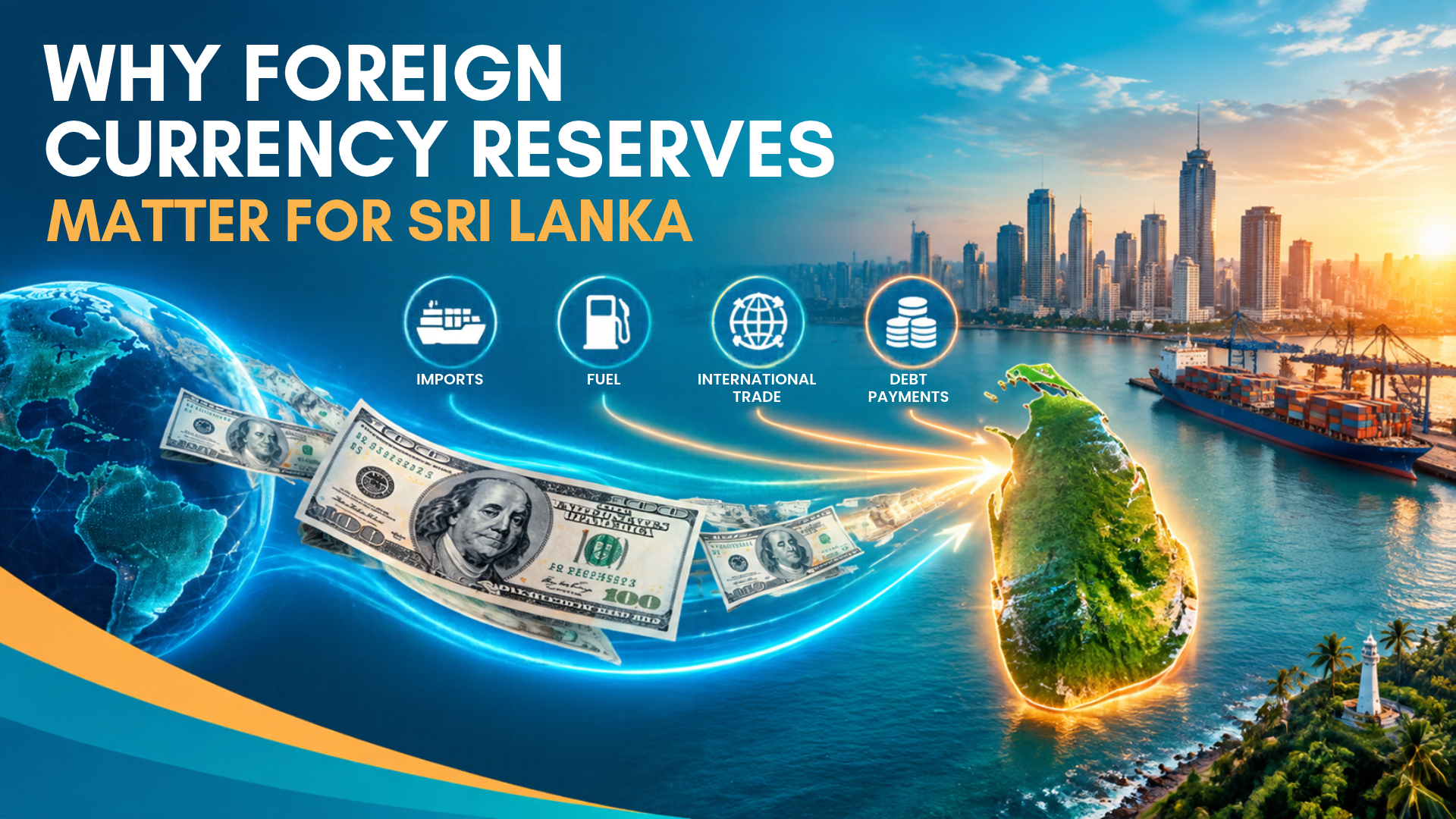
Why Foreign Currency Reserves Matter for Sri Lanka
Rakshika Rathnayake11/17/20265 min read
Share:Facebook
Foreign currency reserves play a major role in maintaining the economic stability of a country. For a developing nation like Sri Lanka, they are particularly important because the country depends heavily on international trade, fuel imports, foreign investment, tourism, and overseas financial transactions. Although people may not think about foreign currency reserves in their daily lives, these reserves have a direct influence on the prices of essential goods, the value of the Sri Lankan rupee, business activities, and the country's ability to meet international financial obligations.
Sri Lanka experienced the serious consequences of insufficient foreign currency reserves during the economic crisis in 2022. The country faced difficulties importing essential products, including fuel, medicine, cooking gas, and certain food items. Long queues formed at fuel stations, electricity shortages affected daily activities, and businesses struggled to continue their operations. These difficulties showed how important foreign currency reserves are for protecting an economy from unexpected financial challenges.
Understanding why foreign currency reserves matter is therefore essential for understanding Sri Lanka's economic recovery and future development.
1. What Are Foreign Currency Reserves?
Foreign currency reserves are financial assets held by a country's central bank, usually in internationally accepted currencies such as the United States dollar, euro, and Japanese yen. They may also include gold, special drawing rights (SDRs) from the International Monetary Fund (IMF), and the country's reserve position at the IMF.
These reserves are maintained to support international payments, manage financial difficulties, and strengthen confidence in the national economy.
For example, Sri Lanka imports large quantities of fuel, machinery, medicine, vehicles, and industrial materials from other countries. International suppliers generally expect payment in widely accepted foreign currencies, particularly US dollars. The Central Bank and the country's financial system need sufficient access to foreign currency to support these transactions.
Foreign currency reserves work like a financial safety net. When a country experiences a shortage of foreign currency earnings, reserves can help meet essential international payment requirements.
However, reserves are not unlimited funds that can be spent without consequences. They must be carefully managed to ensure that the country can meet both immediate and future financial responsibilities.
2. Why Sri Lanka Needs Foreign Currency Reserves
Sri Lanka is an import-dependent economy. Although the country produces many agricultural and industrial products locally, it still relies on international markets for several essential goods and services.
Fuel is one of the most important examples. Sri Lanka requires imported petroleum products to operate vehicles, generate electricity, transport goods, and support industrial activities. The country also imports pharmaceutical products, medical equipment, machinery, fertiliser, and certain food items.
Most of these international purchases require foreign currency.
When foreign currency reserves are sufficient, the country has greater capacity to maintain essential imports and support normal economic activities. However, when reserves become critically low, the government and businesses may struggle to obtain the dollars needed to pay international suppliers.
This can create shortages, increase prices, and interrupt important economic activities.
Foreign currency reserves are therefore essential for maintaining a reliable supply of imported goods and supporting the everyday needs of the population.
3. The Connection Between Foreign Currency Reserves and the Sri Lankan Rupee
Foreign currency reserves also influence the stability of the Sri Lankan rupee.
The exchange rate represents the value of one country's currency compared with another country's currency. For example, it determines how many Sri Lankan rupees are required to purchase one US dollar.
When a country has healthy foreign currency inflows and sufficient reserves, the Central Bank has greater flexibility to manage excessive exchange rate fluctuations. It can use foreign currency transactions as part of its monetary and exchange rate policies when necessary.
However, when foreign currency becomes scarce, demand for dollars may increase while the available supply remains limited. This can put pressure on the local currency.
A weaker rupee makes imported products more expensive because businesses need more rupees to purchase the same amount of foreign currency.
For example, if a company imports machinery worth US$10,000, the amount it pays in Sri Lankan rupees depends on the exchange rate. If the rupee depreciates, the local currency cost of importing that machinery increases.
Businesses may then increase the prices of their products and services to cover higher costs. As a result, consumers may experience higher living expenses.
Therefore, maintaining adequate foreign currency reserves can help strengthen confidence in the economy and reduce the risk of severe external payment difficulties. However, reserves alone cannot guarantee a stable exchange rate because inflation, interest rates, productivity, trade performance, and investor confidence also matter.
4. Foreign Currency Reserves Help Maintain Essential Imports
One of the most important responsibilities of foreign currency reserves is supporting the country's ability to import essential products.
Sri Lanka cannot produce everything required for its population and industries. The country depends on international suppliers for petroleum, certain medicines, medical equipment, fertiliser, industrial machinery, and technology-related products.
When foreign currency reserves are low, importing these products becomes more difficult. Even if local businesses have enough Sri Lankan rupees to purchase goods, they may not be able to complete international payments without access to foreign currency.
This can affect several sectors:
- Healthcare: Hospitals and pharmacies depend on imported medicines, medical equipment, and specialised healthcare products.
- Transportation: Fuel imports are necessary to maintain public transportation, private vehicles, and goods transportation.
- Agriculture: Farmers depend on imported fertiliser, agricultural chemicals, and machinery.
- Manufacturing: Factories require imported raw materials, equipment, and spare parts.
- Education and technology: Schools, universities, and businesses may depend on imported technological equipment and specialised resources.
Therefore, adequate foreign currency reserves help reduce the risk of import disruptions and support the smooth functioning of essential services.
5. Supporting International Debt Repayments
Foreign currency reserves are also important for managing a country's international debt obligations.
Sri Lanka has borrowed money from international financial institutions, foreign governments, and international financial markets to support infrastructure development and other economic activities. These loans often require repayment in foreign currencies.
When loan repayments become due, the country must have sufficient foreign currency to meet its obligations or secure other financing arrangements.
If a country cannot manage its foreign debt payments, it may face serious financial consequences. International lenders and investors may lose confidence, making it more difficult and expensive to obtain future loans.
Sri Lanka experienced this situation in 2022 when the government announced the suspension of servicing selected external public debt obligations in April. The country was facing a severe foreign currency shortage and could no longer maintain normal external debt payments.
This situation affected international confidence and demonstrated the importance of maintaining sustainable debt levels alongside adequate foreign currency reserves.
However, reserves should not be used simply to repay every foreign loan without considering the country's essential import requirements. Governments must carefully balance debt repayments, available financing, and the need to maintain sufficient foreign currency for the economy.
6. Building Confidence Among Foreign Investors
Foreign investors consider several factors before deciding to invest in another country. These include political stability, economic policies, infrastructure, business opportunities, and financial conditions.
Foreign currency reserves are one of the indicators investors examine when assessing a country's economic strength.
When a country maintains adequate reserves, investors may feel more confident that it can manage international payments and meet important financial obligations. It can also reduce concerns about sudden foreign currency restrictions and difficulties transferring profits or investment funds overseas.
For example, an international company considering establishing a manufacturing facility in Sri Lanka may need to import machinery, raw materials, and technical equipment. It may also need to transfer profits to its home country.
If foreign currency is difficult to obtain, these activities could become complicated.
On the other hand, a country with a stronger external financial position can create a more predictable business environment.
Foreign investment can bring several benefits to Sri Lanka, including employment opportunities, modern technology, improved production methods, and access to international markets.
Therefore, maintaining healthy foreign currency reserves can support investor confidence and contribute to long-term economic development.
7. The Role of Tourism and Foreign Remittances
Sri Lanka has several important sources of foreign currency earnings. Tourism and money sent home by Sri Lankans working overseas are among the most significant.
Tourism generates foreign currency when international visitors spend money on hotels, restaurants, transportation, shopping, entertainment, and other services.
Sri Lanka has many attractions, including beaches, wildlife parks, historical sites, cultural destinations, and natural landscapes. These attractions provide opportunities to attract visitors from different parts of the world.
When tourist arrivals increase, hotels, travel companies, restaurants, small businesses, and local communities can benefit. The foreign currency earned through tourism also helps strengthen the country's external financial position.
Foreign remittances are another important source of foreign currency. Many Sri Lankans work in countries such as the United Arab Emirates, Saudi Arabia, Qatar, Kuwait, South Korea, and Japan. They send money to support their families and relatives living in Sri Lanka.
These remittances help households pay for education, healthcare, housing, food, and other expenses. They also contribute to the country's foreign currency inflows.
However, it is important to understand that tourism earnings and workers' remittances do not automatically become official reserves. They first enter the country's foreign exchange system, and the amount eventually accumulated as reserves depends on foreign currency demand, payments, and Central Bank transactions.
Sri Lanka must therefore continue developing tourism and creating opportunities for overseas employment while encouraging official remittance channels.
8. How Foreign Currency Reserves Help During Economic Crises
Every country can experience unexpected economic challenges. Natural disasters, global conflicts, increases in international oil prices, pandemics, and financial market instability can create serious difficulties.
For a country like Sri Lanka, these challenges can increase the demand for foreign currency while reducing the amount earned through exports, tourism, or other international activities.
Foreign currency reserves provide a financial buffer during such difficult periods.
For example, if international oil prices suddenly increase, Sri Lanka may need more dollars to purchase the same quantity of fuel. If tourism earnings also decline during that period, the country could experience additional pressure on its foreign currency supply.
Adequate reserves can help the country manage some of these temporary difficulties without immediately disrupting essential imports.
The COVID-19 pandemic demonstrated how quickly international economic conditions can change. Travel restrictions significantly affected tourism worldwide, including Sri Lanka. This reduced an important source of foreign currency earnings at a time when the country was already facing economic challenges.
The experience highlighted why countries should maintain sufficient financial protection before a crisis occurs rather than trying to build reserves after problems have already developed.
9. What Sri Lanka's 2022 Economic Crisis Taught the Country
Sri Lanka's economic crisis in 2022 provides a clear example of the consequences of insufficient foreign currency reserves.
Several factors contributed to the crisis, including declining tourism earnings following the Easter Sunday attacks and the COVID-19 pandemic, reduced workers' remittances through official channels, high external debt obligations, weak economic policies, and difficulties accessing international financial markets.
As foreign currency became increasingly limited, the country struggled to pay for essential imports.
According to the International Monetary Fund, Sri Lanka's gross international reserves stood at approximately US$1.9 billion at the end of December 2022. This figure included a portion of Chinese yuan reserves that was not freely usable for general international payments.
The shortage created serious problems across the country. Fuel and cooking gas became difficult to obtain, medicine supplies were affected, and electricity shortages disrupted homes and businesses. Import restrictions were introduced to manage the limited foreign currency available.
The Sri Lankan rupee also experienced a sharp depreciation. According to the Central Bank's 2022 Annual Report, it depreciated by approximately 44.8% against the US dollar during that year.
The crisis showed that a country cannot depend on foreign currency reserves alone to solve deeper economic problems. It must also maintain responsible financial management, sustainable borrowing practices, strong exports, and reliable foreign currency income.
International Monetary Fund+2
10. How Sri Lanka Can Strengthen Its Foreign Currency Reserves
Building stronger foreign currency reserves requires long-term economic planning and consistent policies. Sri Lanka should focus on increasing foreign currency earnings while managing unnecessary foreign currency expenses.
Several important steps can help achieve this goal.
Promoting exports: Sri Lanka should expand exports beyond traditional products such as tea, rubber, and garments. Information technology, software development, processed food, engineering services, and other value-added industries offer opportunities to earn more foreign currency.
Developing tourism: Improving tourism infrastructure, transportation, accommodation, and visitor services can help attract more international tourists. Promoting destinations outside popular tourist areas can also distribute tourism income across the country.
Encouraging foreign investment: Creating a business-friendly environment, reducing unnecessary administrative delays, and maintaining consistent economic policies can attract international investors.
Increasing official remittances: The government and financial institutions should encourage overseas workers to send money through official banking channels by providing reliable services and competitive exchange rates.
Managing imports carefully: Sri Lanka should strengthen local production where economically practical and reduce unnecessary dependence on imported products. However, import restrictions should not damage industries that depend on essential imported materials.
Maintaining responsible borrowing: The government must carefully evaluate foreign loans and ensure that borrowed funds contribute to productive economic activities. Sustainable debt management is essential for protecting future foreign currency reserves.
Maintaining economic stability: Consistent monetary and fiscal policies, effective public financial management, and confidence in the banking system can encourage foreign currency inflows and support reserve accumulation.
These measures should work together rather than being implemented separately. A country cannot build sustainable reserves simply by restricting imports. It must develop industries that generate foreign currency and create an economy capable of competing internationally.
11. The Current Situation and Future Importance
Sri Lanka has made progress in rebuilding its foreign currency reserves following the economic crisis. According to Central Bank data reported in November 2026, gross official reserves reached approximately US$7.09 billion by the end of October 2026. This represents a considerable improvement compared with the approximately US$1.9 billion recorded at the end of 2022.
Daily FT+1
This improvement is encouraging, but the country must continue strengthening its external financial position.
The total reserve figure should also be interpreted carefully. Some reserve components may have restrictions, and future foreign debt repayments and other international obligations can reduce the amount available. Therefore, the quality, usability, and sustainability of reserves are just as important as their headline value.
Sri Lanka should not focus only on increasing the reserve balance. It should also develop a stronger export economy, attract sustainable foreign investment, improve productivity, and maintain healthy international financial relationships.
The country's long-term success will depend on its ability to generate sufficient foreign currency through productive economic activities rather than relying excessively on international borrowing.
Conclusion
Foreign currency reserves are an essential part of a country's economic stability. For Sri Lanka, they are particularly important because the country depends on international markets for fuel, medicine, machinery, technology, and many other essential products. They also help manage international debt obligations, support confidence in the rupee, and provide protection during unexpected economic challenges.
The economic crisis in 2022 clearly demonstrated what can happen when a country does not have sufficient foreign currency to meet its international financial requirements. Shortages of essential goods, rising living costs, business difficulties, and economic uncertainty affected millions of people.
Although Sri Lanka has made progress in rebuilding its reserves, maintaining long-term stability requires more than simply accumulating dollars. The country must strengthen exports, develop tourism, encourage foreign investment, increase official remittances, and manage public debt responsibly.
Ultimately, strong foreign currency reserves are not just numbers published in economic reports. They represent a country's ability to maintain international trade, protect essential services, support businesses, and respond to financial challenges. Building and protecting these reserves should therefore remain an important priority for Sri Lanka's future economic development.
Additional Media