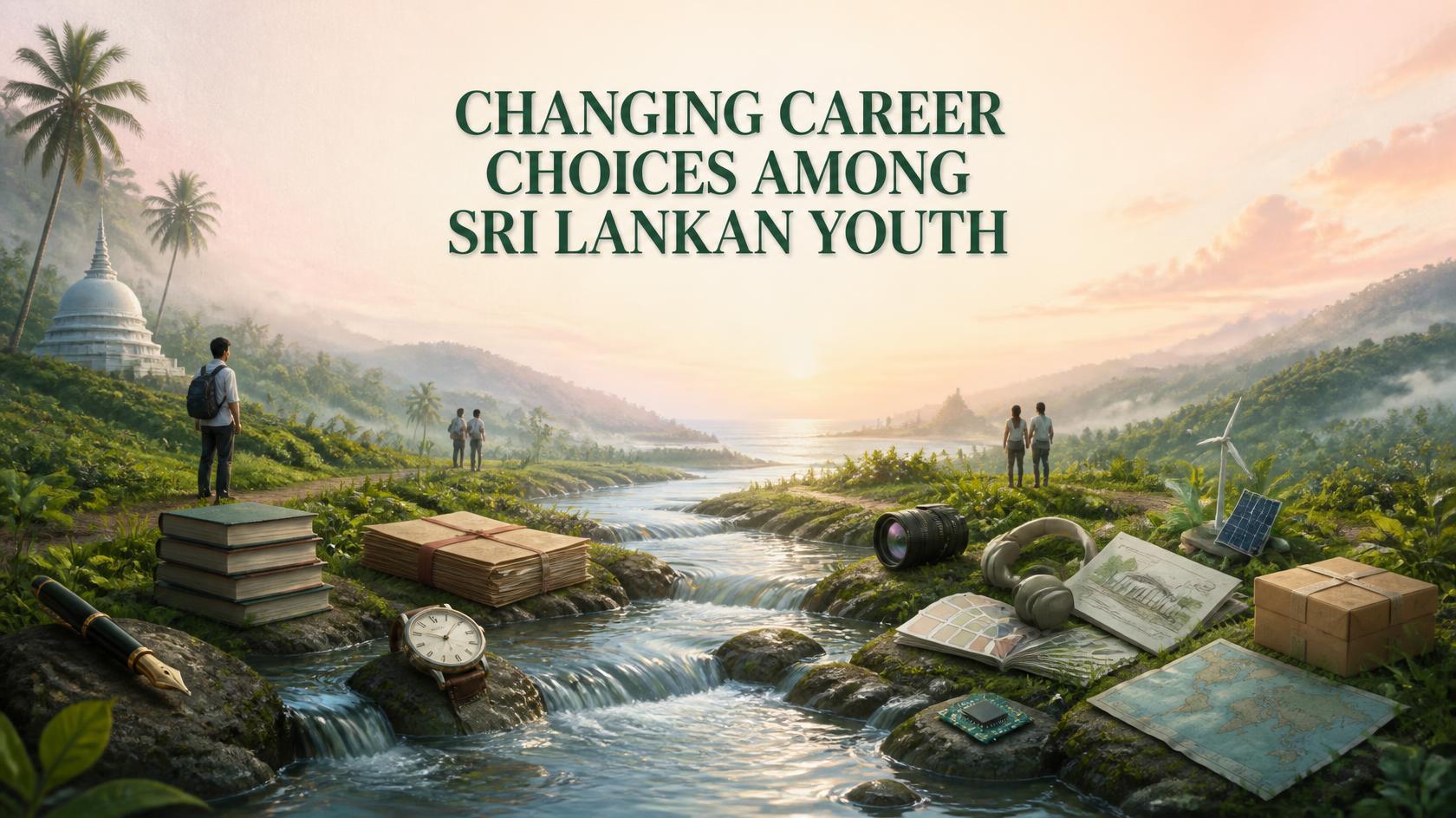
Why Are Traditional Career Paths Losing Popularity Among Sri Lankan Youth?
Rakshika Rathnayake8/29/20265 min read
Share:Facebook
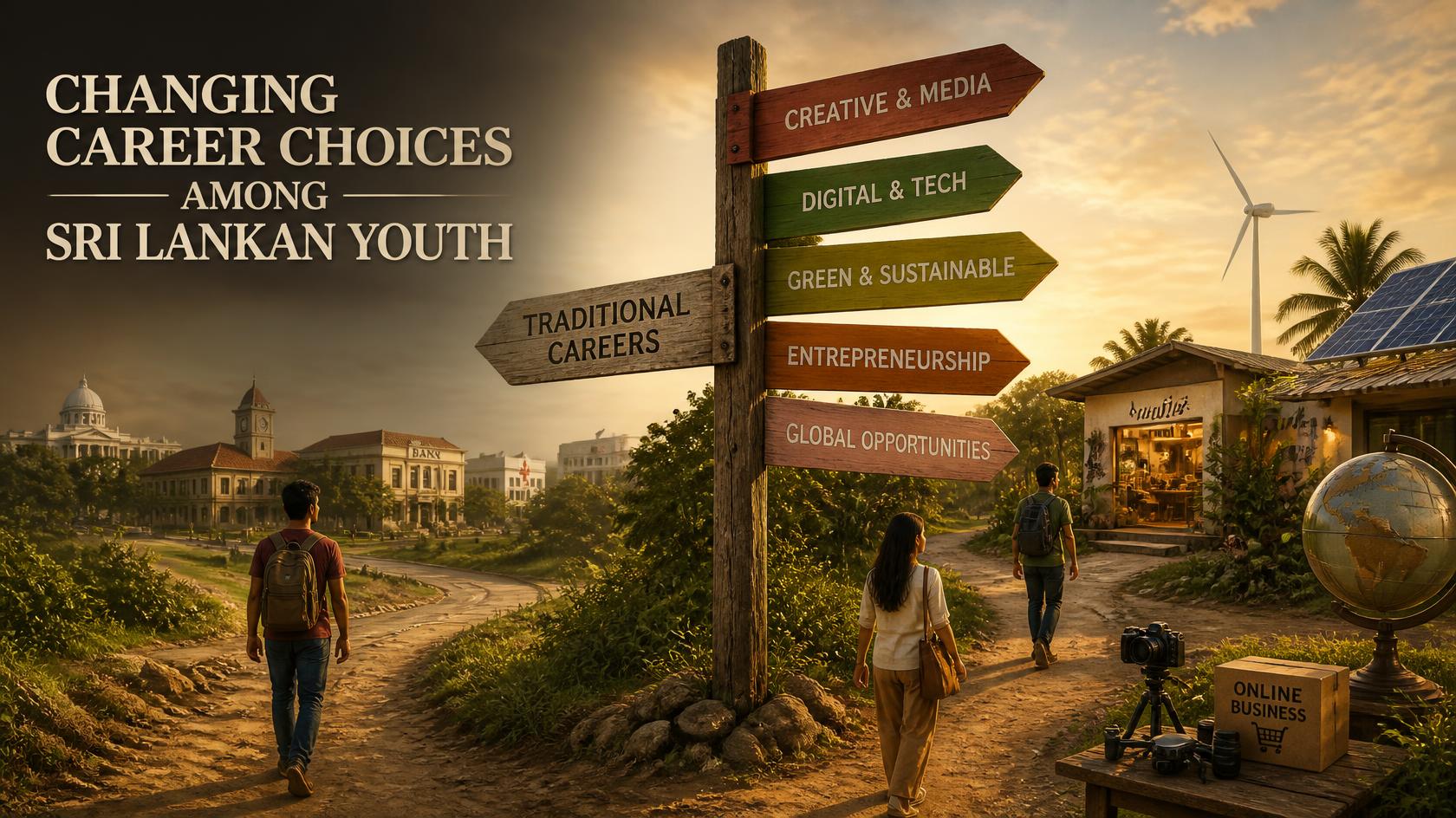
For many decades, traditional career paths held a powerful position in Sri Lankan society. Becoming a doctor, lawyer, teacher, engineer, banker, or government officer was widely considered a sign of success, stability, and social status. Families often encouraged young people to pursue professions that offered a secure income, respectable working conditions, and long-term employment.
However, the attitudes of Sri Lankan youth toward careers are gradually changing. While traditional professions remain popular and highly respected, an increasing number of young people are exploring technology, entrepreneurship, freelancing, remote work, digital marketing, creative industries, international employment, and other less conventional career paths.
This change does not mean that young people have completely rejected traditional employment. Rather, the meaning of a “good career” is changing. Security and status remain important, but many young people are also looking for flexibility, higher earning potential, personal independence, opportunities for creativity, international exposure, and work that matches their interests and skills.
Recent evidence highlights how important this transition has become. The World Bank reported in August 2026 that nearly one million young Sri Lankans are expected to enter the formal workforce over the next decade, while current trends suggest the economy may create far fewer formal jobs. The report also identifies a growing mismatch between graduates' qualifications and employer requirements.
The Traditional Meaning of a Successful Career
In earlier generations, career success in Sri Lanka was often associated with obtaining a stable position in the public sector or a well-established profession.
Government employment was particularly attractive because it was associated with job security, predictable benefits, social recognition, and long-term stability. Historical research on Sri Lankan youth employment preferences has identified public-sector jobs as especially attractive because of security, remuneration, social status, and benefits.
Families also played a major role in shaping career decisions. Parents frequently encouraged children to choose occupations they believed would provide a secure future. The traditional formula was relatively simple: perform well at school, enter university, obtain a degree, and find a respected job.
For many families, careers such as medicine, teaching, engineering, law, government administration, and banking represented reliable pathways to social and economic stability.
Today, however, young people are increasingly questioning whether these traditional pathways are the best fit for their personal goals and the changing labour market.
Changing Ideas About Job Security
One major reason for the changing attitude is the evolving meaning of job security.
For previous generations, job security was closely connected with permanent employment. A stable government position could be attractive because it was expected to provide a predictable career and income over many years.
Younger people increasingly understand that a permanent position is not the only form of security. They may see professional skills, multiple income sources, digital capabilities, international clients, and the ability to move between industries as forms of career security.
This is particularly relevant in a labour market where technological and economic changes can reshape industries quickly.
The World Bank's 2026 analysis points to a difficult employment environment in which many young people are seeking fair pay, career development, relevant work, and opportunities for independence rather than simply any available job.
As a result, a young graduate may prefer to develop a valuable skill and work for several organizations or clients rather than spend an entire career with one employer.
The Influence of Technology
Technology is one of the strongest forces changing career preferences.
The growth of smartphones, high-speed internet, cloud computing, online learning, artificial intelligence, digital platforms, and social media has introduced young people to professions that were less visible or less accessible to earlier generations.
Today, a young person can build a career as a software developer, UI designer, content creator, digital marketer, cybersecurity specialist, data analyst, video editor, online educator, or e-commerce entrepreneur.
These professions can also provide access to international markets.
A talented Sri Lankan graduate may work remotely for an overseas company, provide freelance services to international clients, or operate an online business from home.
The World Bank has noted that Sri Lankan youth are entering a labour market where employers increasingly seek practical experience, digital capabilities, communication skills, and adaptability.
The expansion of technology therefore changes not only available jobs but also young people's understanding of what a career can be.
Social Media and Exposure to New Careers
Social media has accelerated this change.
Platforms such as YouTube, TikTok, Instagram, LinkedIn, and Facebook expose young people to professionals working in fields they may never have encountered through traditional career guidance.
A student can watch a software developer explain their career, follow a Sri Lankan entrepreneur building an online business, learn about freelancing, or discover an international company offering remote jobs.
This constant exposure expands the imagination of young people.
A teenager who once believed that a university degree could lead only to a conventional profession may now realize that skills can be monetized in many different ways.
Social media also promotes new ideas about success. Young people see entrepreneurs, creators, freelancers, designers, programmers, and digital professionals building careers outside conventional structures.
However, social media can also create unrealistic expectations. Online personalities often highlight success without showing the financial risks, long hours, failures, or uncertainty behind it.
Therefore, young people need reliable career guidance alongside exposure to new possibilities.
The Search for Flexibility
Flexibility has become an increasingly important factor in career decisions.
Traditional jobs may involve fixed working hours, strict workplace structures, commuting, and limited control over schedules. Some young workers increasingly value the ability to choose when, where, and how they work.
Remote work and freelancing can offer greater flexibility. A skilled worker may complete projects from home, manage multiple clients, or design a work schedule around personal responsibilities.
Research discussed in the World Bank's Sri Lanka Jobs Diagnostic found that young people place significant value on independence and flexibility, although these preferences do not always translate into actual entrepreneurship.
For some youth, flexibility is therefore not simply about convenience. It is connected to independence and control over their working lives.
Income Expectations Are Changing
Income expectations also influence career choices.
Young people are increasingly aware of differences between salaries in various industries and the earning possibilities available through international markets.
A graduate may compare a traditional entry-level position with the possibility of earning foreign currency through software development, freelancing, digital services, online education, or remote employment.
This does not mean every digital career offers high earnings. Competition can be intense, skills must be continuously updated, and income can be unstable.
Nevertheless, the possibility of accessing international clients has changed young people's perceptions of earning potential.
This is one reason why some youth may be less willing to follow a traditional career path simply because it has high social status.
The Growth of Entrepreneurship
Entrepreneurship is another factor contributing to changing career preferences.
For many years, entrepreneurship in Sri Lanka was often viewed as a risky option, particularly for young people. An ILO source notes that a 2018 study found that fewer than 30% of Sri Lankan youth considered self-employment an ideal career, while public-sector employment remained more strongly preferred.
That perception is gradually changing.
Digital platforms have made it easier to start small businesses, advertise products, communicate with customers, and accept payments without needing a large physical shop.
A young person can start a clothing business through social media, sell handmade products online, provide design services, develop websites, offer tutoring, or operate an online food business.
Entrepreneurship is increasingly seen by some young people not merely as a backup plan after failing to find a job, but as a potential primary career.
The ILO's youth entrepreneurship initiatives in Sri Lanka have also focused on making entrepreneurship a more attractive career option and strengthening young people's ability to establish and grow businesses.
The Importance of Personal Interest
Career decisions are also becoming more connected with personal interests.
Previous generations often placed greater emphasis on social expectations when choosing a career. Today, many young people want work that reflects their interests, talents, and personality.
A young person who enjoys art may prefer graphic design or digital media rather than choosing a profession simply because it is considered prestigious.
Someone interested in computers may prefer software development or cybersecurity.
A person interested in travel and communication may choose tourism, digital content, or international customer service.
This reflects a broader shift from choosing a career based primarily on social approval toward choosing a career based on personal fit.
The Education–Employment Gap
Another reason traditional pathways are losing some of their appeal is the growing awareness that academic qualifications do not always translate directly into suitable employment.
Sri Lanka produces thousands of university graduates every year, but graduates can still struggle to find jobs that match their qualifications and expectations. The World Bank reported in August 2026 that Sri Lanka's universities produce roughly 25,000 to 30,000 graduates annually, while many employers struggle to find workers with the skills they need.
This creates frustration among young people.
A graduate may spend several years obtaining a degree and then discover that employers expect additional practical experience, digital skills, language abilities, or industry-specific knowledge.
The problem is therefore not simply unemployment. It is also the mismatch between what graduates learn, what employers need, and what young people expect from work.
Practical Skills Are Becoming More Valuable
The changing labour market has increased the importance of practical skills.
Employers increasingly value candidates who can demonstrate what they can actually do.
A graduate with a theoretical understanding of marketing may be more competitive if they also know how to run a digital campaign, analyze data, use advertising platforms, and create content.
An accounting graduate may benefit from practical experience with accounting software and data analysis.
An engineering graduate may need familiarity with modern digital tools and industry practices.
The World Bank's recent analysis specifically emphasizes practical experience, digital capabilities, communication skills, and adaptability as increasingly important for young job seekers.
This encourages young people to look beyond academic qualifications and develop employability skills.
Artificial Intelligence and New Career Possibilities
Artificial intelligence is adding another layer to the changing employment landscape.
AI is already influencing software development, customer service, marketing, research, content creation, design, data processing, and administrative work.
For young people, AI can be both a source of concern and an opportunity.
Some may worry that automation will reduce traditional jobs. Others see an opportunity to become specialists who use AI tools to work faster and solve new problems.
This may encourage young people to pursue careers that require creativity, strategic thinking, technology skills, and adaptability.
At the same time, AI makes continuous learning even more important because graduates may need to update their skills repeatedly throughout their careers.
Globalization and International Opportunities
Globalization has also reduced the boundaries between local and international employment.
In the past, a Sri Lankan graduate largely depended on employment opportunities available within the domestic labour market unless they migrated.
Today, digital communication allows some professionals to work for international organizations without physically leaving Sri Lanka.
International freelance platforms, remote employment, online businesses, global professional networks, and digital services have created new pathways.
The rise of e-commerce and digital work has also expanded the potential market for Sri Lankan skills. The ILO's work on the future of work in Sri Lanka has highlighted how technological advancement and global economic integration are reshaping employment opportunities and increasing the importance of reskilling and upskilling.
As young people become more familiar with global opportunities, traditional domestic career paths may appear less restrictive and less financially attractive.
Changing Family Expectations
Although family influence remains strong, attitudes among parents are also changing.
Older generations may still prefer careers such as medicine, teaching, government administration, engineering, or banking because they associate them with security and respectability.
However, parents increasingly recognize that the labour market has changed.
A career in technology, digital marketing, design, entrepreneurship, or remote work may once have seemed uncertain. Today, these paths can provide genuine professional opportunities.
This creates a gradual shift in family conversations. Instead of asking only, “Which profession is safest?” families may increasingly ask, “Which skills will help this young person build a sustainable future?”
The Role of Workplace Culture
Workplace culture is another reason some traditional careers are becoming less attractive.
Young workers may value supportive managers, opportunities for learning, flexible working arrangements, healthy work environments, recognition, and career growth.
Traditional workplaces with rigid hierarchies or limited opportunities for advancement may therefore struggle to attract younger workers.
The World Bank's earlier Sri Lanka Jobs Diagnostic found that young workers placed substantial value on independence, flexibility, leave, and career progression, while employers sometimes expressed concerns about commitment, communication, and workplace expectations.
This suggests that the future workplace may require adaptation from both young employees and employers.
Are Traditional Careers Really Disappearing?
It would be inaccurate to say that traditional careers are disappearing completely.
Medicine, teaching, engineering, law, banking, government administration, accounting, and other established professions continue to provide important employment opportunities.
Many young people still actively pursue these fields.
What is changing is their position relative to alternative careers.
A young person may no longer believe that a traditional profession is automatically the best option simply because previous generations considered it successful.
Traditional careers are increasingly being compared with other possibilities based on income, flexibility, work-life balance, professional development, international opportunities, creativity, and personal interests.
The choice is therefore becoming broader rather than simply traditional versus modern.
The Risk of Unrealistic Expectations
The shift toward new career paths also has risks.
Social media may make entrepreneurship, freelancing, content creation, or remote work appear easier than they really are. A successful individual can attract thousands of viewers while the years of learning and failure behind that success remain invisible.
Some young people may also have unrealistic expectations about salaries, flexible schedules, or rapid career growth.
The World Bank has previously identified a mismatch between youth career expectations and labour-market realities as a factor that can discourage labour-force participation.
Good career decisions therefore require research, realistic planning, practical experience, and an understanding of the effort involved.
What Sri Lanka Needs to Do
The changing attitudes of young people should not be viewed as a problem in themselves. Instead, they can be an opportunity to modernize the country's labour market.
Universities need stronger connections with industry. Students should receive more opportunities for internships, practical projects, career guidance, entrepreneurship, digital skills, and professional training.
Employers can help by offering internships, entry-level training, mentoring, and clearer career development pathways.
Government policy can support private-sector job creation, entrepreneurship, digital infrastructure, innovation, and industries with potential for sustainable employment.
The World Bank's August 2026 analysis emphasizes the need for stronger private-sector growth, better skills, internships, entrepreneurship opportunities, and closer connections between education and industry.
Conclusion
Traditional career paths are not losing popularity because Sri Lankan youth no longer value hard work or stability. Rather, young people are living in a very different economic and technological environment from previous generations.
The traditional idea of success was often based on obtaining a secure job, maintaining it for many years, and achieving social recognition. Today's youth increasingly define success more broadly. They may want financial independence, flexibility, meaningful work, international opportunities, creativity, continuous learning, and control over their careers.
Technology has expanded the range of available professions. Social media has exposed young people to new possibilities. Remote work and freelancing have reduced geographical barriers. Entrepreneurship has become more accessible. Artificial intelligence is changing workplace tasks. Globalization has connected Sri Lankan workers with international markets.
At the same time, these opportunities come with risks. Not every new career is stable, not every online business succeeds, and not every digital skill guarantees a high income.
The most important change, therefore, is not that traditional careers are disappearing. It is that Sri Lankan youth now have more career choices than previous generations, and they are increasingly willing to evaluate those choices according to their own goals and the realities of the modern labour market.
For Sri Lanka, the challenge is to ensure that young people have the education, practical skills, career guidance, digital knowledge, entrepreneurship support, and decent employment opportunities needed to make informed choices.
The future workforce will likely include teachers and engineers alongside software developers, entrepreneurs, digital marketers, researchers, designers, remote workers, technicians, environmental professionals, and many occupations that are still emerging.
The real goal should not be to replace traditional careers with modern ones. It should be to create a labour market where young Sri Lankans can choose careers based on their abilities, aspirations, and opportunities—and build sustainable lives through the work they do.
Additional Media