Understanding the Current Economic Situation in Sri Lanka
Rakshika Rathnayake7/16/20265 min read
Share:Facebook
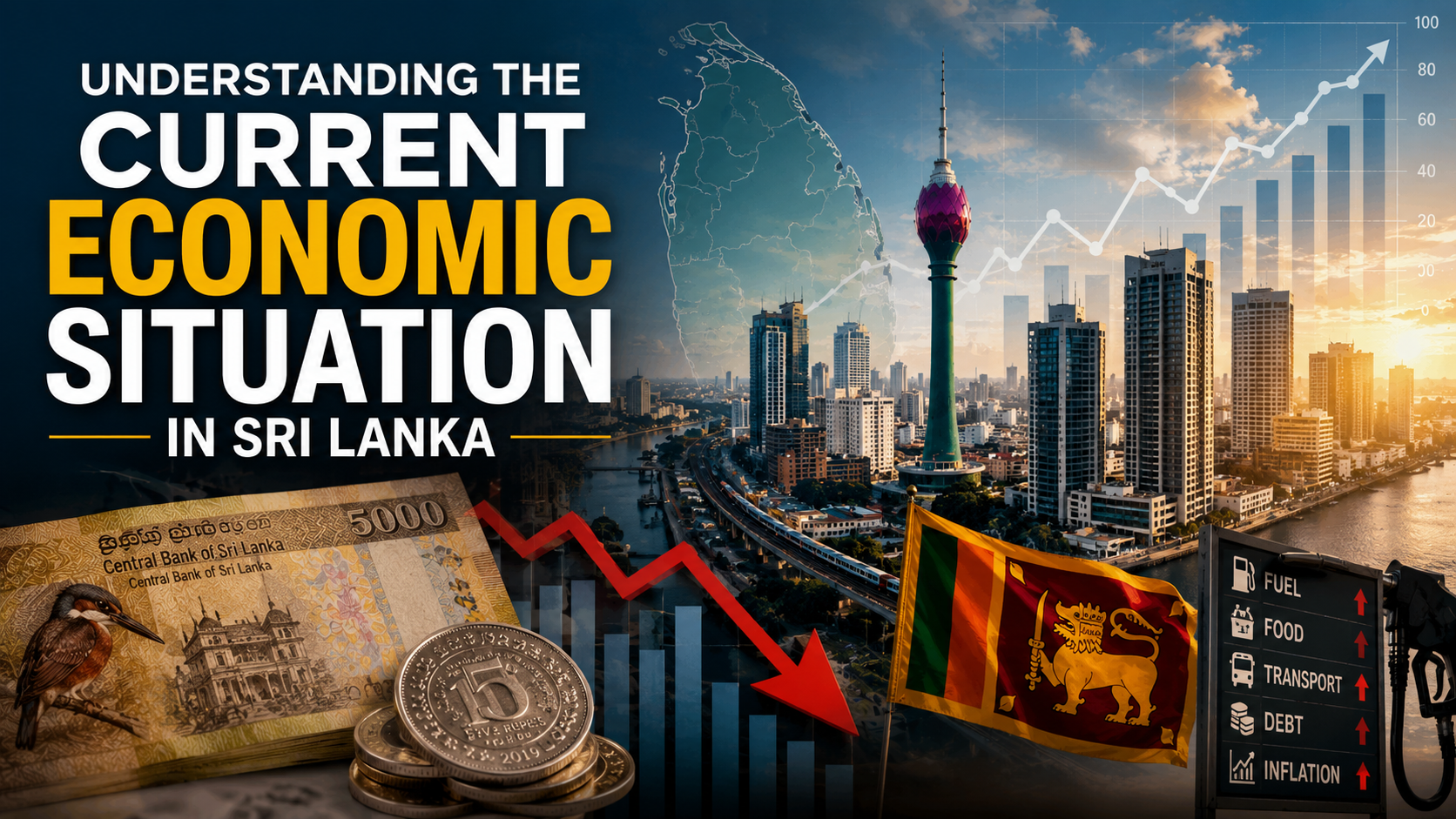
Sri Lanka's economy has navigated a period of profound crisis, culminating in a sovereign default in 2022, and is now on a complex path toward recovery. The island nation's recent economic trajectory offers a critical case study in sovereign debt, macroeconomic stabilization, and the impacts of structural reforms. Analyzing its economic health is significant not only for the Asia-Pacific region but also for understanding the interplay of domestic policy, external shocks, and international financial assistance in a globalized world. This article will examine the historical context of the crisis, the current status of recovery efforts, and the economic projections for the coming years.
Historical Context: The lead-up to the 2022 crisis was marked by unsustainable fiscal deficits, dwindling foreign exchange reserves, and significant policy missteps.
Current Landscape: Supported by an IMF program, Sri Lanka is implementing comprehensive reforms, including debt restructuring and fiscal consolidation, which have started to stabilize the economy.
Recovery Efforts: Key policy responses include enhancing tax revenue, tightening monetary policy to control inflation, and undertaking structural reforms to improve governance and competitiveness.
Future Projections: Economic growth is resuming, but the outlook for 2025 and 2026 remains contingent on sustained reform momentum and a stable global environment.
Policy Imperatives: Long-term stability hinges on continued fiscal discipline, export diversification, attracting foreign investment, and ensuring inclusive growth to mitigate the social impact of reforms.
Historical Context and Genesis of Recent Economic Challenges
The severe economic crisis that gripped Sri Lanka was not a sudden event but the culmination of long-standing structural weaknesses and policy errors. For years, the country operated with persistent twin deficits—a fiscal deficit and a current account deficit—financed largely through external borrowing. This created significant vulnerabilities in its balance of payments. By early 2022, foreign exchange reserves had been depleted to critically low levels, making it impossible to service foreign debt or finance essential imports like fuel, food, and medicine.
Several internal and external factors converged to trigger the downturn. Internally, ill-timed and deep tax cuts in 2019 severely eroded government revenue, exacerbating the fiscal deficit. A rigid exchange rate policy and a struggling state-owned enterprise sector further strained public finances. Externally, the COVID-19 pandemic decimated the crucial tourism industry, a primary source of foreign currency. The subsequent rise in global commodity prices following geopolitical events further intensified the pressure on the nation's limited reserves.
The immediate consequences were dire. The nation experienced hyperinflation, severe shortages of essential goods, and widespread power cuts, leading to significant social unrest and political instability. The economy contracted sharply, plunging a significant portion of the population into poverty and reversing years of development gains. The crisis underscored the critical need for comprehensive economic and governance reforms to address the root causes of instability.
The Current Economic Landscape and Initial Recovery Efforts
The Sri Lankan economy today is in a phase of stabilization and initial recovery, guided by a comprehensive reform agenda. Following the 2022 default, the government embarked on a series of stringent fiscal and monetary policy adjustments to restore macroeconomic stability. A cornerstone of this effort is the Extended Fund Facility (EFF) arrangement with the International Monetary Fund (IMF), which provides financial assistance contingent on the implementation of deep structural reforms. This program has been pivotal in anchoring the reform agenda and rebuilding credibility with international partners.
A central component of the recovery has been the complex process of debt restructuring with both official and private creditors. Progress on this front is crucial for restoring debt sustainability and regaining access to international capital markets. On the domestic front, fiscal policy has focused on revenue generation through measures like increasing the Value Added Tax (VAT) and broadening the tax base. Monetary policy was initially tightened to combat soaring inflation, which has since been brought under control. The Central Bank of Sri Lanka has since been able to cautiously ease its policy stance to support economic activity.
These efforts are showing tentative signs of success. Foreign exchange reserves have seen improvement, and the currency has stabilized after a sharp depreciation. After a severe contraction, Sri Lanka economic growth has returned, with real GDP expanding by 5% in 2025. Ongoing structural reforms are aimed at enhancing economic resilience by improving governance, strengthening public financial management, and creating a more competitive environment for trade and investment.
Economic Outlook and Projections for 2025 and 2026
Looking ahead, the economic outlook for Sri Lanka is one of cautious optimism, with growth expected to continue, albeit at a more moderate pace. Institutional forecasts for the Sri Lanka GDP reflect this stabilization. The World Bank projects that the Sri Lankan economy will grow by 3.5 percent in 2026. Similarly, the International Monetary Fund (IMF) forecasts growth to slow to 3 percent in 2026, citing the economic impact of external shocks like the conflict in the Middle East.
The current economic situation in Sri Lanka in 2025 and 2026 will be shaped by several factors. Inflation is expected to remain under control, provided fiscal discipline is maintained and external price pressures do not intensify significantly. Exchange rate stability will depend on the continued buildup of foreign reserves and the successful completion of debt restructuring. The current economic situation in Sri Lanka for 2026 hinges on the government's ability to stay the course on its reform agenda, particularly after a period of crisis-driven austerity.
Key drivers for the recovery include a resurgence in the tourism sector, which is a vital source of foreign exchange, and a steady flow of remittances from Sri Lankans working abroad. Efforts to diversify exports and attract more foreign direct investment are critical for long-term growth. However, significant risks remain. These include potential reform fatigue, political instability, vulnerability to external shocks, and the social impact of the stringent adjustment measures. The World Bank has warned that the recovery remains fragile and could lose momentum without sustained reform implementation.
Policy Imperatives and Future Trajectories for Sustainable Growth
To secure a future of long-term, sustainable growth, Sri Lanka must build on its current stabilization efforts with a focus on deep-seated structural reforms. A critical policy imperative is maintaining fiscal discipline. This involves not only enhancing revenue mobilization but also improving the efficiency of public expenditure and reforming state-owned enterprises that have historically been a drain on the national budget. Continued adherence to the targets set under the IMF program is essential for safeguarding medium-term debt sustainability.
Beyond fiscal consolidation, fostering export competitiveness is paramount for sustainable Sri Lanka GDP growth. This requires strategies to diversify the export basket beyond traditional sectors like tea and garments, integrate into global value chains, and create a more favorable environment for foreign direct investment. Reducing trade barriers and improving the ease of doing business are key components of this strategy. These measures will help build the economic buffers needed to withstand future external shocks.
Furthermore, governance reforms and the strengthening of institutions are necessary to build investor confidence and ensure transparency and accountability. Addressing corruption and enhancing the rule of law are fundamental to creating a stable and predictable economic environment. Crucially, the social implications of the economic adjustment must be managed through targeted social safety nets to protect the most vulnerable segments of the population. By balancing tough but necessary reforms with inclusive growth strategies, Sri Lanka has the potential to move beyond recovery and establish a resilient and equitable economic future.
Conclusion
Sri Lanka stands at a critical juncture. The journey from a debilitating economic crisis in 2022 to the current state of fragile stability is a testament to the impact of difficult but necessary policy reforms. The initial phase of recovery, supported by the IMF and focused on fiscal consolidation and monetary stabilization, has successfully curbed hyperinflation and returned the economy to a growth trajectory. Key indicators, such as improved foreign exchange reserves and a primary fiscal surplus, signal that the immediate hemorrhaging has been stopped. The current economic situation in Sri Lanka is now defined by the challenging transition from stabilization to sustainable growth.
The path forward, however, is laden with challenges. The economic outlook for 2025 and 2026, with growth projected to moderate, underscores the reality that the recovery is not yet entrenched. Sustaining momentum requires unwavering commitment to the reform agenda, particularly in the areas of debt restructuring, state-owned enterprise reform, and governance enhancement. The social fabric, stretched thin by the crisis, must be repaired through inclusive policies that ensure the benefits of growth are shared broadly and protect the vulnerable from the costs of adjustment. The ultimate success of Sri Lanka's economic turnaround will depend on its ability to transform this hard-won stability into a foundation for resilient, diversified, and equitable development for years to come.
Frequently Asked Questions
What is the current GDP growth forecast for Sri Lanka?
According to the World Bank, Sri Lanka's economic growth is projected to be 3.5 percent in 2026. The IMF projects a slightly more conservative growth rate of 3.0 percent for 2026, citing potential external pressures.
What caused the recent economic crisis in Sri Lanka?
The crisis was caused by a combination of factors, including long-term structural weaknesses like persistent fiscal and current account deficits, significant tax cuts in 2019 that reduced government revenue, the depletion of foreign exchange reserves, and the impact of external shocks like the COVID-19 pandemic on tourism.
What is the role of the IMF in Sri Lanka's recovery?
The International Monetary Fund (IMF) is supporting Sri Lanka's recovery through a 48-month Extended Fund Facility (EFF) arrangement. This provides financial assistance and anchors a comprehensive program of economic reforms aimed at restoring macroeconomic stability, ensuring debt sustainability, and implementing structural changes to unlock growth potential.
How is Sri Lanka addressing its debt problem?
Sri Lanka is in the process of restructuring its substantial foreign and domestic debt. This involves negotiating with its creditors, including bilateral lenders, international sovereign bondholders, and other private creditors, to reprofile debt payments and restore long-term sustainability.
What are the main drivers of Sri Lanka's economic growth today?
The main drivers of the current economic growth include a strong recovery in the tourism sector, robust remittances from overseas workers, and a rebound in industrial and service sector activities. Continued implementation of structural reforms is expected to further support this growth.
What are the key risks to Sri Lanka's economic recovery?
Key risks include the potential for reform fatigue or policy slippage, political instability, vulnerability to global economic shocks (such as rising energy prices), and the social impact of austerity measures, which could lead to unrest if not managed carefully. The World Bank has noted that the recovery remains fragile.
Has the poverty rate in Sri Lanka improved since the crisis?
While the economy is recovering, many households are still struggling. Poverty and malnutrition levels remain above pre-crisis levels, and real wages have not fully recovered. Addressing these social challenges is a key priority for ensuring an inclusive recovery.
Additional Media