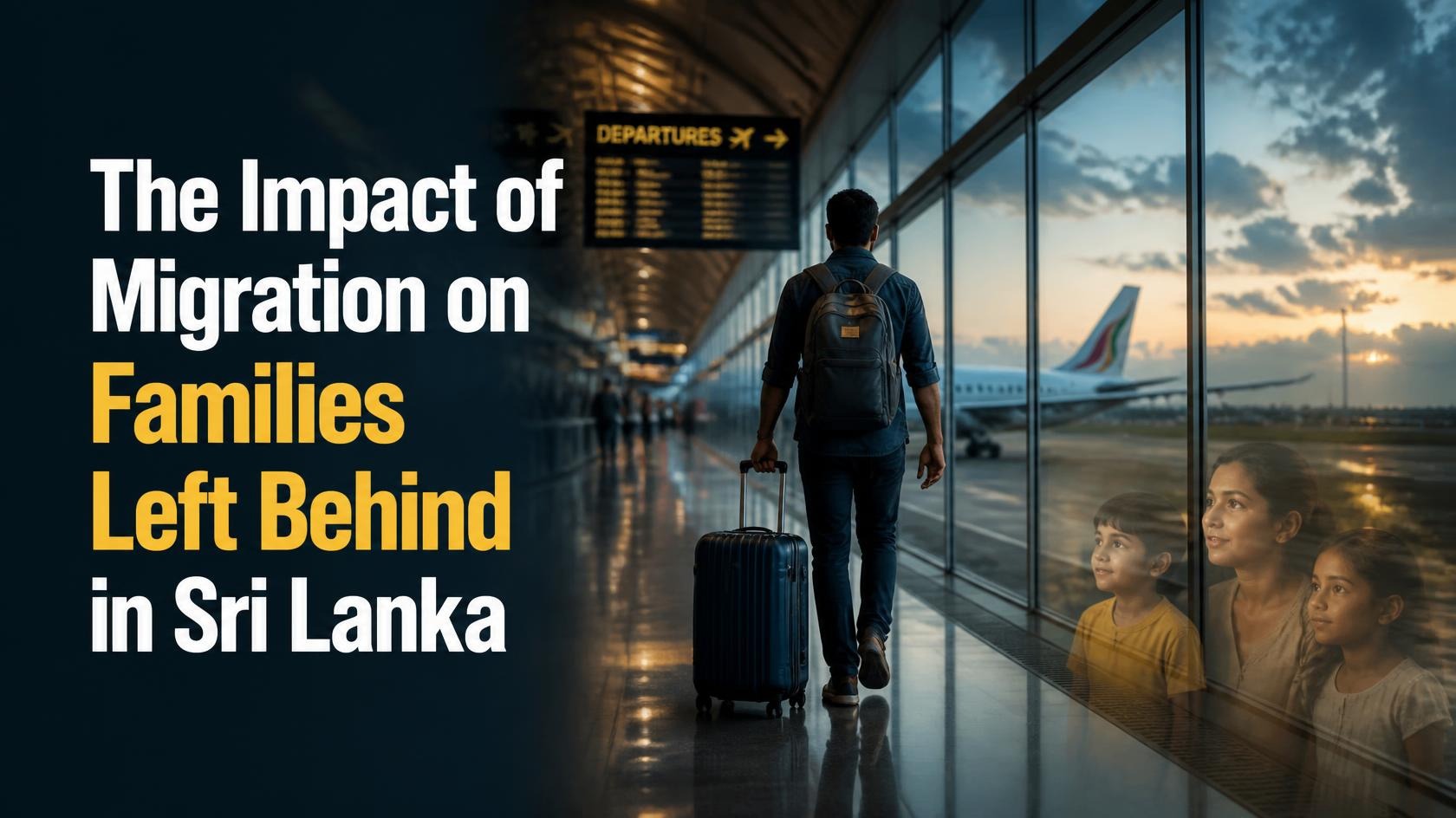
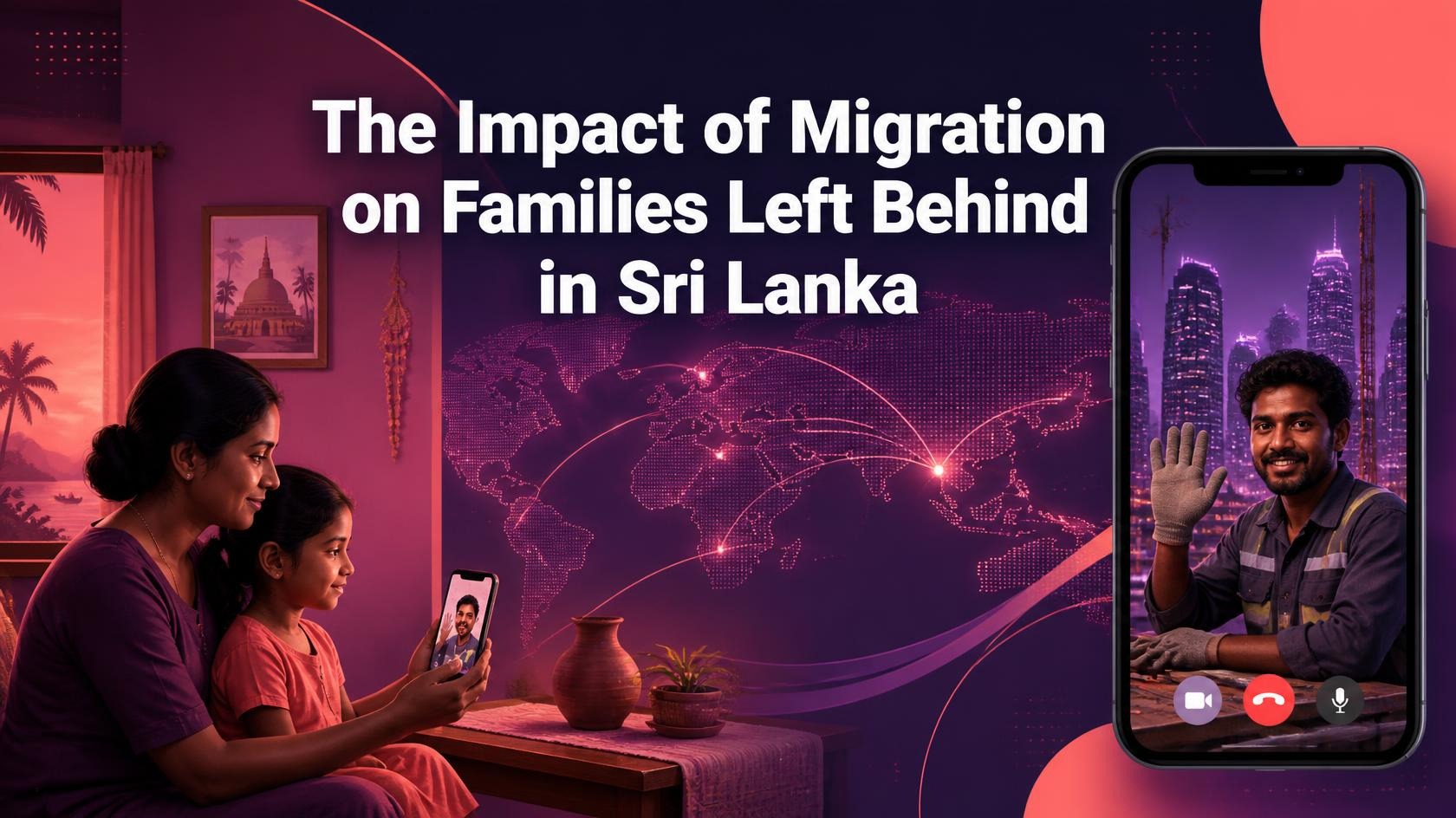
The Impact of Migration on Families Left Behind in Sri Lanka
Rakshika Rathnayake9/7/20265 min read
Share:Facebook
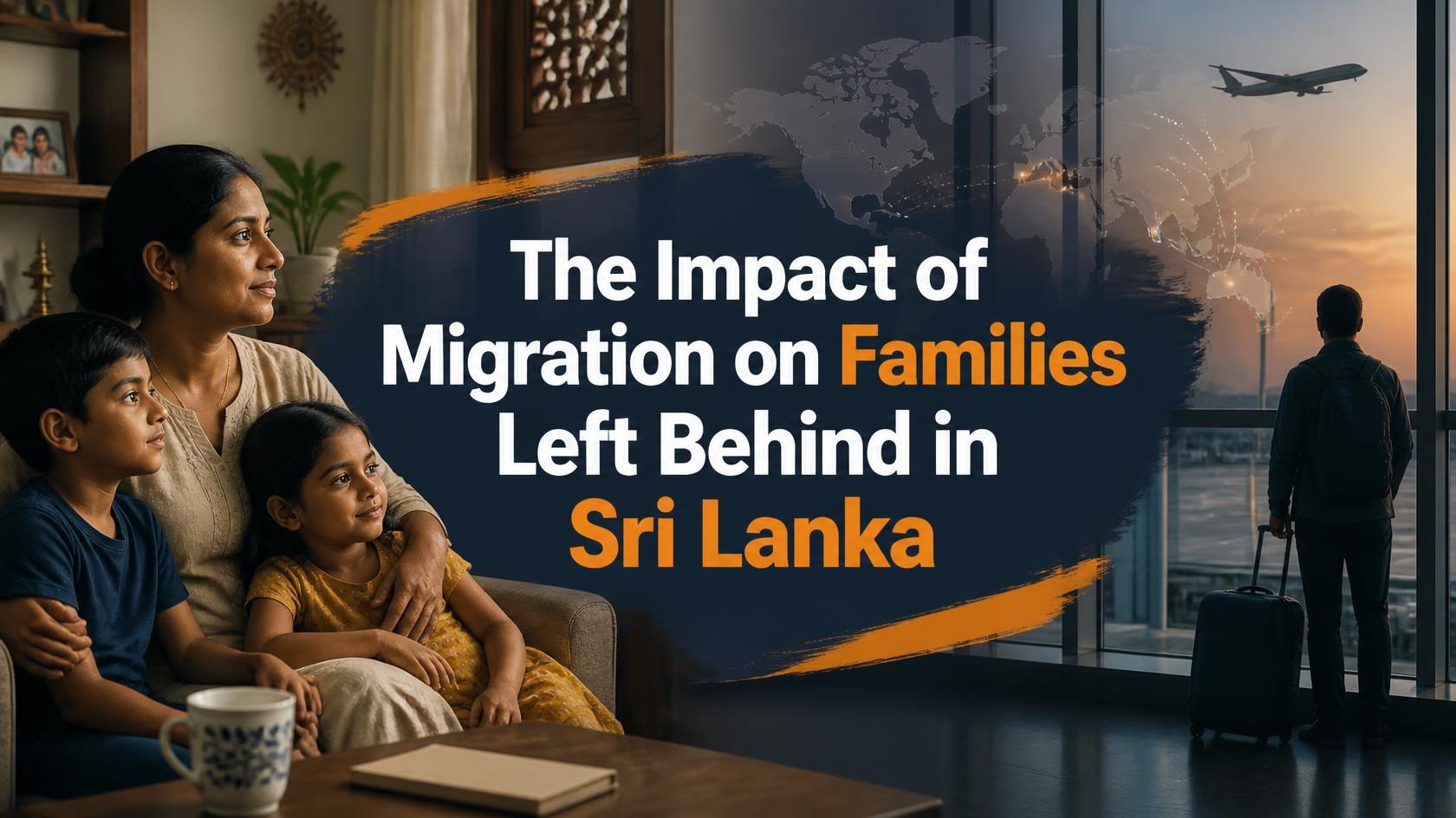
International labour migration has become an important part of Sri Lanka’s economy and the lives of many Sri Lankan families. Every year, a large number of Sri Lankans leave the country to seek employment opportunities overseas, particularly in countries in the Middle East, Asia and other regions. For many households, migration provides an opportunity to increase income, repay debts, build houses, educate children and improve living conditions. At the national level, migrant workers make a major contribution through foreign exchange earnings and remittances.
However, migration is not only an economic process. When a parent, spouse or other family member leaves the country for employment, those who remain at home experience significant social and emotional changes. Children may grow up without the daily presence of a parent, spouses may have to manage households separately, and elderly parents may become dependent on other relatives. Research on Sri Lankan labour migration has identified effects on the health, well-being and family structures of people left behind.
Therefore, the impact of migration on families left behind needs to be understood from both economic and social perspectives.
The Growth of Labour Migration in Sri Lanka
Foreign employment has become an important livelihood strategy for many Sri Lankan households. Economic difficulties, limited employment opportunities, expectations of higher salaries and the desire to improve family living standards are among the factors that encourage people to seek employment abroad.
The scale of overseas employment remains significant. According to the Sri Lanka Bureau of Foreign Employment (SLBFE), more than 300,000 Sri Lankans had departed for foreign employment by mid-December 2024. The number of migrant workers is important not only because of the workers themselves, but also because each migrant worker may have several family members depending on the income and support they provide.
Remittances are one of the major economic benefits of labour migration. During the first half of 2025, Sri Lanka received approximately US$3.73 billion in workers’ remittances, an increase of 18.9% compared with the same period in 2024. In 2025, annual workers' remittances reached a record US$8.076 billion, according to analysis by the Institute of Policy Studies of Sri Lanka.
These figures demonstrate the economic importance of migration. Nevertheless, financial benefits do not always compensate for the social and emotional costs experienced by families separated by migration.
Economic Benefits for Families
One of the most visible positive effects of migration is increased household income.
When a family member obtains employment abroad, the income received from overseas can provide financial resources that may not have been available through local employment. Families may use remittances to purchase food, pay utility bills, improve housing conditions, repay loans and meet other household expenses.
Education is another important area. Parents working abroad may send money to pay school expenses, university-related costs, private tuition fees, books and other educational requirements. In some households, migration can therefore improve children's educational opportunities.
Remittances can also help families construct or renovate houses. Some migrant workers invest their earnings in land, housing, small businesses, agricultural activities or other productive assets.
At the national level, these individual remittances also contribute to Sri Lanka's foreign exchange earnings. Labour migration research has highlighted the relationship between international migration, remittances, household income stability and welfare.
However, the economic benefits depend greatly on how remittances are managed. A household may receive a substantial income but still experience financial difficulties if money is spent mainly on short-term consumption or if the family accumulates new debt.
Emotional Impact on Spouses
The absence of a husband or wife can create significant emotional challenges.
When one spouse migrates, the partner who remains in Sri Lanka often has to manage household responsibilities alone. This may include caring for children, managing finances, dealing with schools, maintaining the household and supporting elderly relatives.
Long periods of separation can also create feelings of loneliness, anxiety and uncertainty. Communication through telephone calls, video calls and social media can reduce the distance, but digital communication cannot completely replace physical presence and everyday interaction.
In some families, prolonged separation may create misunderstandings between spouses. Differences in expectations, communication problems and concerns about relationships can contribute to emotional stress.
This does not mean that migration inevitably causes family breakdown. Many families successfully maintain strong relationships despite geographical separation. However, the length of separation, quality of communication, financial circumstances and availability of family support can influence how households experience migration.
Effects on Children
Children are among the family members most affected when parents migrate for employment.
A child may experience sadness, loneliness and a sense of missing the absent parent. Younger children may particularly struggle to understand why their mother or father has to remain abroad for long periods.
The situation can be different depending on which parent migrates and who remains responsible for childcare. Children may live with the other parent, grandparents, relatives or other caregivers.
In some cases, remittances improve children's material conditions. They may have better educational resources, improved housing and greater access to healthcare. However, economic improvement does not automatically remove emotional difficulties.
A child may have everything financially but still miss the everyday presence of a parent. Important events such as birthdays, school activities, examinations and family celebrations can become emotionally difficult when a parent is absent.
This is why studies on families left behind emphasize that the effects of migration should not be measured only through household income. The health and well-being of children and other family members must also be considered. IOM research on families left behind in Asia has specifically highlighted health-related consequences associated with parental labour migration.
The Increasing Responsibility of Grandparents
Migration can also change the role of grandparents.
When both parents or one parent migrates, grandparents may become primary caregivers for children. In Sri Lanka, extended family networks can provide valuable support in such circumstances.
Grandparents may provide emotional support, supervise children's education, prepare meals and manage everyday household activities.
However, this responsibility can also become difficult, particularly for elderly people with limited physical or financial resources. Caring for young children requires time, energy and patience. Therefore, increased responsibility may create stress for older family members.
At the same time, grandparents can play an important protective role by maintaining family routines and providing children with emotional stability during the parent's absence.
Changes in Family Relationships
Migration can change the traditional structure of the Sri Lankan family.
A family that previously lived together may become a geographically separated family. One member may live in the Middle East, another in Sri Lanka, while children and grandparents remain in the family home.
Technology has made it easier for families to maintain contact. WhatsApp, video calls, social media and other digital communication platforms allow migrant workers to communicate with their children and spouses regularly.
Nevertheless, communication alone cannot completely reproduce the experience of living together.
Family members may also develop new roles. A spouse who previously depended on the migrant worker for financial decisions may become responsible for managing household finances. Older children may take on additional responsibilities at home. Grandparents may become primary caregivers.
Migration can therefore transform not only the economic position of a family but also its internal relationships and responsibilities.
Impact on Women's Roles
Female labour migration has a particularly complex impact on Sri Lankan families.
When mothers migrate for employment, fathers, grandparents or other relatives may become responsible for childcare. In some cases, women migrate because overseas employment offers significantly better earning opportunities than available local employment.
The income earned by migrant women can improve household financial security. However, mothers may experience considerable emotional difficulties because of separation from their children.
Sri Lanka has long had experience with female migrant workers, particularly in domestic and care-related employment. The experiences of migrant women and their families therefore need to be considered when designing migration policies.
Policies should not focus only on protecting workers abroad. They should also address the welfare of children and other family members who remain in Sri Lanka.
Health and Psychological Well-being
The effects of migration can extend to physical and psychological health.
Family members left behind may experience stress because of uncertainty about the migrant worker's safety, employment situation and financial circumstances. This can become more serious when the migrant worker experiences illness, injury, exploitation or other difficulties overseas.
Research on Sri Lankan labour migration has found that post-migration periods can affect the health, well-being and structure of families left behind.
Children may also experience behavioural or emotional difficulties depending on their age, family environment and the circumstances surrounding parental separation.
Therefore, migration-related policies should consider mental health and family counselling alongside economic assistance.
The Problem of Financial Dependence
Although remittances can improve household welfare, excessive dependence on migrant income can create vulnerability.
If a household depends almost entirely on one migrant worker, the family may face serious financial difficulties if that worker loses employment, becomes ill, returns home unexpectedly or experiences problems overseas.
Families can reduce this vulnerability by using part of the income for savings, education, skills development or productive investments.
Financial literacy is therefore important for migrant households. Families need guidance on budgeting, savings, insurance, investment and long-term financial planning.
Migration and Social Mobility
Migration can contribute to social mobility.
A family that previously had limited financial resources may use overseas earnings to improve its housing, education and economic position. Children of migrant workers may gain access to better educational opportunities and potentially enter professional occupations.
Migration can therefore contribute to improvements in the socioeconomic position of families over time.
However, not every migrant household experiences the same outcome. Migration involves costs such as recruitment expenses, travel expenses, loans and periods of unemployment. Some families may therefore struggle to obtain the expected benefits.
The outcome depends on factors including the migrant's occupation, destination country, salary, length of employment, recruitment costs and how remittances are used.
Social Risks and Family Vulnerability
Some migrant families are more vulnerable than others.
Families with young children, elderly dependents, limited social support or financial difficulties may face greater challenges when a household member migrates.
There may also be serious concerns when migrant workers experience abuse, exploitation, serious illness, imprisonment or death abroad. Research concerning Sri Lankan left-behind families has highlighted the importance of support mechanisms when such adverse events occur.
This demonstrates why migrant worker protection must be connected to family protection.
A migration policy that focuses only on sending workers overseas and increasing remittances is incomplete. The welfare of families left behind should also be part of national migration policy.
The Role of Government and Institutions
The Sri Lankan government has recognized the importance of protecting migrant workers and their families. The National Policy and National Action Plan on Migration for Employment 2023–2027 includes the objective of strengthening the rights and protection of migrant workers and ensuring the well-being of their families.
Government institutions, including the Sri Lanka Bureau of Foreign Employment, can contribute through pre-departure education, worker protection, information services and support for migrant families.
Schools and community organizations can also help identify children experiencing difficulties due to parental migration.
Counselling services should be available to families experiencing serious emotional or relationship difficulties. Financial education can also help households use remittances more effectively.
What Can Be Done to Support Families Left Behind?
Several measures can reduce the negative effects of migration.
First, families should maintain regular and meaningful communication with migrant workers. Parents should make an effort to remain involved in children's education and important family decisions even when they are abroad.
Second, migrant families should receive financial management education. Remittances should ideally contribute not only to daily consumption but also to savings, education and sustainable investments.
Third, children of migrant workers should have access to counselling and school-based support when necessary.
Fourth, elderly caregivers should receive appropriate community and social support when they take responsibility for grandchildren.
Fifth, migrant workers need access to reliable information before departure and protection during overseas employment.
Finally, government migration policies should measure success not only by the number of workers departing or the amount of remittances received but also by the well-being of families left behind.
Conclusion
International labour migration has become an important part of Sri Lanka's economy and the livelihood strategies of many households. Overseas employment provides families with opportunities to increase income, improve housing, invest in education and achieve greater economic security. The large volume of remittances entering Sri Lanka demonstrates the national importance of migrant workers.
However, migration also has a human cost. Families left behind may experience loneliness, emotional stress, changes in family roles, childcare difficulties and concerns about the safety and well-being of the migrant worker. Children may benefit financially while simultaneously experiencing the emotional absence of a parent. Spouses may gain financial independence but face increased household responsibilities. Grandparents may provide essential childcare while carrying additional physical and emotional burdens.
Therefore, migration should not be evaluated solely according to the amount of money sent home. The real impact of migration must also be measured by the well-being, relationships, health and future opportunities of the families who remain in Sri Lanka.
Sri Lanka's future migration policies should seek a balance between economic development and family welfare. Protecting migrant workers, supporting children, strengthening caregivers, providing counselling and promoting responsible use of remittances can help reduce the negative effects of separation.
Ultimately, migration can become a powerful pathway for economic and social development when the benefits are shared by both the migrant worker and the family left behind. A successful migration system is therefore not simply one that sends workers abroad and receives remittances; it is one that protects workers, strengthens families and creates better opportunities for the next generation.
Additional Media