The Impact of Economic Challenges on Sri Lankan University Students
Rakshika Rathnayake9/8/20265 min read
Share:Facebook
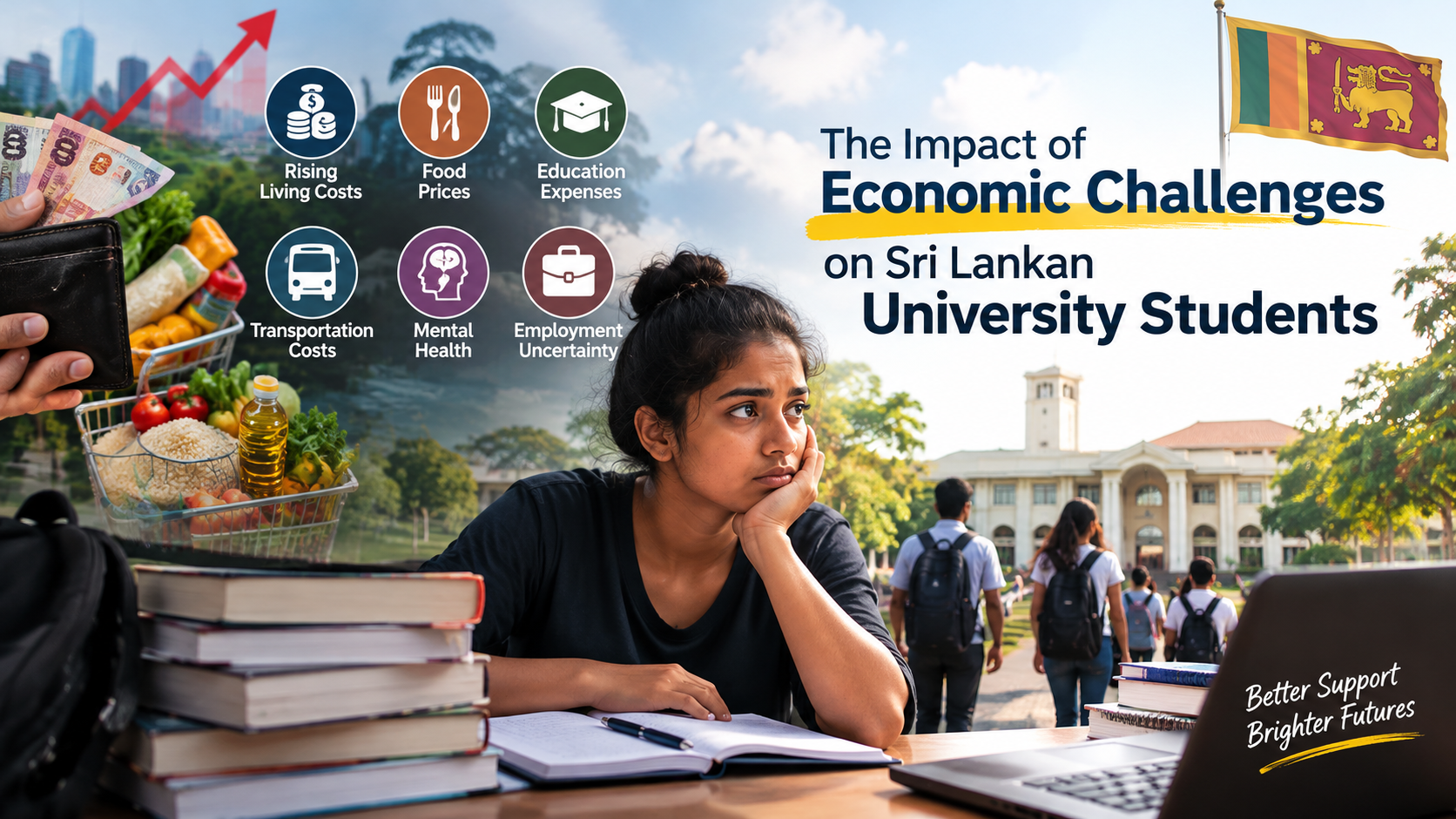
Sri Lanka’s economic crisis has affected almost every part of daily life. Although the country has moved away from the most severe stage of the 2022 crisis, many households are still dealing with high living costs, reduced purchasing power, income difficulties and uncertainty about the future. These problems are especially important for university students because their education depends heavily on household income, transportation, food, accommodation, technology and other basic expenses.
For many Sri Lankan university students, studying at university is not simply about attending lectures and completing examinations. Students have to manage transport costs, meals, accommodation, books, stationery, internet connections, laptops and other educational requirements. When the financial situation of a family becomes difficult, these expenses can become a serious burden. Recent research has also shown that economic difficulties can influence students’ academic performance, mental well-being, food choices and overall university experience.
The Economic Situation and Its Effect on Students
Sri Lanka experienced one of its most serious economic crises in recent history in 2022. Shortages of fuel, food, medicine and other essential goods were accompanied by very high inflation. Inflation reached 69.8% in September 2022 before falling considerably as economic conditions began to stabilize. However, lower inflation does not mean that prices returned to their earlier levels. Many families continued to experience reduced purchasing power and income pressure.
The World Bank reported that poverty remained significantly above pre-crisis levels even during the recovery period. In 2024, poverty was estimated at 24.5%, around twice the 2019 level, while food prices had more than doubled between 2021 and 2024. These conditions matter to university students because students are members of households that must divide limited income among food, housing, education, healthcare and other essential needs.
For a student living away from home, the situation can be even more difficult. Monthly expenses may include boarding fees, electricity, food, transportation and internet costs. A student who previously managed these expenses comfortably may suddenly have to reduce spending or ask the family for additional financial support.
Rising Cost of Living
One of the most visible effects of economic challenges is the rising cost of living. Food, transportation and accommodation are essential expenses for university students. Even a small increase in each category can create a significant monthly burden.
Students who travel from their homes to university have to spend money on buses, trains or other forms of transportation. Those who live near campus may still have to pay for meals and educational materials. Students studying in Colombo and other urban areas can face particularly high accommodation and food expenses.
As household incomes remain under pressure, parents may find it difficult to provide the same level of financial support they provided before the economic crisis. This can force students to change their daily habits.
Some may reduce the number of meals they purchase, avoid unnecessary travel, stop participating in social activities or delay buying educational materials. These decisions may appear small individually, but over a long period they can affect a student's physical and emotional well-being.
Educational Expenses
University education involves many expenses beyond tuition. Students need notebooks, printing, photocopying, stationery, textbooks, laboratory materials and other academic resources. Increasing prices can make even basic educational requirements difficult to afford.
Technology has also become an important part of higher education. Students are expected to use smartphones, laptops, online learning platforms and internet connections for assignments, presentations, research and communication.
For a student from a financially comfortable household, purchasing a laptop or paying for a reliable internet connection may be manageable. For a low-income family, however, these expenses can represent a major financial commitment.
Research on Sri Lankan public university students has identified rising living costs and the cost of educational materials as important financial challenges.
This creates an important inequality among students. Two students may attend the same university and follow the same course, but their ability to access educational resources may be very different because of their family financial situations.
Food and Nutrition
Economic difficulties can also influence what students eat. When food prices increase, students often have to think carefully about how they spend their limited money.
A 2026 study of 206 university students in Sri Lanka found that 64.6% of participants reported a reduction in household income during the previous three months, while 84% had adopted cost-cutting strategies. The study also found that 93.7% had reduced university-related expenses, including spending on food. Some students replaced main meals with cheaper snacks or bakery products.
This is an important issue because food is directly connected to students' health and academic performance. A student who regularly skips meals or chooses food mainly according to price rather than nutritional value may experience tiredness, poor concentration and reduced physical well-being.
Therefore, the economic challenges faced by students should not be viewed only as financial problems. They can also become education and health problems.
Impact on Academic Performance
Financial difficulties can directly and indirectly affect academic performance.
A student who is worried about paying rent, buying food or meeting transportation costs may find it difficult to concentrate on studies. Financial stress can occupy a significant part of a student's attention.
A 2025 study examining undergraduate students in private universities in Colombo found that the ability to meet academic needs and students' mental health were significantly associated with academic performance. The researchers emphasized the importance of financial support, career guidance, mentorship and mental-health interventions for students experiencing economic difficulties.
For example, imagine a student who needs to submit an assignment but does not have enough money for printing. Another student may have difficulty attending a university activity because transportation costs are too high. These situations may seem minor, but repeated financial obstacles can gradually affect educational participation.
Some students may also reduce their use of supplementary learning resources because they cannot afford books, private classes, paid software or additional internet data.
Mental Health and Emotional Stress
Economic problems can create considerable psychological pressure among university students.
University life is already a period when young people experience academic pressure, career uncertainty, relationship changes and concerns about their future. Financial difficulties can add another layer of stress.
Students may worry about their parents' financial situation, family debts, accommodation expenses or whether they will find employment after graduation. Some may feel guilty because their education is creating additional financial pressure on their families.
Research involving medical students at the University of Colombo found that the economic crisis affected areas including diet, sleep, psychosocial well-being, education and career plans.
Financial stress may also reduce motivation. A student who is constantly worried about money may lose interest in extracurricular activities, social interaction and even academic work.
This demonstrates why universities should consider financial well-being and mental health together rather than treating them as completely separate issues.
Students Taking Part-Time Jobs
Another response to economic pressure is part-time employment.
Some university students take part-time jobs to cover transportation, food, accommodation or personal expenses. Part-time work can be beneficial because it provides income and valuable work experience. However, excessive working hours can create difficulties when combined with a demanding academic schedule.
A student who works late in the evening may have less time to study, sleep or complete assignments. In some cases, financial pressure may force students to prioritize employment over education.
This creates a difficult situation: students need work because they need money, but too much work can negatively affect their studies.
Universities and employers could help by creating flexible employment opportunities that are compatible with academic schedules.
Transportation and Accommodation Problems
Transportation is another major concern. Students travelling long distances may spend a significant part of their monthly income on transport.
During periods of fuel shortages, transportation became particularly difficult. Even after the worst shortages eased, higher transportation costs continued to affect household budgets.
Accommodation is another challenge, particularly for students who come from rural areas and study in other districts. Boarding houses and rented accommodation can consume a large proportion of a student's monthly budget.
When accommodation becomes too expensive, students may move to cheaper places that are farther from the university. This can increase travelling time and transportation expenses.
The Digital Divide
Modern university education increasingly depends on digital technology. Online lectures, learning management systems, electronic journals, research databases and digital assignments have become normal parts of university education.
However, not every student has equal access to devices and reliable internet connections.
A student who shares one smartphone with family members or depends on mobile data may face difficulties completing online academic activities. Students with better financial resources can purchase laptops, broadband connections and other technologies, giving them an advantage.
The economic crisis therefore has the potential to increase the existing digital divide among university students.
Career Anxiety and the Future
Economic uncertainty also influences how students think about their future.
University students generally expect their degree to provide better employment opportunities. However, when the economy is unstable, students may become uncertain about whether suitable jobs will be available after graduation.
This concern can influence students' decisions about their fields of study, career choices and plans to pursue postgraduate education.
Some graduates may consider working overseas because they believe better employment opportunities exist outside Sri Lanka. Others may consider entrepreneurship or freelancing as alternatives to traditional employment.
Career uncertainty can create additional psychological pressure, particularly for students approaching graduation.
Inequality Among Students
Economic challenges do not affect all university students equally.
Students from higher-income families may have savings, private transportation, personal laptops and greater access to educational resources. Students from low-income households may have to carefully manage every expense.
Students from rural areas can face additional challenges because they may have to relocate for university education. Students with disabilities may also face additional costs related to transportation, accommodation and educational accessibility.
Therefore, the economic impact on university students should not be considered as one uniform experience. Different students experience different levels of financial pressure depending on their family income, location, course requirements and living arrangements.
How Universities Can Help
Universities have an important role to play in reducing the impact of economic difficulties on students.
One important measure is strengthening financial assistance programmes. Scholarships, emergency funds and hardship grants can provide temporary support to students experiencing serious financial difficulties.
Universities can also improve access to affordable meals. Student cafeterias offering nutritious food at reasonable prices can help students who struggle with food expenses.
Access to educational resources should also be improved. Libraries can provide more digital resources, computers and printing facilities. Universities can consider lending laptops or other equipment to students who cannot afford them.
Mental-health support is equally important. Counselling services should be easily accessible and students should feel comfortable seeking help when financial problems affect their emotional well-being.
Career guidance is another important area. Universities can help students develop employability skills, identify internships and explore legitimate part-time employment opportunities without compromising their studies.
The Role of Government and Society
Government policies are also important because the economic well-being of students is closely connected to the wider economic condition of their families.
Social protection programmes, employment opportunities, affordable transportation and targeted educational assistance can help vulnerable households.
The World Bank has noted that although Sri Lanka's economy has shown signs of recovery, poverty and household financial pressures remain important concerns.
Society also has a role. Alumni associations, private organizations, NGOs and community groups can support students through scholarships, mentoring programmes, donated learning equipment and internship opportunities.
Conclusion
Economic challenges have affected Sri Lankan university students in many different ways. The problem is not limited to whether students can pay their university expenses. It can influence what they eat, where they live, how they travel, what educational resources they can access, how much they work and how they feel about their future.
Sri Lanka has made important progress since the severe economic crisis of 2022, but the effects of the crisis have not disappeared from people's everyday lives. Household incomes and purchasing power remain under pressure, while the cost of essential goods continues to influence family decisions.
For university students, these economic pressures can become barriers to achieving their educational goals. A student should not have to choose between buying food and purchasing essential academic materials. Nor should financial difficulties force a talented student to abandon education or sacrifice their health.
Supporting university students is therefore not simply a matter of providing short-term financial assistance. It is an investment in Sri Lanka's future workforce and human capital. Universities, government institutions, families, private organizations and society must work together to ensure that economic hardship does not prevent young people from completing their education.
The experiences of Sri Lankan university students during the economic crisis also provide an important lesson. Economic recovery should not be measured only through national growth figures or inflation rates. It should also be measured by whether ordinary people, including young people pursuing higher education, are able to live with dignity, study successfully and look toward the future with confidence.
If Sri Lanka is to build a stronger and more sustainable future, protecting the educational opportunities and well-being of its university students must remain an important priority.
Additional Media