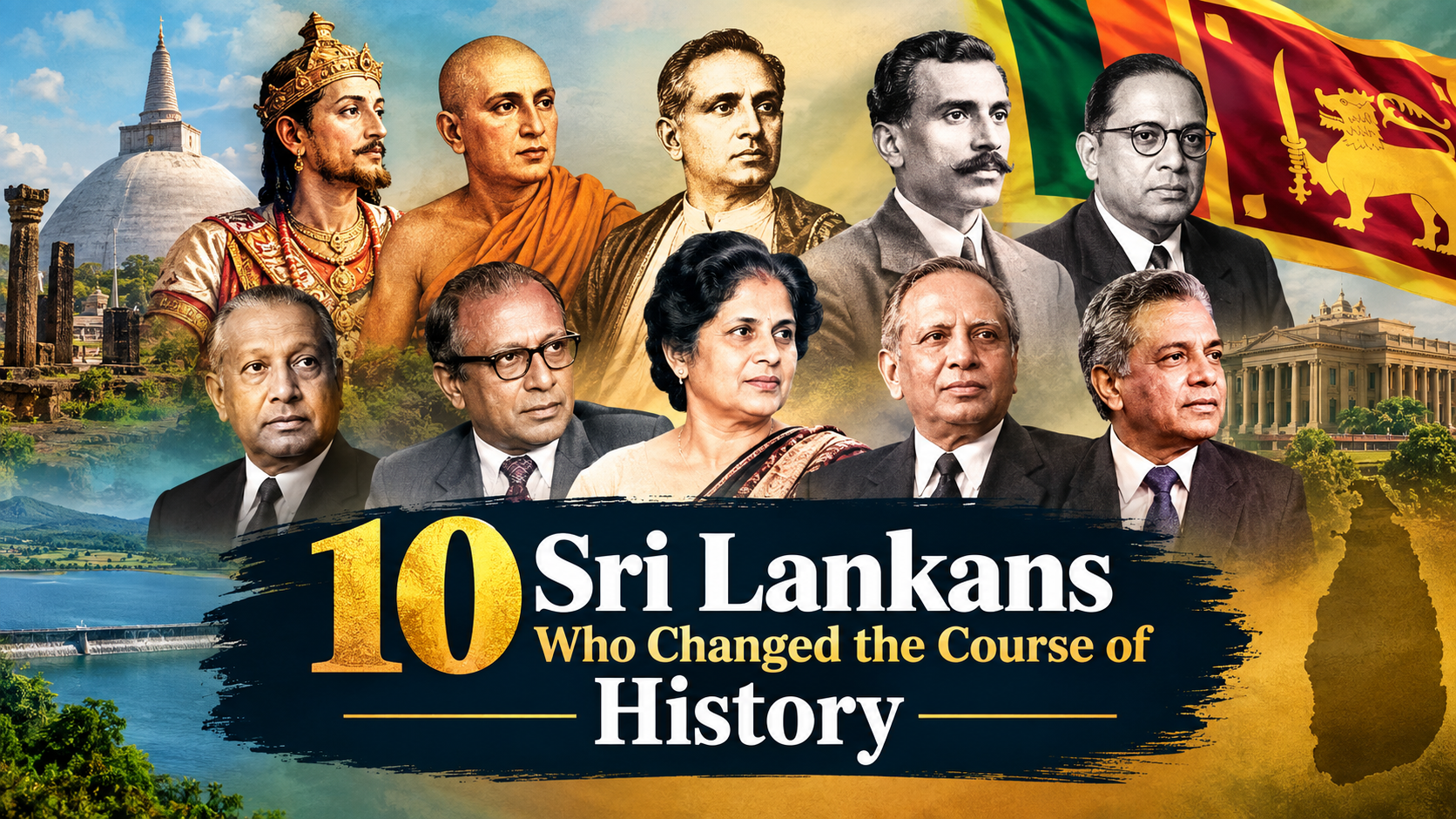
Sri Lanka has a long and remarkable history shaped by kings, political leaders, religious figures, educators, reformers, writers, and social activists. Some people influenced the country through political decisions, while others transformed education, religion, culture, independence, and social development. Their contributions continue to affect Sri Lankan society today.
The following ten Sri Lankans played particularly important roles in shaping the direction of the country's history.
1. King Devanampiya Tissa – The Beginning of Buddhism in Sri Lanka
King Devanampiya Tissa ruled Anuradhapura during the 3rd century BCE and is remembered for his close relationship with Emperor Ashoka of India. His reign became one of the most important turning points in Sri Lankan history because Buddhism was introduced to the island during his time.
According to the Mahavamsa, Emperor Ashoka sent his son, Arahant Mahinda Thera, to Sri Lanka as part of a Buddhist mission. Mahinda Thera met King Devanampiya Tissa at Mihintale and introduced Buddhist teachings to the king and his people.
The king accepted Buddhism and supported its establishment in Sri Lanka. Mihintale subsequently became an important Buddhist centre, while Anuradhapura developed into a major centre of Buddhist civilisation.
King Devanampiya Tissa's significance therefore goes beyond his political rule. His acceptance of Buddhism helped shape Sri Lanka's religious identity, architecture, art, literature, traditions, and social institutions for more than two thousand years.
6
2. King Dutugemunu – A Symbol of Ancient Sri Lankan Statehood
King Dutugemunu, also known as Dutthagamani, is one of the best-known rulers in Sri Lankan history. He lived during the 2nd century BCE and became particularly famous for defeating King Elara and bringing large parts of the island under his rule.
The story of Dutugemunu is recorded prominently in the Mahavamsa. His struggle against Elara has traditionally been presented as an important event in the political unification of ancient Sri Lanka.
Dutugemunu is also remembered for his contribution to Buddhist religious and cultural development. The Ruwanwelisaya, one of Sri Lanka's most famous stupas, was constructed during his reign. His period therefore left a lasting mark on the religious landscape of Anuradhapura.
Although modern historians approach ancient chronicles critically and recognise the complexities of the period, Dutugemunu remains an important historical figure because his reign became closely associated with ideas of political unity, kingship, and Buddhist patronage.
3. King Parakramabahu I – The King Who Strengthened Ancient Sri Lanka
King Parakramabahu I ruled the Polonnaruwa Kingdom during the 12th century and is regarded as one of the most capable rulers of medieval Sri Lanka.
His reign is particularly famous for irrigation development. He invested heavily in reservoirs, canals, and agricultural infrastructure. The massive Parakrama Samudra at Polonnaruwa stands as one of the most visible reminders of this period.
Agriculture was the foundation of the medieval Sri Lankan economy. By improving water management, Parakramabahu strengthened food production and supported the population and the state.
His reign also witnessed developments in Buddhist institutions, architecture, administration, and overseas relations.
Parakramabahu's legacy demonstrates an important principle that remains relevant today: Sri Lanka's prosperity has historically depended heavily on effective management of water and agricultural resources.
6
4. Anagarika Dharmapala – A Major Figure in Buddhist and Cultural Revival
Anagarika Dharmapala was born Don David Hewavitarne in 1864 and became one of the most influential figures of Sri Lanka's Buddhist revival movement.
During the British colonial period, Christianity had a strong institutional presence in education and public life. Dharmapala believed that Sri Lanka's Buddhist heritage needed to be strengthened and protected.
He travelled widely, gave speeches, established organisations, and promoted Buddhist education and cultural awareness. He was also strongly connected with the international Buddhist revival movement.
One of his most important international contributions was his involvement in efforts to restore Buddhist sites in India, particularly Bodh Gaya.
Dharmapala's influence extended beyond religion. He encouraged Sri Lankans to value their language, culture, traditions, education, and national identity.
His ideas contributed to the growth of cultural nationalism in the late 19th and early 20th centuries and influenced later movements for political independence.
5. Sir Ponnambalam Ramanathan – A Prominent Voice in Colonial Politics
Sir Ponnambalam Ramanathan was an influential lawyer, politician, and public figure during the British colonial period.
He served as Solicitor-General and later became an important representative of Ceylonese interests within the colonial political system.
Ramanathan played a significant role in constitutional politics and advocated for greater participation of local people in government. He was also involved in education and religious activities.
His political career is important because it reflects the complex development of Sri Lankan political representation before independence. Different communities and political groups were attempting to determine how Ceylon should be governed and how power should be shared.
Ramanathan was also associated with efforts to preserve Hindu religious and cultural institutions.
His career illustrates the transition from colonial administration toward a more representative political system.
6. D. S. Senanayake – The Father of Independent Sri Lanka
Don Stephen Senanayake is widely known as the first Prime Minister of independent Ceylon and is often called the "Father of the Nation."
He was a leading figure in Sri Lanka's gradual movement toward self-government. Rather than pursuing independence only through confrontation, Senanayake worked through constitutional negotiations and political institutions.
Ceylon gained independence from British rule on 4 February 1948, and Senanayake became the country's first prime minister.
His government focused on agriculture, irrigation, settlement schemes, and economic development. The expansion of agricultural settlements was intended to increase food production and provide land and opportunities for rural communities.
Senanayake's period was therefore important not only because he led the country at independence but also because his government attempted to establish the foundations of the new state.
The political system, agricultural policies, and administrative structures developed during his leadership influenced Sri Lanka for decades.
6
7. C. W. W. Kannangara – The Man Who Transformed Education
Dr. C. W. W. Kannangara occupies a special place in Sri Lankan history because of his contribution to free education.
Born in 1884, Kannangara became an important political leader and served as the first Minister of Education of the State Council of Ceylon.
At a time when access to quality education was strongly influenced by wealth, location, and social circumstances, Kannangara argued that education should be available to children regardless of their economic background.
His education reforms helped establish the foundation for free education in Sri Lanka. The Central Colleges he supported were particularly important because they expanded access to secondary education outside major urban centres.
The long-term consequences were enormous. Free education helped generations of Sri Lankans from rural and less wealthy families enter schools, universities, professions, and public institutions.
Sri Lanka's relatively high literacy rate and strong educational culture are closely connected with reforms associated with Kannangara.
His contribution shows how changing an education system can influence an entire society over generations.
8. Sirimavo Bandaranaike – The World's First Woman Prime Minister
Sirimavo Bandaranaike made history in 1960 when she became the world's first woman to serve as a prime minister.
Her achievement was significant not only for Sri Lanka but also internationally. At a time when women were still severely underrepresented in political leadership around the world, her election demonstrated that a woman could lead a national government.
She served as Prime Minister three times: 1960–1965, 1970–1977, and 1994–2000.
Her governments introduced significant economic and social policies, including nationalisation and expansion of the state's role in education and economic activity. Her administration also played a major role in establishing the 1972 Constitution, under which Ceylon became the Republic of Sri Lanka.
Her political career was controversial in several respects, and her governments faced serious economic and political challenges. Nevertheless, her place in world history is undeniable.
Sirimavo Bandaranaike changed perceptions about women's political leadership and became an internationally recognised symbol of women in politics.
6
9. J. R. Jayewardene – The Architect of a New Political and Economic Era
Junius Richard Jayewardene became one of the most influential political leaders in post-independence Sri Lanka.
He served as Prime Minister before becoming the country's first Executive President under the 1978 Constitution.
His government introduced major changes to Sri Lanka's political and economic system. The executive presidency fundamentally changed the structure of political power, giving the president extensive executive authority.
At the same time, Jayewardene's government moved Sri Lanka away from the highly state-controlled economic policies that had dominated much of the previous period. It opened the economy to greater private-sector participation, foreign investment, and international trade.
The creation of the Greater Colombo Economic Commission, later associated with the development of investment zones, contributed to the expansion of export-oriented industries.
Jayewardene's period also coincided with some of the most difficult ethnic and political tensions in modern Sri Lankan history. The ethnic conflict that intensified during this period would profoundly affect the country for decades.
His legacy is therefore complex: he transformed Sri Lanka's political and economic structure while also governing during a period of deep social conflict.
10. Lakshman Kadirgamar – A Diplomat Who Represented Sri Lanka Globally
Lakshman Kadirgamar was one of Sri Lanka's most respected modern diplomats and politicians.
A distinguished lawyer by profession, Kadirgamar became Foreign Minister and represented Sri Lanka internationally during a difficult period in the country's history.
He worked extensively to explain Sri Lanka's position to the international community, particularly regarding the country's ethnic conflict and the activities of the LTTE.
Kadirgamar was known for his strong communication skills, international experience, and diplomatic approach. He played an important role in Sri Lanka's foreign relations and worked to strengthen the country's international standing.
His assassination in 2005 was a major shock to Sri Lanka.
Kadirgamar's life demonstrates that changing history does not always mean commanding armies or leading mass political movements. Diplomacy, international relations, and communication can also have a significant impact on a country's future.
The Lasting Influence of These Ten Sri Lankans
These ten individuals lived in very different periods and worked in very different fields. Some were ancient kings, while others were modern politicians, educators, religious reformers, or diplomats.
Their contributions can be seen in many aspects of Sri Lankan life today.
Devanampiya Tissa helped establish Buddhism as a central part of Sri Lankan civilisation. Dutugemunu became a symbol of ancient political unity and Buddhist patronage. Parakramabahu I demonstrated the importance of irrigation and agricultural development.
Centuries later, Anagarika Dharmapala contributed to the revival of Buddhist and cultural consciousness. Ponnambalam Ramanathan participated in the development of constitutional politics under colonial rule.
After independence, D. S. Senanayake helped establish the new nation, while C. W. W. Kannangara transformed opportunities through education. Sirimavo Bandaranaike broke an international political barrier by becoming the world's first female prime minister.
J. R. Jayewardene reshaped Sri Lanka's political and economic system, while Lakshman Kadirgamar played an important role in representing the country internationally.
Their legacies are not all straightforward. Some of their decisions remain debated, and historians continue to examine their achievements, failures, and the wider circumstances of their times.
That is an important part of studying history. Historical figures should not simply be remembered as heroes or villains. Their lives should be examined in context, including the opportunities and challenges they faced and the consequences of their decisions.
Conclusion
Sri Lanka's history was not shaped by one person or one generation. It was built through the decisions, struggles, achievements, and mistakes of countless people.
The ten individuals discussed here represent only a small part of that story. Yet each of them influenced an important aspect of Sri Lankan society—from religion and irrigation to education, independence, political reform, economic policy, women's leadership, and international diplomacy.
Their stories also provide valuable lessons for the present generation. History is not simply about remembering famous names. It is about understanding how individual decisions can create changes that continue for decades or even centuries.
For Sri Lankans today, learning about these figures can help create a deeper understanding of how the country developed into the society it is now—and how the choices made today may shape its history tomorrow.