Sri Lanka: A Small Island with an Extraordinary Wealth of Biodiversity
Rakshika Rathnayake9/30/20265 min read
Share:Facebook
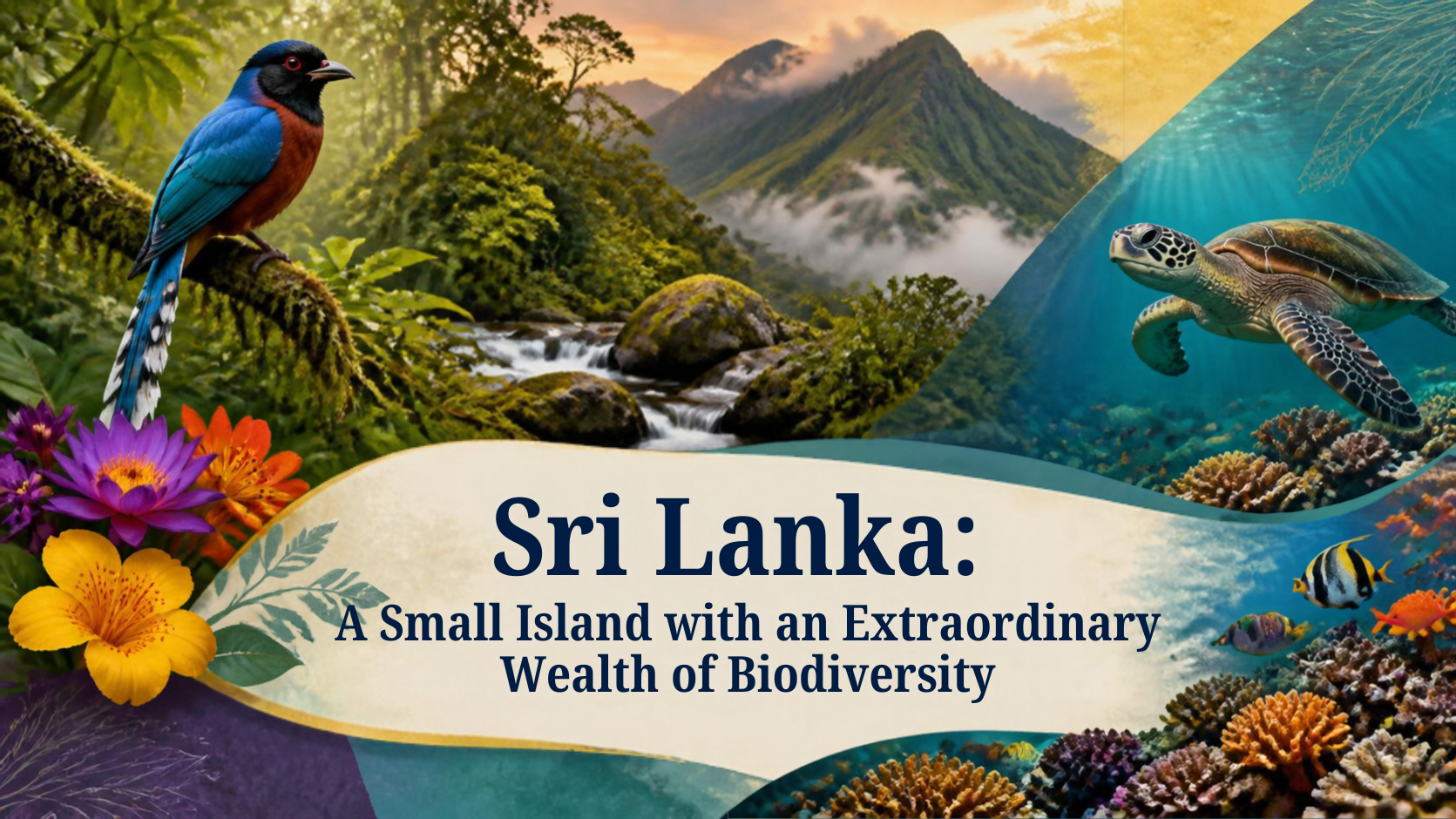
Sri Lanka may look small on the world map, but its natural wealth is far greater than its size suggests. From mist-covered mountains and ancient rainforests to dry-zone forests, wetlands, rivers, coral reefs and coastal lagoons, the island contains an impressive variety of ecosystems. These different environments provide homes for thousands of species of plants, animals, insects, birds, fish and other forms of life.
What makes Sri Lanka particularly special is not only the number of species found here, but also the large number of species that occur nowhere else in the world. These are known as endemic species. Sri Lanka is recognised as part of the Western Ghats–Sri Lanka biodiversity hotspot, an area of global importance because of its exceptional biological richness and the threats faced by many of its species.
So, why does such a small island have such remarkable biodiversity?
A Geography That Creates Many Habitats
One of the main reasons is Sri Lanka's geography. The island has mountains, valleys, plains, forests, rivers, wetlands, grasslands and a long coastline. Elevation changes dramatically from lowland areas to the central mountains, creating different temperatures, rainfall patterns and habitats.
The central highlands are particularly important. Areas such as the Knuckles Conservation Forest, Peak Wilderness and Horton Plains contain several types of vegetation, including montane forests, cloud forests and grasslands. These environments support many species specially adapted to higher elevations. The Central Highlands are also recognised as a UNESCO World Heritage Site and are considered an area of exceptional biodiversity.
A walk from a warm lowland area towards the central hills can therefore feel like travelling through several different natural worlds. The plants and animals change as the climate, altitude and vegetation change.
A Variety of Climate Zones
Climate is another major reason behind Sri Lanka's biological richness.
The country has wet, dry and intermediate climatic conditions. The southwest receives considerably more rainfall than many parts of the north and southeast, while the dry zone experiences a different seasonal pattern.
These differences create different natural environments. Wet areas can support dense evergreen forests, while drier regions are suitable for dry-zone forests, grasslands and scrub. Mountain regions have their own cooler environments.
According to the Convention on Biological Diversity, Sri Lanka contains a wide range of ecosystems, including rainforests, mountain cloud forests, dry-zone forests, arid thorn scrub, agricultural landscapes, freshwater ecosystems and marine environments.
This means that Sri Lanka's biodiversity is not concentrated in one type of landscape. It is spread across many different environments.
The Importance of the Rainforests
Sri Lanka's rainforests are among the country's most valuable biodiversity areas.
Sinharaja Forest Reserve is perhaps the best-known example. The forest provides habitat for a large number of plants, birds, reptiles, amphibians, insects and other organisms. Many species found in Sri Lanka's wet-zone forests are endemic to the island.
The wet zone is especially important because a very high proportion of Sri Lanka's endemic species are associated with its forests. Older IUCN assessments also show that wet and montane zones contain exceptionally high levels of species richness and endemism compared with much of the dry zone.
Rainforests are also much more than collections of trees. A forest contains layers of life. Tall trees form the canopy, smaller trees and shrubs grow below them, while vines, ferns, mosses, fungi and countless insects occupy other levels. Streams running through forests create additional habitats for freshwater organisms.
This interconnected system allows many species to survive in the same relatively small area.
Why Are So Many Species Endemic to Sri Lanka?
Endemism is one of the most fascinating features of Sri Lankan biodiversity.
An endemic species is a species naturally found only in a particular geographical area. Sri Lanka has unusually high levels of endemism in several groups, particularly among amphibians, reptiles, freshwater fish, freshwater crabs and some groups of plants and invertebrates.
One important reason is the island's long geological and evolutionary history.
Sri Lanka has experienced periods of connection and separation from the Indian subcontinent during its geological past. Over long periods, populations of organisms became isolated from related populations elsewhere. Once isolated, they followed their own evolutionary paths. Over generations, some populations became sufficiently different to form new species.
Sri Lanka's mountains also contributed to this process. A species living in one isolated mountain environment may have little opportunity to mix with populations living in another region. Over thousands or millions of years, such isolation can encourage the development of distinct species.
The country's National Biodiversity Strategy and Action Plan identifies factors such as topography, climate, water availability and historical connections with other land masses as important influences on Sri Lanka's high level of endemism.
Freshwater Ecosystems Are Exceptionally Important
Sri Lanka's biodiversity is not limited to forests.
The island has a large network of rivers, streams, waterfalls, reservoirs, wetlands, marshes and small freshwater habitats. These environments support fish, amphibians, freshwater crabs, aquatic plants, insects and many other organisms.
Freshwater habitats are particularly important for endemic species. Sri Lanka has a high level of endemism among freshwater fish and freshwater crabs, making the protection of rivers and streams especially important.
Even a small stream running through a forest can support species that cannot survive in other environments. Changes in water quality, pollution, excessive extraction of water and destruction of streamside vegetation can therefore have serious effects on biodiversity.
The Dry Zone Has Its Own Richness
It is easy to associate biodiversity only with green rainforests, but Sri Lanka's dry zone is also biologically important.
National parks such as Yala, Wilpattu, Udawalawe and Minneriya contain forests, grasslands, wetlands and other habitats that support large mammals and many other species.
The dry zone is particularly important for animals such as elephants, leopards, sloth bears, deer, monkeys and numerous bird species. Wetlands and reservoirs also provide water and feeding grounds for wildlife.
The different ecosystems of the dry zone demonstrate an important fact about Sri Lankan biodiversity: biological richness does not always mean dense forest. Open landscapes, seasonal wetlands, grasslands and dry forests can all play important ecological roles.
A Rich Coastal and Marine World
Sri Lanka's biodiversity continues beyond the land.
Surrounded by the Indian Ocean, the island has a coastline extending for more than 1,600 kilometres. Its coastal and marine environments include coral reefs, mangroves, seagrass beds, lagoons, estuaries, salt marshes, beaches and other habitats.
These ecosystems support fish, turtles, dolphins, whales, crustaceans, molluscs, seabirds and many other marine organisms.
Coral reefs provide shelter and feeding areas for numerous marine species, while mangroves serve as important nursery habitats for fish and other organisms. Seagrass beds also support marine life and contribute to healthy coastal ecosystems.
The biodiversity found around Sri Lanka therefore cannot be understood by looking only at forests and national parks. The ocean is an equally important part of the country's natural heritage.
Birds Make Sri Lanka a Special Destination
Sri Lanka is also well known for its bird diversity.
The island supports resident birds as well as migratory species that travel thousands of kilometres between breeding and feeding grounds. Different habitats attract different birds. Wetlands can provide feeding areas for waterbirds, forests support endemic forest species, and dry-zone parks provide habitat for larger birds and raptors.
The island's location along important migratory routes adds another dimension to its birdlife.
For birdwatchers, this means that a relatively small country can offer an impressive range of experiences. A person may see very different bird communities when travelling from a rainforest to a wetland, mountain forest or dry-zone national park.
Biodiversity Also Supports Human Life
Biodiversity is not simply about protecting rare animals for future generations. Human communities depend on healthy ecosystems every day.
Forests help regulate water, protect soil and reduce erosion. Wetlands can store water and help reduce flooding. Mangroves provide coastal protection and support fisheries. Pollinators contribute to agriculture, while plants and microorganisms have potential importance for medicine, food and scientific research.
Sri Lanka's biodiversity also supports tourism. Wildlife parks, rainforests, mountains, coral reefs, wetlands and whale-watching areas attract both local and international visitors.
Healthy ecosystems can therefore contribute to livelihoods, food security, water resources and the wider economy.
A Natural Heritage Under Pressure
Sri Lanka's biodiversity is remarkable, but it is not guaranteed to survive without protection.
Habitat loss and fragmentation, deforestation, pollution, unsustainable resource use, invasive species, climate change and poorly planned development can all affect ecosystems and wildlife. The high level of endemism makes the situation particularly important because species found only in Sri Lanka cannot simply be replaced by populations from another country.
The National Biodiversity Strategy and Action Plan identifies habitat loss as a major factor behind the threatened status of many species.
This is why protecting forests alone is not enough. Rivers, wetlands, agricultural landscapes, coastal habitats, grasslands and marine ecosystems also need attention.
Protecting Biodiversity Is a Shared Responsibility
Conservation is often associated with national parks and government institutions, but ordinary people also have an important role.
Avoiding unnecessary plastic pollution, protecting native trees, reducing damage to wetlands, keeping waterways clean and avoiding the illegal capture or trade of wildlife are simple examples.
Farmers can contribute through environmentally responsible agricultural practices. Businesses can reduce pollution and consider biodiversity when planning development. Schools and universities can help young people understand local ecosystems. Travellers can visit natural areas responsibly and follow park and conservation rules.
Most importantly, biodiversity conservation should be based on understanding. People are more likely to protect something when they know why it matters.
Why Sri Lanka's Biodiversity Matters to the World
Sri Lanka's importance goes beyond its national borders.
The island contains species and ecosystems with global conservation value. Some species occur only here, while others represent unique evolutionary histories. The country's forests, mountains, wetlands and coastal ecosystems also provide services that benefit both nature and people.
The Central Highlands provide a clear example. The area contains many endemic and threatened species and is also important for water and ecosystem services. Recent conservation work in the region has highlighted its global importance and the need to balance biodiversity protection with the livelihoods of communities that depend on these landscapes.
In other words, protecting Sri Lanka's biodiversity is not simply about preserving beautiful scenery. It is about protecting living systems that have developed over very long periods of time.
Conclusion
Sri Lanka's extraordinary biodiversity is the result of several factors working together. Its island geography, varied climate, mountains, forests, rivers, wetlands and surrounding ocean have created a remarkable collection of habitats. Long periods of geographical and ecological isolation have also allowed many unique species to evolve.
From the smallest amphibian living in a mountain forest to the blue whale travelling through surrounding seas, Sri Lanka's natural world is remarkably diverse.
The real value of this biodiversity lies not only in the number of species found on the island, but in the relationships connecting them. Forests depend on water, animals depend on plants, wetlands support birds and fish, and coastal ecosystems protect both wildlife and human communities.
Sri Lanka may be a small island, but its biological heritage is enormous. Protecting that heritage is a responsibility shared by government institutions, scientists, businesses, communities and ordinary citizens. If these natural ecosystems are cared for today, future generations will have the opportunity to experience the same remarkable diversity that makes Sri Lanka one of the world's most biologically important island nations.
Additional Media