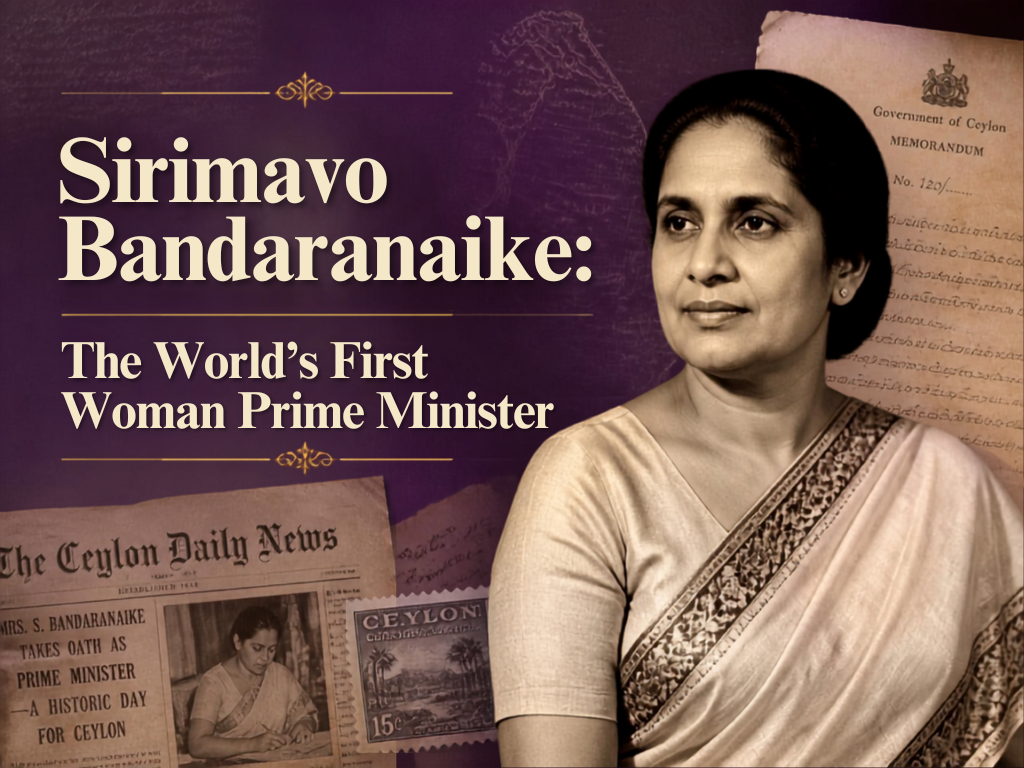
Sirimavo Bandaranaike: The World’s First Woman Prime Minister
Rakshika Rathnayake9/9/20265 min read
Share:Facebook
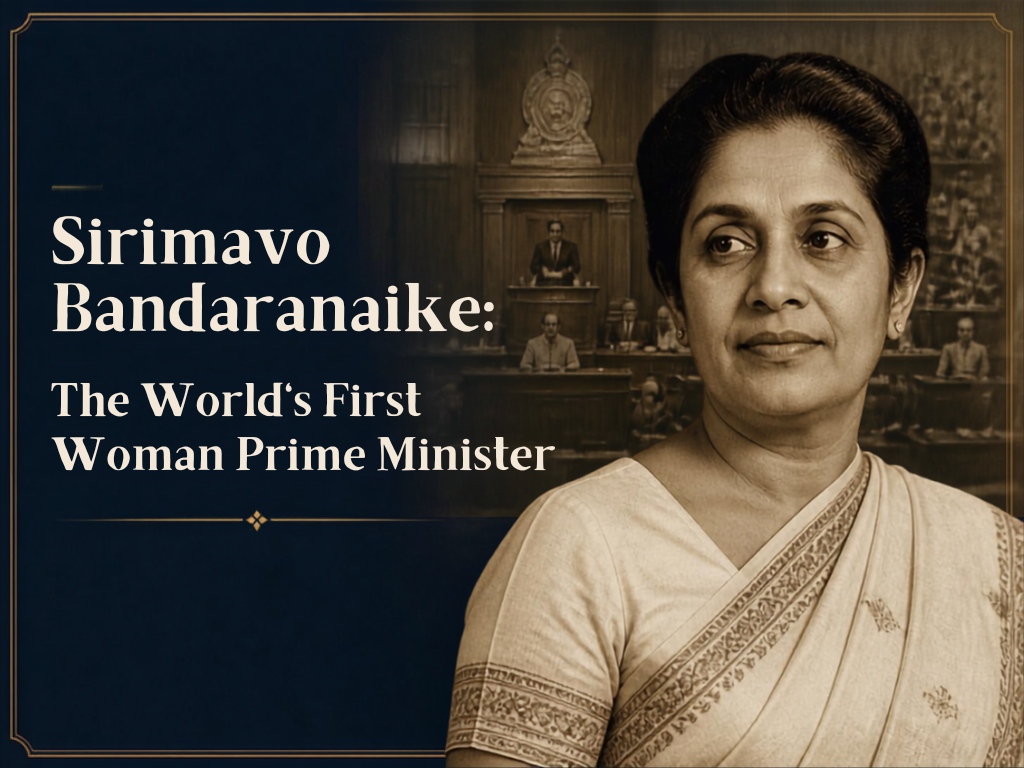
Sirimavo Bandaranaike holds a unique place in both Sri Lankan and world history. On 21 July 1960, she became the world’s first woman to serve as a head of government, when she was sworn in as Prime Minister of Ceylon, the country now known as Sri Lanka. Her achievement was particularly significant because, at the time, political leadership in most countries was overwhelmingly dominated by men. Her rise to power demonstrated that women could occupy the highest levels of political leadership and influence national and international affairs.
Bandaranaike's political career was closely connected with the history of post-independence Sri Lanka. She served as Prime Minister three times: from 1960 to 1965, 1970 to 1977, and 1994 to 2000. During those years, she experienced political victories, economic difficulties, social unrest, constitutional change, international diplomatic challenges and personal political setbacks. Her career therefore provides an important window into the political and social transformation of Sri Lanka during the second half of the twentieth century.
Early Life and Family Background
Sirimavo Ratwatte Dias Bandaranaike was born on 17 April 1916 in Ratnapura, in what was then British Ceylon. She came from a prominent Kandyan family with a long connection to local administration and public life. Her father, Barnes Ratwatte, was associated with the traditional administrative structure of the Sabaragamuwa region. She was educated at St. Bridget's Convent in Colombo.
Her early life was not initially directed toward a political career. Like many women of her social background at the time, she was involved more in family and community activities than in formal politics. However, her family environment exposed her to public affairs from an early age.
In 1940, she married Solomon West Ridgeway Dias Bandaranaike, commonly known as S. W. R. D. Bandaranaike. He was already an important political figure and later became Prime Minister of Ceylon in 1956. Through her marriage, Sirimavo became closely familiar with the political environment of the country. She observed political debates, election campaigns, government administration and the challenges faced by political leaders.
Although she was not initially a politician, her experience as the wife of a senior political leader helped prepare her for the political responsibilities that would come later.
The Influence of S. W. R. D. Bandaranaike
S. W. R. D. Bandaranaike founded the Sri Lanka Freedom Party (SLFP) in 1951 and became Prime Minister after his party and its allies won the 1956 general election. His government promoted policies associated with nationalism, social welfare and economic change.
Sirimavo supported her husband's political activities and became involved in social work. She was particularly interested in improving the circumstances of women and rural communities. Her experience during these years gave her an understanding of the concerns of ordinary people as well as the workings of government.
However, her life changed dramatically in September 1959, when her husband was assassinated. His death created a major political crisis for the SLFP and left a leadership vacuum. Sirimavo was initially reluctant to enter active politics. Nevertheless, senior members and supporters of the SLFP encouraged her to take leadership of the party. Eventually, she accepted the challenge.
This decision changed not only her life but also the history of women in global politics.
Entering Politics
In 1960, Sirimavo Bandaranaike became leader of the SLFP. At the time, many people doubted whether a woman without previous experience as an elected politician could successfully lead a major political party.
The political situation was also difficult. Sri Lanka had experienced considerable instability following the assassination of her husband and changes of government. The country needed strong political leadership, while the SLFP needed to regain public confidence.
Bandaranaike entered the general election campaign as the leader of the SLFP. Her political opponents often portrayed her as someone whose leadership was based primarily on her connection to her late husband. However, she proved capable of leading a national political campaign.
The July 1960 election produced a decisive victory for the SLFP. Bandaranaike subsequently became Prime Minister on 21 July 1960, making history as the world's first female head of government.
Her achievement was internationally significant. Women had participated in politics in many countries before 1960, but no woman had previously become the head of a national government through the electoral process in the modern era. Her victory therefore became an important milestone in the global history of women's political participation.
Her First Term as Prime Minister
Bandaranaike's first government served from 1960 to 1965. During this period, she attempted to continue several policies associated with the SLFP and her late husband's political vision.
Her government supported a stronger role for the state in the economy and emphasized social welfare. Education, health and assistance for lower-income communities remained important aspects of the political agenda.
One of the major characteristics of her leadership was her commitment to a foreign policy based on non-alignment. During the Cold War, the world was divided mainly between the United States-led Western bloc and the Soviet-led communist bloc. Bandaranaike sought to maintain friendly relations with different countries while avoiding complete alignment with either major power.
Her government also faced serious challenges. Sri Lanka was experiencing ethnic, linguistic and political tensions, while disagreements over government policies created opposition. Economic difficulties and political instability affected her administration.
In the 1965 general election, the SLFP was defeated, and Bandaranaike left the office of Prime Minister. However, her political career was far from over.
The Road Back to Power
After leaving government, Bandaranaike continued to lead the SLFP. She became a major opposition figure between 1965 and 1970. Her political experience and continuing popularity helped the SLFP build a broader alliance.
In the 1970 general election, an alliance led by the SLFP won a substantial parliamentary victory. Bandaranaike returned to power as Prime Minister on 29 May 1970.
Her second administration was one of the most consequential periods of her political career.
The Creation of the Republic of Sri Lanka
One of the most important achievements of Bandaranaike's second government was the transition from Ceylon to a republic.
On 22 May 1972, the country adopted its first Republican Constitution. The name "Ceylon" was replaced by Sri Lanka, and the country became a republic. The new constitutional framework also changed the country's relationship with the British monarchy.
This was a major milestone in Sri Lanka's post-colonial development. Bandaranaike's government regarded the establishment of the republic as an important step in completing the country's constitutional transformation after independence.
The 1972 Constitution also strengthened the country's emphasis on national sovereignty and introduced significant changes to the political and legal structure.
Economic Policies and Nationalization
Bandaranaike's second government followed a strong state-oriented economic approach. Her administration nationalized or brought several important sectors and businesses under greater state control. The plantation sector, which had been an important part of the colonial economy, was significantly affected by these policies.
The government also introduced restrictions on imports and emphasized domestic production. The intention was to reduce dependence on foreign goods and encourage self-sufficiency.
However, these policies also produced serious economic difficulties. Sri Lanka experienced shortages of consumer goods, unemployment and pressure on household living standards. The global economic environment also created additional challenges.
The government therefore faced increasing criticism over its economic management. While supporters viewed nationalization and state intervention as necessary for economic independence, critics argued that excessive government control contributed to inefficiency and shortages.
The 1971 Youth Insurrection
Another major challenge during Bandaranaike's second term was the 1971 youth insurrection, associated with the Janatha Vimukthi Peramuna (JVP).
The uprising represented deep dissatisfaction among sections of the country's youth, particularly concerning unemployment, economic opportunities and political conditions. The government responded with military force and emergency measures.
The conflict was a traumatic period in Sri Lankan history. It demonstrated the seriousness of social and economic problems facing the country and highlighted the difficulties faced by Bandaranaike's administration.
Although the government eventually suppressed the insurrection, the events of 1971 left a lasting impact on Sri Lankan politics and society.
Leadership in the Non-Aligned Movement
Sirimavo Bandaranaike was also an influential figure in international diplomacy. Her foreign policy emphasized non-alignment, peaceful coexistence and cooperation among developing countries.
Sri Lanka hosted the Fifth Conference of Heads of State or Government of the Non-Aligned Movement in Colombo in 1976. More than 60 countries participated in the summit, which demonstrated Sri Lanka's growing diplomatic importance at the time.
Bandaranaike's role in international diplomacy helped establish her reputation beyond South Asia. She developed relationships with leaders from Asia, Africa, Europe and other parts of the developing world.
Her approach to foreign policy reflected the interests of smaller countries seeking to maintain independence during the Cold War. Rather than simply supporting one superpower, she promoted the idea that developing countries should have an independent voice in international affairs.
The 1977 Election and Political Defeat
Despite her international reputation, Bandaranaike's domestic government faced growing economic and political problems.
By 1977, dissatisfaction with shortages, unemployment and economic restrictions had increased. The United National Party (UNP), led by J. R. Jayewardene, campaigned for major economic reforms.
The UNP won a landslide victory in the 1977 general election, ending Bandaranaike's second period as Prime Minister.
Her political difficulties continued after the election. In 1980, she was deprived of her civic rights following a parliamentary process concerning allegations relating to the exercise of power during her period in office. This effectively prevented her from participating in politics for several years.
Nevertheless, her political influence did not disappear completely.
Return to Political Life
Bandaranaike eventually returned to active politics. In 1989, she became Leader of the Opposition, serving until 1994.
The political situation in Sri Lanka had changed significantly by this time. The country was experiencing a serious ethnic conflict, political violence and economic transformation.
Her daughter, Chandrika Bandaranaike Kumaratunga, emerged as a major political figure and eventually became President of Sri Lanka in 1994. When Kumaratunga won the presidential election, she appointed her mother Sirimavo Bandaranaike as Prime Minister.
Thus, Bandaranaike returned to the position she had first occupied more than three decades earlier.
Her Third Term as Prime Minister
Bandaranaike's third term lasted from November 1994 until August 2000.
This period was very different from her earlier governments. The Sri Lankan political system had changed considerably following the introduction of the executive presidency in 1978. The President now held the dominant executive authority, while the Prime Minister's role was different from that of the earlier parliamentary system.
As Prime Minister under President Chandrika Kumaratunga, Bandaranaike served mainly as a senior political figure and symbol of continuity. Her long experience in government remained valuable to the administration.
However, advancing age and declining health eventually led her to resign.
On 10 August 2000, she resigned from the office of Prime Minister and retired from active political life.
Death and Final Years
Sirimavo Bandaranaike remained politically active until the end of her life. On 10 October 2000, she cast her vote at the general election and was returning home when she died.
She was 84 years old.
Her death attracted international attention because of the extraordinary nature of her political career. She had entered politics after the assassination of her husband, become the world's first woman Prime Minister, served three times as Prime Minister, led her country through major political and economic transformations, and remained involved in national politics for decades.
Her Legacy for Women in Politics
Perhaps Bandaranaike's most important legacy is her role in opening the door for women in political leadership.
When she became Prime Minister in 1960, women were still underrepresented in political institutions around the world. Her achievement demonstrated that a woman could lead a national government and participate in major international diplomatic affairs.
Her success was followed by the rise of other female political leaders around the world, although Bandaranaike's achievement should not be interpreted as meaning that women's political equality was immediately achieved. Many countries continued to have significant barriers to women's participation in government.
In Sri Lanka itself, her political legacy continued through her daughter Chandrika Bandaranaike Kumaratunga, who became the country's first female President. Sri Lanka therefore became notable for having both a female Prime Minister and a female President at the same time.
A Complex Political Legacy
Sirimavo Bandaranaike's historical legacy is complex. She is widely admired for becoming the world's first woman Prime Minister and for her contribution to Sri Lanka's international diplomatic standing. Her role in establishing the republic in 1972 and promoting non-alignment remains important in the country's political history.
At the same time, her governments faced serious criticism over economic policies, shortages, political instability and the government's response to opposition movements. A balanced assessment of her career therefore requires recognition of both her achievements and the controversies surrounding her leadership.
She governed during a particularly difficult period when Sri Lanka was attempting to define its identity after colonial rule. The country was struggling with economic development, social inequality, ethnic tensions and the pressures of Cold War politics. Her governments attempted to respond to these challenges through state intervention, social policies and an independent foreign policy.
Conclusion
Sirimavo Bandaranaike was much more than the world's first woman Prime Minister. She was one of the most influential political figures in modern Sri Lankan history and an important figure in the global history of women in politics.
Her journey from a politically connected but initially non-political woman to the head of a national government was extraordinary. Following the assassination of her husband, she accepted the difficult responsibility of leading the Sri Lanka Freedom Party and subsequently won the 1960 election. On 21 July 1960, she made history as the world's first woman head of government.
Her three periods as Prime Minister covered four decades of enormous political change. She witnessed Ceylon's transformation into the Republic of Sri Lanka, promoted non-alignment on the international stage, faced economic and social crises, experienced electoral defeat and political exclusion, and ultimately returned to government in her later years.
Her career also had an enduring impact on women's political representation. Her achievement in 1960 challenged traditional ideas about political leadership and demonstrated that women could occupy the highest office in government.
Sirimavo Bandaranaike died in 2000, but her name remains closely associated with Sri Lanka's political history and the worldwide struggle for greater representation of women in leadership. Her life illustrates how political circumstances, personal tragedy, determination and historical opportunity can combine to produce a figure whose influence extends far beyond her own country.
For Sri Lanka, she remains a significant part of the nation's post-independence story. For the world, she remains remembered as the first woman to become a head of government, a milestone that permanently changed the history of women in politics.
Additional Media