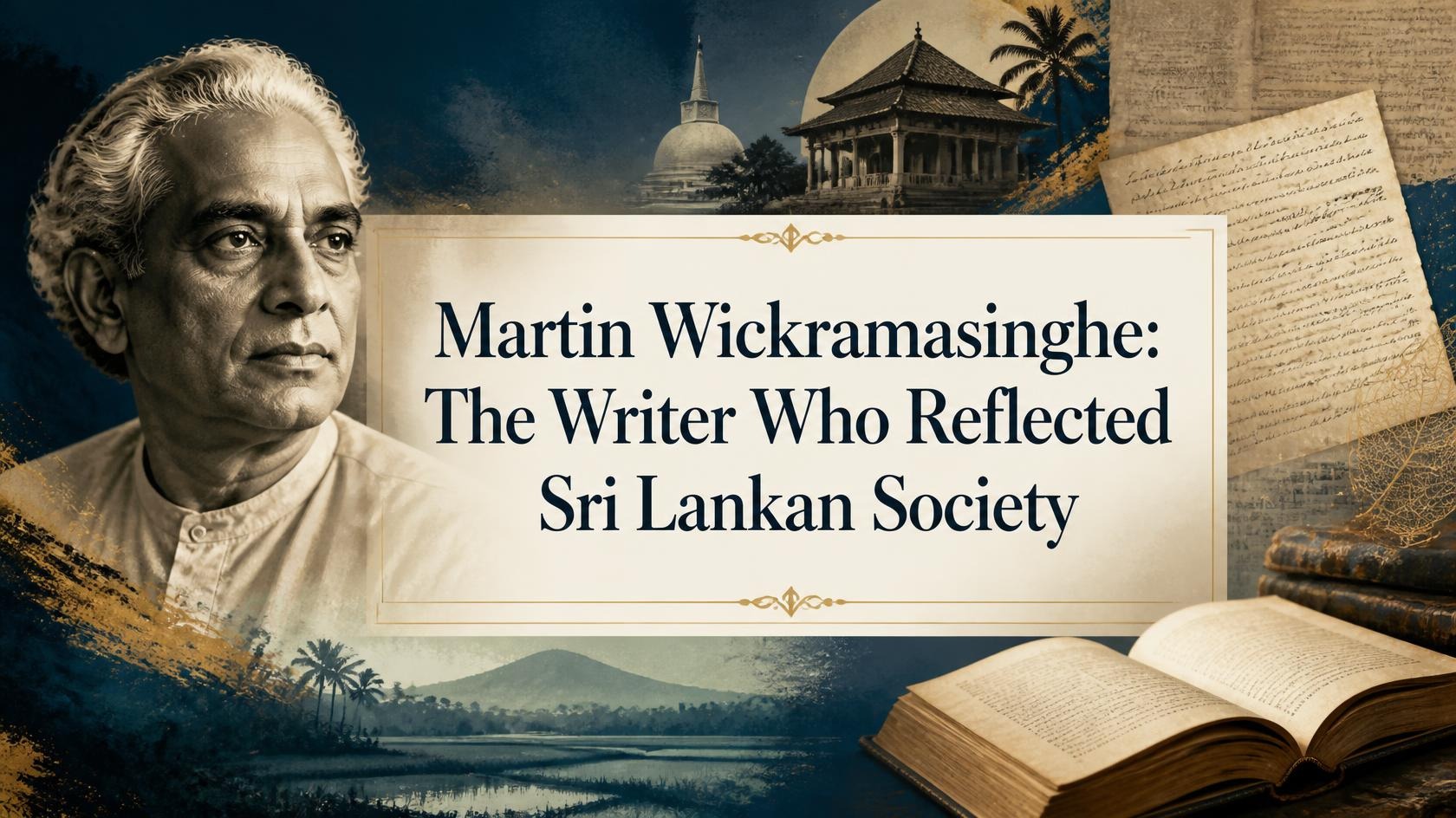
Martin Wickramasinghe: The Writer Who Reflected Sri Lankan Society
Rakshika Rathnayake9/18/20265 min read
Share:Facebook
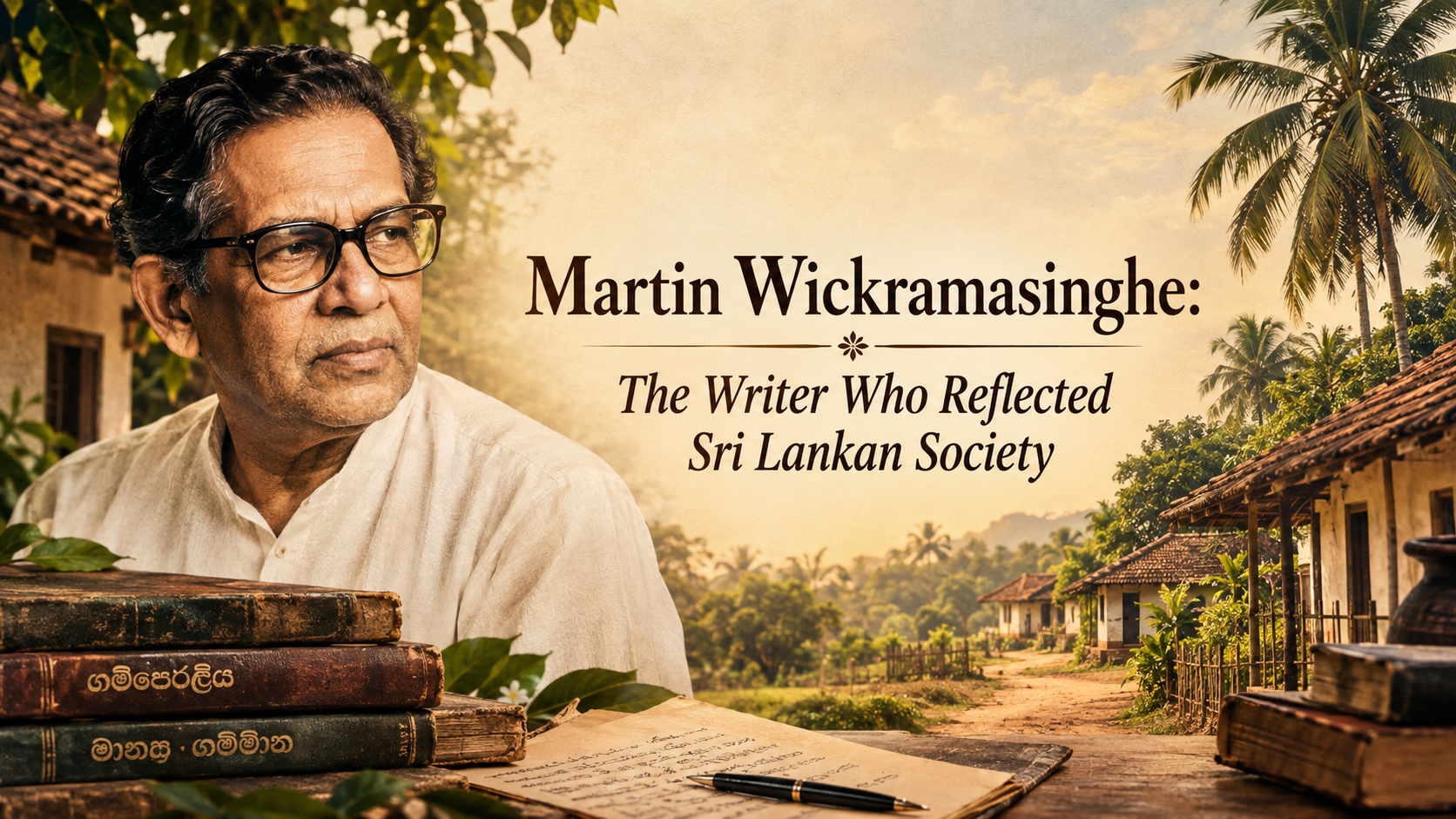
Martin Wickramasinghe is widely regarded as one of the most influential writers in Sri Lankan literature. Through his novels, short stories, essays, and literary criticism, he captured the changing nature of Sri Lankan society during a period when the country was moving from traditional village life toward a more modern social environment. His writing was not limited to entertainment. He explored the lives of ordinary people, social customs, family relationships, education, religion, class differences, changing values, and the tension between tradition and modernity.
Born on 29 May 1890 in Koggala, in the Southern Province of Sri Lanka, Martin Wickramasinghe grew up in an environment that deeply influenced his later writing. The rural landscape, village communities, traditional customs, and everyday experiences that surrounded him became important sources of inspiration. His understanding of ordinary people's lives allowed him to create characters and situations that many Sri Lankan readers could recognize.
Wickramasinghe lived through a period of significant change in Sri Lanka. During his lifetime, the country experienced the final years of British colonial rule, the growth of modern education, changes in social structures, and eventually independence in 1948. These changes can be seen throughout his literary work. He observed society carefully and used literature to examine how people responded to a changing world.
A Writer Shaped by Sri Lankan Society
One of the most important characteristics of Martin Wickramasinghe's writing is his close connection with Sri Lankan society. Instead of concentrating only on wealthy or powerful people, he often focused on ordinary families and communities. His characters came from different social backgrounds and faced problems that reflected real social conditions.
Village life was particularly important in his work. He understood that a village was not simply a collection of houses. It was a social environment where traditions, beliefs, family relationships, economic conditions, and community expectations influenced people's lives.
His descriptions of village society provide readers with a picture of Sri Lanka during an earlier period. Traditional occupations, relationships between generations, religious practices, customs, and community values appear naturally in his stories.
At the same time, Wickramasinghe did not present traditional society as perfect. He also examined its weaknesses. Social pressure, rigid customs, inequality, superstition, and resistance to change could create difficulties for individuals. This balanced approach made his writing more realistic.
“Gamperaliya” and the Changing Village
Among Martin Wickramasinghe's most famous works is Gamperaliya, first published in 1944. The novel is considered an important work in modern Sinhala literature because it presents the transformation of traditional village society.
The title Gamperaliya can be understood as “The Transformation of the Village.” The novel examines how social and economic changes affect a traditional village community. Old social structures begin to weaken, while new ideas, economic opportunities, and lifestyles emerge.
The novel focuses on the lives and relationships of its characters rather than simply describing historical events. Through these personal experiences, Wickramasinghe demonstrates how wider social changes can affect individuals and families.
One of the strengths of Gamperaliya is its realistic portrayal of social change. A society does not suddenly become modern overnight. Change takes place gradually through education, economic development, new occupations, changing relationships, and different ideas about status and success.
Wickramasinghe captured this process effectively. The novel therefore became more than a story about one village. It became an examination of a changing Sri Lankan society.
The Trilogy of Social Change
Gamperaliya was followed by Yuganthaya and Kaliyugaya, creating a trilogy that explores different stages of social transformation.
Yuganthaya examines the rise of new economic and social forces. It reflects the emergence of a new generation and the decline of some traditional structures.
Kaliyugaya continues the examination of a society undergoing further change. Together, the three novels provide a broad picture of Sri Lankan society as it moved away from older traditions and toward modern social and economic systems.
The trilogy is particularly valuable because Wickramasinghe did not describe social change only through political events. He showed how change enters people's homes, workplaces, relationships, ambitions, and everyday lives.
For example, ideas about marriage, education, social status, employment, and wealth can change when society changes. Younger generations may have different expectations from their parents. Traditional families may struggle to understand new lifestyles. Economic opportunities can change relationships between social groups.
These themes remain relevant because societies continue to experience similar tensions between generations and between traditional and modern ways of life.
“Madol Doova” and Youth
Another famous work by Martin Wickramasinghe is Madol Doova, published in 1947. The novel is particularly popular among younger readers and has become an important part of Sri Lankan children's and youth literature.
The story follows Upali Giniwella and his friend Jinna, who leave their familiar environment and experience life on an island known as Madol Doova. Their adventures provide entertainment, but the novel also explores independence, friendship, responsibility, courage, and the desire of young people to experience life on their own terms.
Unlike stories that portray young people simply as obedient children, Wickramasinghe gave his young characters personalities, ambitions, weaknesses, and curiosity. They make mistakes and learn through experience.
This is one reason Madol Doova has remained popular across generations. Young readers can identify with the desire to explore the world, form friendships, make decisions, and discover their own abilities.
Tradition and Modernity
A central theme throughout Wickramasinghe's writing is the relationship between tradition and modernity.
Sri Lankan society during his lifetime was experiencing major changes. Western education and colonial influence introduced new ideas, while traditional customs and beliefs continued to play an important role.
Wickramasinghe did not simply argue that tradition was good and modernity was bad, or the other way around. Instead, he examined the complicated relationship between the two.
Some traditions provided communities with identity and stability. However, certain customs could also restrict individuals or preserve unfair social structures. Modern education could create new opportunities, but it could also produce conflicts between generations and traditional expectations.
His characters often exist within this tension. They have to decide whether to follow established customs or pursue new opportunities.
This makes his writing especially valuable for understanding social change. He showed that modernization is not merely about buildings, technology, or economic development. It also changes people's thinking, relationships, ambitions, and understanding of themselves.
Religion, Culture, and Beliefs
Religion and cultural traditions also appear frequently in Wickramasinghe's work. Sri Lankan society has historically been deeply influenced by Buddhism and other religious and cultural traditions, and these influences shaped people's daily lives.
Wickramasinghe approached religious and cultural subjects with an analytical mind. He was interested in understanding how beliefs influenced human behavior and society.
He also examined the difference between genuine spiritual values and practices that might be influenced by superstition or social pressure. His writing encouraged readers to think critically rather than accepting every belief without examination.
This intellectual approach became an important part of his contribution to Sri Lankan literature.
Ordinary People as Literary Characters
One of Wickramasinghe's greatest achievements was making ordinary Sri Lankan people central to serious literature.
His characters were not perfect heroes. They had ambitions, fears, weaknesses, mistakes, prejudices, hopes, and disappointments. This made them believable.
He understood that social history can often be found in the lives of ordinary people. A family argument, a marriage decision, a change in occupation, an educational opportunity, or a financial difficulty can reveal larger changes happening within society.
Through such characters, readers can understand how social structures influence individual lives.
His attention to ordinary people also helped Sinhala literature move toward a more realistic style. Rather than relying heavily on idealized characters and traditional storytelling patterns, he developed characters who felt like real members of Sri Lankan communities.
His Contribution to Sinhala Literature
Martin Wickramasinghe was not only a novelist. He was also a short-story writer, essayist, literary critic, journalist, and thinker.
His literary criticism contributed to discussions about the development of Sinhala literature and culture. He examined traditional literature while also considering new literary approaches.
He believed that literature should be connected to human life and society. This philosophy influenced his approach to storytelling.
His writing also contributed to the development of modern Sinhala prose. He demonstrated that Sinhala could be used effectively to describe complex psychological experiences, social changes, philosophical questions, and everyday life.
As a result, his influence extended beyond individual books. He helped shape the direction of modern Sinhala literature.
Education and Intellectual Development
Wickramasinghe's own life is also interesting because his formal education was limited compared with many other prominent intellectuals of his time. Much of his knowledge was developed through independent reading and personal study.
His intellectual curiosity encouraged him to explore literature, history, philosophy, religion, science, and culture.
This aspect of his life demonstrates the importance he placed on learning beyond formal education. His broad interests influenced the subjects he explored in his writing.
He was particularly interested in understanding humanity and the development of society. His works therefore contain both storytelling and social observation.
Literature as a Record of Society
One reason Martin Wickramasinghe remains important today is that his books can be read as literary records of social change.
Historical documents often tell us about governments, political events, economic developments, and major institutions. Literature can provide something different: an understanding of how people experienced change in their everyday lives.
Through Wickramasinghe's novels, readers can gain insight into family structures, village communities, social expectations, education, economic change, relationships, and cultural traditions.
His works therefore have value not only for literature students but also for people interested in Sri Lankan history, sociology, anthropology, culture, and social development.
Why His Writing Still Matters
Although many of Wickramasinghe's works were written decades ago, several of the issues he explored remain relevant.
Sri Lanka continues to experience social change. Rural communities are changing, young people are moving to cities and overseas, education is creating new opportunities, technology is transforming communication, and traditional values are interacting with modern lifestyles.
The tension between generations also continues. Parents and young people may have different ideas about education, careers, marriage, relationships, and personal freedom.
These changes are different from those experienced during Wickramasinghe's lifetime, but the basic question remains similar: how does a society preserve its identity while adapting to change?
His literature encourages readers to examine this question carefully.
A Lasting Legacy
Martin Wickramasinghe died on 23 July 1976, but his influence on Sri Lankan literature has continued. His books remain widely read, studied, discussed, and adapted.
The Martin Wickramasinghe Museum of Folk Culture in Koggala preserves aspects of his life, work, and the traditional environment that influenced him. His literary legacy has also become part of Sri Lanka's cultural heritage.
His importance comes not simply from the number of books he wrote but from the way he looked at society. He paid attention to ordinary people and recognized that their lives could reveal the character of an entire nation.
Conclusion
Martin Wickramasinghe was much more than a successful Sri Lankan novelist. He was an observer of society, a literary thinker, and an important figure in the development of modern Sinhala literature.
Through works such as Gamperaliya, Yuganthaya, Kaliyugaya, and Madol Doova, he explored the lives of people living through periods of social transformation. He wrote about villages, families, youth, education, religion, traditions, economic change, social class, and the complicated relationship between the old and the new.
His greatest contribution was perhaps his ability to turn everyday Sri Lankan life into meaningful literature. He showed that the experiences of ordinary people could reveal important truths about society.
For readers today, his works offer both literary enjoyment and a window into the Sri Lanka of the past. They help us understand how communities changed, how people responded to new ideas, and how traditional values interacted with modern life.
In this sense, Martin Wickramasinghe remains an important literary voice because his writing does not simply tell stories. It preserves memories of a changing society and encourages each generation to think about its own relationship with tradition, change, identity, and the future.
Additional Media