Investing vs Saving: What Should Young Sri Lankans Understand?
Rakshika Rathnayake11/13/20265 min read
Share:Facebook
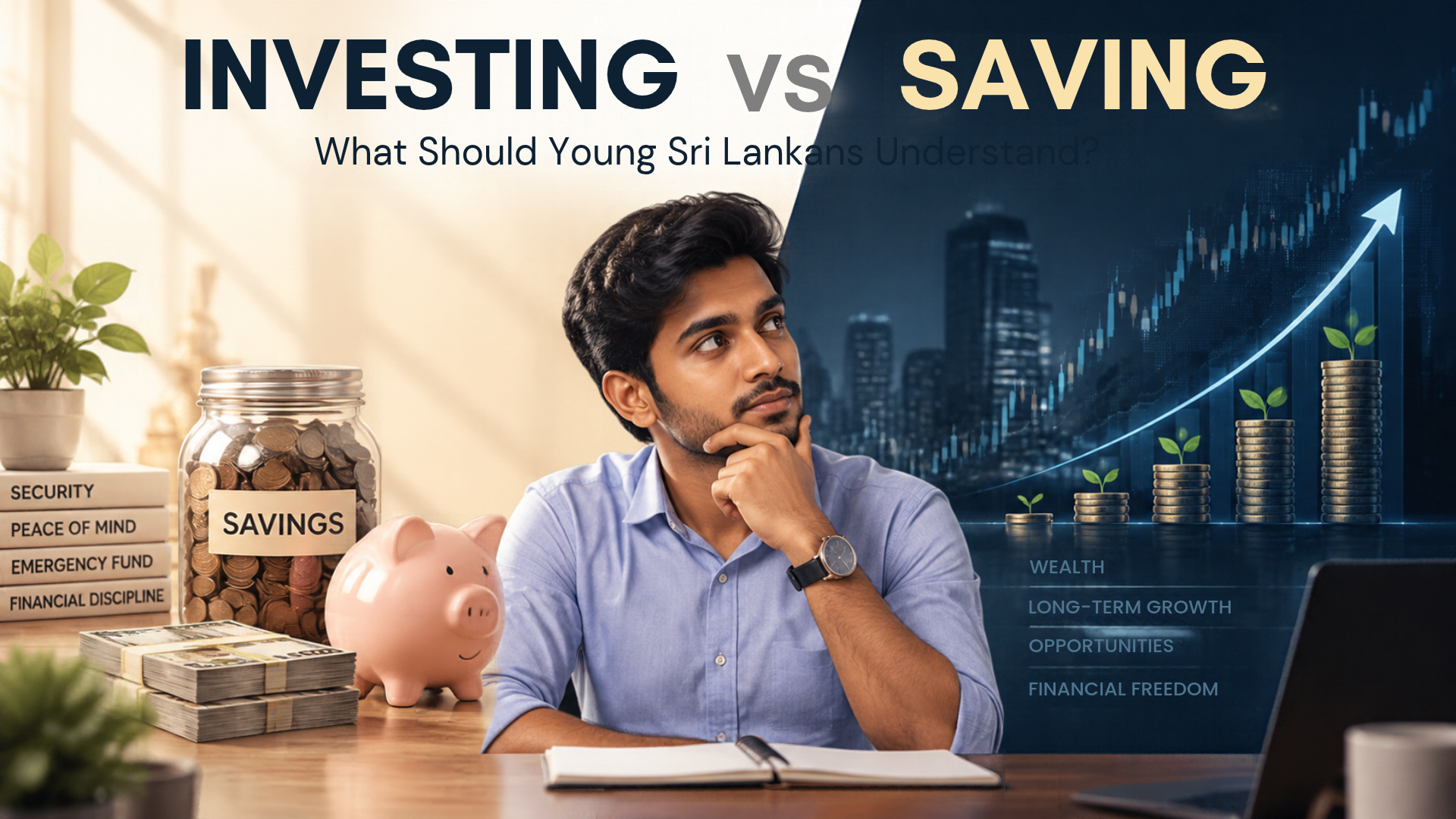
For many young Sri Lankans, earning money is only the first step towards financial independence. The next and often more difficult question is: **What should I do with my money? Should I save it, or should I invest it?**
Saving and investing are sometimes treated as if they mean the same thing. However, they serve different purposes. Saving is generally about keeping money safe and available for future needs, while investing involves putting money into assets that may grow in value or generate returns over time. Both can play an important role in building a secure financial future.
For young people in Sri Lanka, understanding this difference has become especially important. Rising living costs, changing job opportunities, inflation and economic uncertainty have made financial planning more necessary than ever. Whether someone is a university student, a young professional, a freelancer or a small business owner, learning how to manage money early can make a major difference later in life.
## What Does Saving Mean?
Saving simply means setting aside part of your income instead of spending all of it immediately. The money is usually kept somewhere relatively safe and accessible, such as a savings account or another low-risk financial option.
People save money for many reasons. A young person may save for:
- An emergency
- University or professional education
- Buying a vehicle
- Starting a business
- A wedding
- A house deposit
- Travel
- Future family responsibilities
The main purpose of savings is **security and accessibility**. If an unexpected situation occurs, saved money can help without forcing someone to borrow money or sell important assets.
For example, imagine a young employee earns a monthly salary and regularly keeps a portion aside. After several months, they may have enough money to deal with an unexpected medical expense, repair a vehicle or manage a temporary loss of income. This is one of the most important benefits of saving.
However, saving also has limitations. Money kept as cash or in an account may not always grow fast enough to maintain its purchasing power over many years, especially when prices rise because of inflation.
## What Does Investing Mean?
Investing means putting money into an asset or financial instrument with the expectation that it may generate income or increase in value over time.
Depending on the type of investment, examples may include shares, unit trusts, government securities, property or other investment products. Every investment carries its own level of risk, potential return and time horizon.
The main goal of investing is generally **long-term growth**.
For example, instead of keeping all available money idle for many years, a person may invest part of it in an appropriate investment based on their financial goals and risk tolerance. If the investment performs well over time, the value may increase or generate returns.
However, investing is not the same as guaranteed profit. The value of some investments can rise and fall. Some investments may perform poorly, and in certain situations, investors can lose part or even all of their money. This is why understanding an investment before putting money into it is essential.
## The Main Difference Between Saving and Investing
The easiest way to understand the difference is to look at their main purposes.
**Saving is mainly about protecting money and keeping it available.**
**Investing is mainly about trying to grow money over time.**
Savings are generally more suitable for short-term needs and emergencies. Investments are often more suitable for longer-term goals.
For instance, if a young person needs money within the next few months to pay for an important course, keeping that money in a highly volatile investment may not be a wise choice. If the investment loses value just before the money is needed, the person could face a problem.
On the other hand, someone saving for a financial goal many years in the future may need to think beyond simply keeping all their money as idle cash. Long-term financial growth may require carefully considering suitable investment options.
Therefore, the question is not always **“Should I save or invest?”** In many cases, the better question is **“How much should I save, and how much should I consider investing according to my goals?”**
## Why Young Sri Lankans Should Start Learning Early
One of the biggest advantages young people have is **time**.
A person who starts developing good financial habits in their twenties may have decades to save, invest and improve their financial knowledge. Even small and regular contributions can become meaningful over a long period.
Unfortunately, many young adults only begin thinking seriously about money after facing financial difficulties. Some may spend most of their income without planning, depend heavily on borrowing or make investment decisions based on social media trends and advice from friends.
Financial knowledge should be treated as an important life skill. Young people learn how to prepare for careers, but understanding budgeting, debt, savings and investments is also necessary for long-term independence.
Starting early does not mean a person must invest large amounts of money. It means developing discipline.
Even a young person with a modest income can begin by learning to:
1. Track income and expenses.
2. Avoid unnecessary debt.
3. Build an emergency fund.
4. Save regularly.
5. Learn about investment risks.
6. Set realistic financial goals.
These habits can be more valuable than trying to find a “quick way to become rich.”
## The Importance of an Emergency Fund
Before thinking seriously about higher-risk investments, young people should understand the importance of having emergency savings.
Life can change unexpectedly. A person may lose a job, face an urgent expense or experience a family emergency. Without savings, the only option may be borrowing money.
An emergency fund can provide an important financial safety net.
The exact amount needed will be different for every person. Someone living with parents and having few responsibilities may need a different level of emergency savings compared with someone supporting a family.
The important point is to gradually build money that is reserved for genuine emergencies.
This money should generally be kept in a place where it can be accessed when necessary, rather than being locked into a risky or unsuitable investment.
## Inflation: Why Keeping Money Alone May Not Be Enough
One important concept for young people to understand is **inflation**.
Inflation refers to a general increase in prices over time. When prices rise, the same amount of money may buy fewer goods and services than before.
For example, the amount of money needed for food, transport, education and other daily expenses may increase over the years. This means that simply keeping money without considering how its purchasing power may change can affect long-term financial planning.
This does not mean that saving is useless. Savings remain essential, particularly for emergencies and short-term goals.
However, for long-term goals, young people should understand the importance of considering whether their money has the potential to grow at a rate that supports their future needs.
That is one reason why investing becomes part of financial planning.
## Investment Always Comes With Risk
One of the most dangerous misunderstandings among inexperienced investors is the belief that all investments guarantee profits.
They do not.
Different investments involve different levels of risk. Generally, opportunities that promise higher potential returns may also involve greater uncertainty.
Young investors should be especially careful about schemes that promise:
- Guaranteed high returns
- Very fast profits
- “Risk-free” investments with unusually high earnings
- Easy income without understanding the business or product
- Urgent instructions to invest immediately
If something sounds too good to be true, it deserves careful investigation.
Sri Lankans have increasingly encountered online financial promotions, social media advertisements and informal investment opportunities. A professional-looking website or a popular influencer does not automatically mean that an investment is safe or legitimate.
Before investing, people should research the organisation, understand the product and check whether it operates under the appropriate regulations where relevant.
## Do Not Invest Money You Cannot Afford to Risk
This is an important rule for beginners.
Money needed for rent, food, education, loan repayments or emergencies should not be treated as money available for risky investments.
A young person should first understand their financial responsibilities.
For example, someone may receive a salary and immediately decide to invest most of it because they expect a quick profit. But if an emergency occurs or the investment loses value, they may be forced to borrow money for daily needs.
Good financial planning requires balance.
Investing should support financial stability, not destroy it.
## Setting Clear Financial Goals
Young people should avoid saving or investing without a purpose.
A financial goal gives direction to decisions.
For example:
**Short-term goals** may include buying a laptop, paying for a course or building an emergency fund.
**Medium-term goals** may include purchasing a vehicle, starting a business or saving for a major personal milestone.
**Long-term goals** may include buying a home, building retirement savings or creating long-term financial security.
The time period matters because it can influence how a person manages money.
Money needed soon should generally be handled differently from money intended for a goal many years away.
A clear goal can help young people avoid emotional decisions and unnecessary spending.
## The Power of Regular Contributions
Many people believe investing is only for wealthy individuals. However, financial discipline can begin with small amounts.
A young worker may not be able to save or invest a large amount immediately. But regularly setting aside a reasonable amount can create a habit of financial responsibility.
The key is consistency.
Instead of waiting until someone earns a very high salary, it can be useful to start learning how to manage a smaller income properly.
As income increases, the amount allocated towards savings and suitable investments can also be reviewed.
The important thing is not to copy another person's financial situation. Everyone has different salaries, responsibilities, debts and goals.
A strategy that works for one person may not be suitable for another.
## Avoid Following Social Media Hype
Social media has made financial information more accessible, but it has also created new risks.
Young people often see videos claiming that a particular investment will make them rich quickly. Some content creators show luxury lifestyles and suggest that success can be achieved simply by following a particular trading strategy or investing in a specific asset.
These messages can be misleading.
Financial decisions should not be based only on a viral video, a friend's recommendation or fear of missing out.
Before investing, ask important questions:
- How does this investment work?
- What are the risks?
- How can money be lost?
- How easily can I access my money?
- Are there fees or hidden costs?
- Is the organisation trustworthy?
- Does this investment match my financial goals?
Taking time to research is usually better than rushing because everyone else appears to be investing.
## Debt and Financial Planning
Saving and investing become more difficult when a person is struggling with expensive debt.
Young people should understand the difference between useful borrowing and unnecessary debt. Borrowing money for an important purpose may sometimes be necessary, but constantly borrowing for lifestyle spending can create serious financial pressure.
Before investing significant amounts, it may be important to review existing financial obligations, particularly debts with high interest costs.
A person who is paying heavy interest on debt while taking unnecessary investment risks may not be improving their overall financial position.
A sensible financial plan should consider income, expenses, debt, savings and long-term goals together.
## A Balanced Approach May Be Best
For many young Sri Lankans, the most practical approach is not choosing only one option.
Saving and investing can work together.
A simple financial approach may look like this:
**Step 1: Manage daily expenses responsibly.**
Create a realistic budget and understand where money is going.
**Step 2: Build emergency savings.**
Set aside money for unexpected situations.
**Step 3: Reduce unnecessary high-cost debt.**
Avoid allowing debt to consume a large portion of income.
**Step 4: Set clear financial goals.**
Decide what you want to achieve in the short, medium and long term.
**Step 5: Learn before investing.**
Understand the available options, risks and potential returns.
**Step 6: Invest according to your goals and risk tolerance.**
Avoid copying others blindly.
**Step 7: Review your financial plan regularly.**
Your income, responsibilities and goals may change over time.
## Financial Education Is an Investment in Itself
Perhaps the most valuable investment a young person can make at the beginning is in financial knowledge.
Understanding basic financial concepts can help people avoid scams, control unnecessary spending and make better long-term decisions.
Young Sri Lankans should learn about budgeting, interest, inflation, debt, savings, investment risk and financial planning. Reliable information can come from recognised financial institutions, educational resources and qualified professionals.
It is also important to ask questions when something is unclear.
There is nothing wrong with being a beginner. The real danger is pretending to understand an investment when you do not.
## Conclusion
Saving and investing are both important, but they serve different purposes.
Saving provides security and helps people prepare for emergencies and short-term needs. Investing may help money grow over the long term, but it also involves risk and requires knowledge, patience and careful decision-making.
For young Sri Lankans, the goal should not be to become rich overnight. Instead, it should be to build strong financial habits.
Start by controlling spending. Build savings. Prepare for emergencies. Set clear goals. Learn about investment options. Understand the risks. Avoid scams and unrealistic promises.
The best financial journey is usually not based on one dramatic decision. It is built through many small and responsible decisions made consistently over time.
A young person who understands the difference between saving and investing is better prepared to make informed choices about money. By balancing financial security with long-term growth, young Sri Lankans can take meaningful steps towards a more stable and confident financial future.
**Disclaimer:** This article is for general educational purposes and should not be considered personal financial or investment advice. Individuals should carefully research financial products and seek qualified professional advice where appropriate before making major financial decisions.
Additional Media