How to Identify Fake Online Shops Before Making a Payment
Rakshika Rathnayake11/4/20265 min read
Share:Facebook
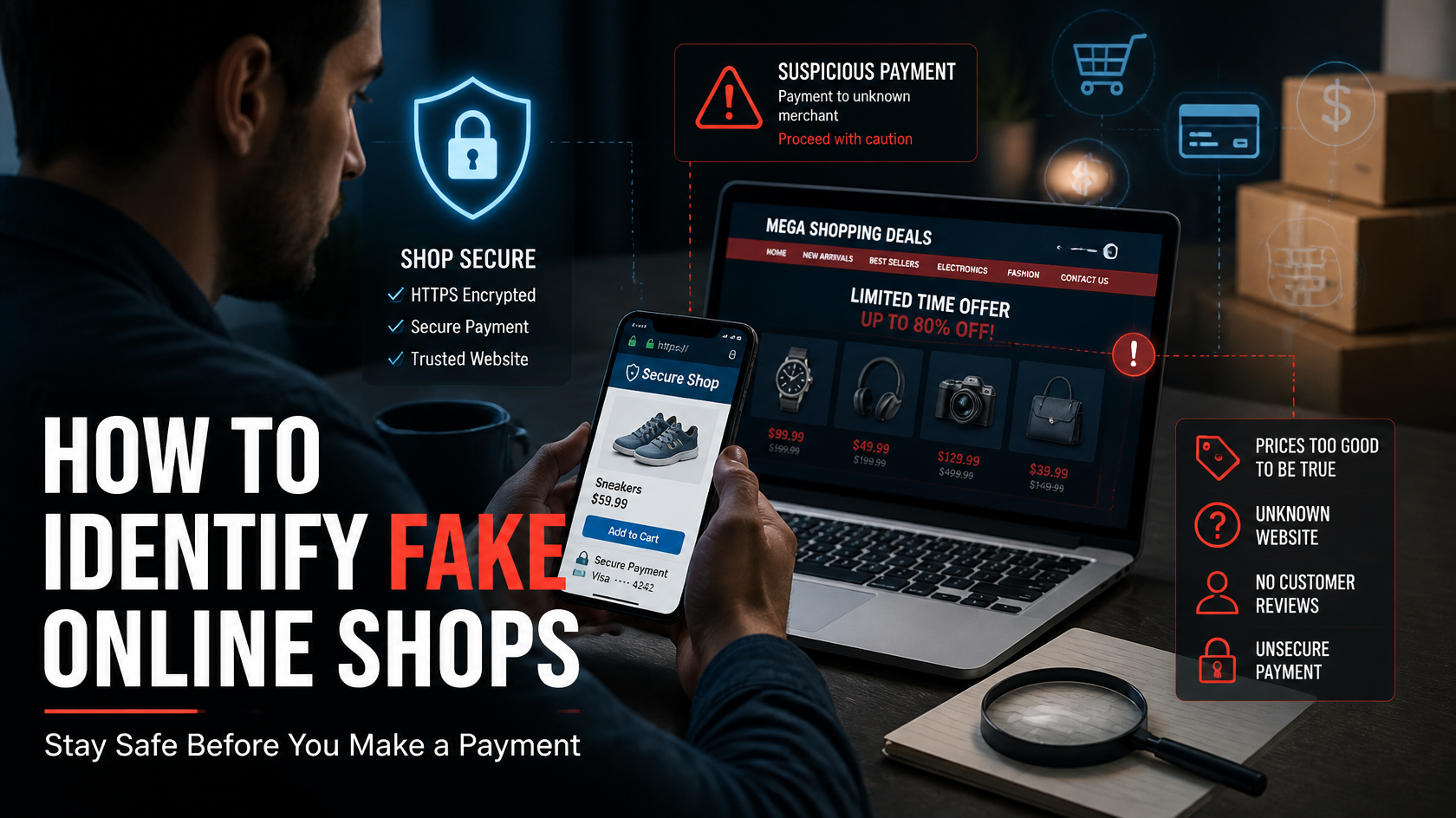
Online shopping has made life much easier. Today, people can buy clothes, electronics, cosmetics, food, household items and many other products without leaving home. A few clicks on a website or a message through Facebook, Instagram, TikTok or WhatsApp can be enough to place an order.
However, the convenience of online shopping has also created opportunities for scammers. Fake online shops have become increasingly sophisticated. Some use professional-looking websites, attractive product photographs, fake customer reviews and even copied logos from well-known businesses. Others operate entirely through social media pages and disappear as soon as they receive enough payments.
The biggest mistake many shoppers make is trusting an online shop simply because it looks professional. A beautiful website or a large number of followers does not automatically mean that a business is genuine. Before transferring money or entering your card details, it is important to take a few minutes to investigate the seller.
Learning how to identify a fake online shop can save you from losing money, receiving counterfeit products or exposing your personal and banking information.
## 1. Be Careful When the Price Looks Too Good to Be True
One of the most common warning signs is an unbelievably low price.
Imagine seeing a popular smartphone, branded watch or expensive pair of shoes being sold for a fraction of its normal market price. The offer may seem like an amazing opportunity, especially when the advertisement says things such as:
- “Today only!”
- “80% OFF!”
- “Last chance!”
- “Only two items left!”
- “Clearance sale – pay now!”
Scammers understand that people are attracted to bargains. They often use extremely low prices to make customers act quickly without thinking carefully.
Before buying, compare the price with several trusted sellers. If an expensive product is dramatically cheaper than everywhere else, there is a good reason to be suspicious. The product may be counterfeit, completely different from the advertisement, or may not exist at all.
A genuine discount can happen, but a huge discount should encourage you to investigate further rather than immediately make a payment.
Sri Lankan authorities have also warned consumers about online fraud involving deceptive advertisements and counterfeit or imitation websites designed to obtain money and personal information.
## 2. Check Who Is Actually Behind the Online Shop
Before paying, try to find out who is running the business.
A genuine business should usually provide enough information for customers to identify and contact it. Look for:
- The official business name
- A working telephone number
- A physical business address, if applicable
- A business email address
- Clear customer service information
Be cautious if the seller only provides a WhatsApp number and refuses phone calls or avoids answering basic questions.
If an address is provided, search for it online or check whether the location appears to be genuine. If the business claims to have a physical shop, see whether there is any independent evidence that the business actually operates there.
Some fake shops use addresses copied from completely unrelated businesses. Others provide vague information such as simply saying “Colombo” or “Sri Lanka” without giving any proper details.
A lack of clear information does not always prove that a seller is a scammer, especially for small home-based businesses. However, when several warning signs appear together, it is wise not to take the risk.
## 3. Examine the Website Address Carefully
Scammers often create websites that look very similar to genuine ones.
For example, a fake website may use a name that is almost identical to a famous brand but contains a small spelling change, an extra word or an unusual domain extension.
Do not simply look at the logo or website design. Check the actual web address in your browser.
You should ask yourself:
- Does the website address match the business name?
- Is the spelling correct?
- Does the domain look unusual?
- Was the link sent to you through a suspicious message?
- Does the website redirect you somewhere unexpected?
Sri Lanka Police have specifically warned the public about counterfeit websites that imitate legitimate platforms and advised users to carefully verify web addresses before providing banking information or making payments.
However, remember that **HTTPS and the padlock symbol alone do not prove that a shop is genuine**. They indicate that the connection is encrypted, but scammers can also create websites that use HTTPS. A secure connection is helpful, but you still need to verify the identity and reputation of the seller.
## 4. Do Not Trust Only the Reviews Shown by the Shop
Customer reviews can be useful, but they can also be manipulated.
A fake online shop may display dozens of perfect five-star reviews on its own website. These reviews may be completely invented or copied from another business.
Instead of relying only on reviews displayed by the seller, search independently.
Try searching:
**The business name + reviews**
or
**The business name + scam**
You can also check Google reviews, social media comments and other independent platforms where customers may share their experiences.
Look carefully for warning signs such as:
- Many reviews posted within a short period
- Generic comments with no real details
- Repeated wording
- Every review giving five stars
- Comments that appear unrelated to the product
- Customers reporting that they never received their orders
Also examine negative reviews. A genuine business may occasionally receive complaints, but the way it responds can tell you a lot about its customer service.
Independent reviews are generally more useful than testimonials selected and displayed by the seller.
## 5. Check the Social Media Page Properly
A large number of followers does not automatically mean that a Facebook, Instagram or TikTok shop is trustworthy.
Fake pages can buy followers, likes and engagement. Some scammers also copy the name, logo and product photographs of genuine businesses.
Before making a payment, check:
- How long the page has been active
- How frequently it posts
- Whether older posts exist
- Whether customers interact naturally
- Whether comments appear genuine
- Whether the page regularly changes its name
Be suspicious of pages with thousands of followers but very little real interaction.
For example, a page may have 50,000 followers but receive only a few generic comments such as “Nice” or “Interested.” This could indicate artificial engagement.
Also look at the comments carefully. Sometimes previous customers may directly warn others that they were scammed.
New pages are not automatically fraudulent, because every legitimate business starts somewhere. The important thing is to consider the overall picture rather than judging the page based on one detail alone.
## 6. Ask Questions Before You Pay
A genuine seller should normally be able to answer reasonable questions about a product.
Before paying, ask about:
- Product availability
- Exact size or specifications
- Delivery time
- Warranty
- Return policy
- Exchange options
- Total price, including delivery charges
You can also ask for recent photographs or videos of the actual product, particularly when purchasing expensive items.
Be cautious if the seller:
- Avoids answering questions
- Gives confusing answers
- Refuses to provide product details
- Sends the same copied response repeatedly
- Pressures you to pay immediately
A scammer may be more interested in receiving your money than helping you understand what you are buying.
## 7. Be Extremely Careful With Advance Bank Transfers
Payment method is one of the most important things to consider.
If an unknown seller insists that you transfer money directly into a personal bank account before receiving the product, you should be cautious.
Direct bank transfers can be difficult to reverse after the money has been sent. This is why scammers often prefer payment methods that give buyers little protection.
When possible, consider safer options such as:
- Cash on delivery
- Trusted payment platforms
- Payment methods that provide a dispute process
- Established marketplaces with buyer protection
Sri Lanka CERT has advised online shoppers to be cautious about direct bank deposits and to use secure payment methods. It also warns that fake retailers may attempt to steal money and financial information.
This does not mean that every seller requesting a bank transfer is fraudulent. Many genuine small businesses use bank transfers. But if the seller is unknown and other warning signs are present, sending a large advance payment can be a serious risk.
## 8. Never Share Your OTP, PIN or Banking Password
A genuine online shop does not need your banking password.
You should never share:
- Your ATM PIN
- Internet banking password
- One-Time Password (OTP)
- Full card security information through messages
- Banking login details
Scammers may pretend that they need an OTP to “confirm your order” or “process a refund.” In reality, the OTP may be used to authorise a financial transaction.
Sri Lankan financial authorities have repeatedly warned consumers not to disclose confidential banking information such as PINs, card security details and OTPs.
If someone asks you to provide this information through WhatsApp, Messenger, SMS or a suspicious website, stop immediately.
## 9. Read the Return and Refund Policy
Before buying from an unfamiliar shop, check whether it clearly explains:
- How returns work
- Who pays for return delivery
- Whether refunds are available
- How long refunds take
- What happens if the product is damaged or incorrect
A missing or confusing return policy can be a warning sign.
Some fake websites copy privacy policies and terms from other businesses. You may even find the name of another company mentioned inside the policy.
If the shop has a return policy, read it carefully instead of simply assuming that it provides customer protection.
## 10. Watch Out for Pressure and Artificial Urgency
Scammers often try to make people feel that they have no time to think.
You may see messages such as:
**“Pay within 10 minutes or your order will be cancelled!”**
**“Only one item remaining!”**
**“Sale ends in five minutes!”**
Sometimes countdown timers and stock warnings are genuine marketing tools. However, they can also be used to pressure customers into making quick decisions.
Never allow a stranger to rush you into sending money.
A genuine product will usually still be available after you take a few minutes to research the seller.
When you feel pressured, stop and ask yourself a simple question:
**“Why does this seller need me to pay immediately?”**
Taking time to investigate can prevent a costly mistake.
## 11. Check Product Images Carefully
Fake shops frequently use photographs copied from other websites, brands or genuine sellers.
You can try searching for the same product image online to see whether it appears on multiple unrelated websites.
If the shop claims that it has taken original photographs but the same image appears everywhere, this should raise questions.
AI-generated images and videos have also made online scams more convincing. A professional-looking product photograph is no longer proof that a seller actually owns the item.
Whenever possible, ask for a recent photograph or video of the actual product.
For expensive purchases, request clear evidence before transferring money.
## 12. Look for a Pattern, Not Just One Warning Sign
It is important to understand that one unusual detail does not automatically mean a business is fake.
A new business may have few reviews. A small seller may operate from home and not have a physical shop. A genuine website may occasionally contain a spelling mistake.
The real danger appears when multiple warning signs occur together.
For example:
- An unbelievably low price
- A recently created social media page
- No proper business information
- Only a WhatsApp number
- Pressure to pay immediately
- A request for a full advance bank transfer
- No return policy
- Numerous suspicious reviews
When several of these signs appear together, it is much safer to walk away.
## What Should You Do If You Have Already Paid?
If you believe you have sent money to a fake online shop, act quickly.
First, contact your bank or payment provider immediately and explain what happened. Depending on the circumstances, they may be able to advise you about the available options.
You should also:
- Save screenshots of advertisements and conversations
- Keep payment receipts
- Save the seller's phone number and bank details
- Record the website address or social media page
- Avoid deleting any evidence
Report the matter to the appropriate authorities and follow their instructions. Sri Lanka Police advises the public to report suspected fraud promptly and to remain cautious about suspicious links and requests for financial information.
Do not feel embarrassed about reporting a scam. Fraudsters deliberately design their schemes to look convincing, and reporting suspicious activity may help protect other people as well.
## Final Thoughts
Online shopping can be convenient, affordable and safe when customers take sensible precautions. The problem is not online shopping itself. The problem begins when people trust advertisements, websites or social media pages without checking who is behind them.
Before making a payment, slow down.
Check the seller. Compare prices. Read independent reviews. Verify contact details. Examine the website address. Understand the return policy. Most importantly, do not allow an attractive offer or a countdown timer to pressure you into sending money.
The simplest rule is also one of the most effective:
**If something feels suspicious, do not pay until you have verified it.**
A few minutes of research can protect your money, your personal information and your peace of mind. In the world of online shopping, being careful is not being overly suspicious—it is simply being a smart consumer.
Additional Media