How Online Misinformation Spreads and How Readers Can Check the Facts
Rakshika Rathnayake11/2/20265 min read
Share:Facebook
The internet has made information available faster than at any other time in history. With a smartphone and an internet connection, people can follow breaking news, learn about science, watch educational videos and communicate with people around the world within seconds. However, this same speed and accessibility have created another serious challenge: the rapid spread of false or misleading information.
A single social media post, video or message can reach thousands—or even millions—of people before anyone has checked whether it is true. False information can influence personal decisions, damage reputations, create fear and confusion, and affect public discussions. It can also have serious consequences when people rely on inaccurate information about health, disasters, finance or other important issues.
Understanding how misinformation spreads is therefore an essential digital skill. Readers do not need to become professional journalists or investigators to protect themselves. By slowing down, asking a few important questions and checking reliable sources, ordinary internet users can make much better decisions about what to believe and share.
What Is Online Misinformation?
Misinformation is false or inaccurate information that is shared without necessarily intending to deceive others. A person may forward a false message because they genuinely believe it is true or because they think they are helping friends and family.
Disinformation is different because it involves deliberately creating or spreading false or manipulated information to mislead people. The motivation may include financial gain, political influence, social conflict or simply the desire to attract attention. The important difference is the intention behind the information. World Health Organization
Not every incorrect statement online is part of an organised attempt to deceive the public. Sometimes a person misunderstands a news story. Sometimes an old photograph is shared as if it were new. A headline may exaggerate what an article actually says. These small mistakes can still become serious when thousands of people repeat and share them.
The term “fake news” is often used to describe many different types of false content. However, online misinformation can take many forms, including misleading headlines, edited images, false statistics, impersonation accounts, rumours, conspiracy theories and videos presented without their original context.
Why Does Misinformation Spread So Quickly?
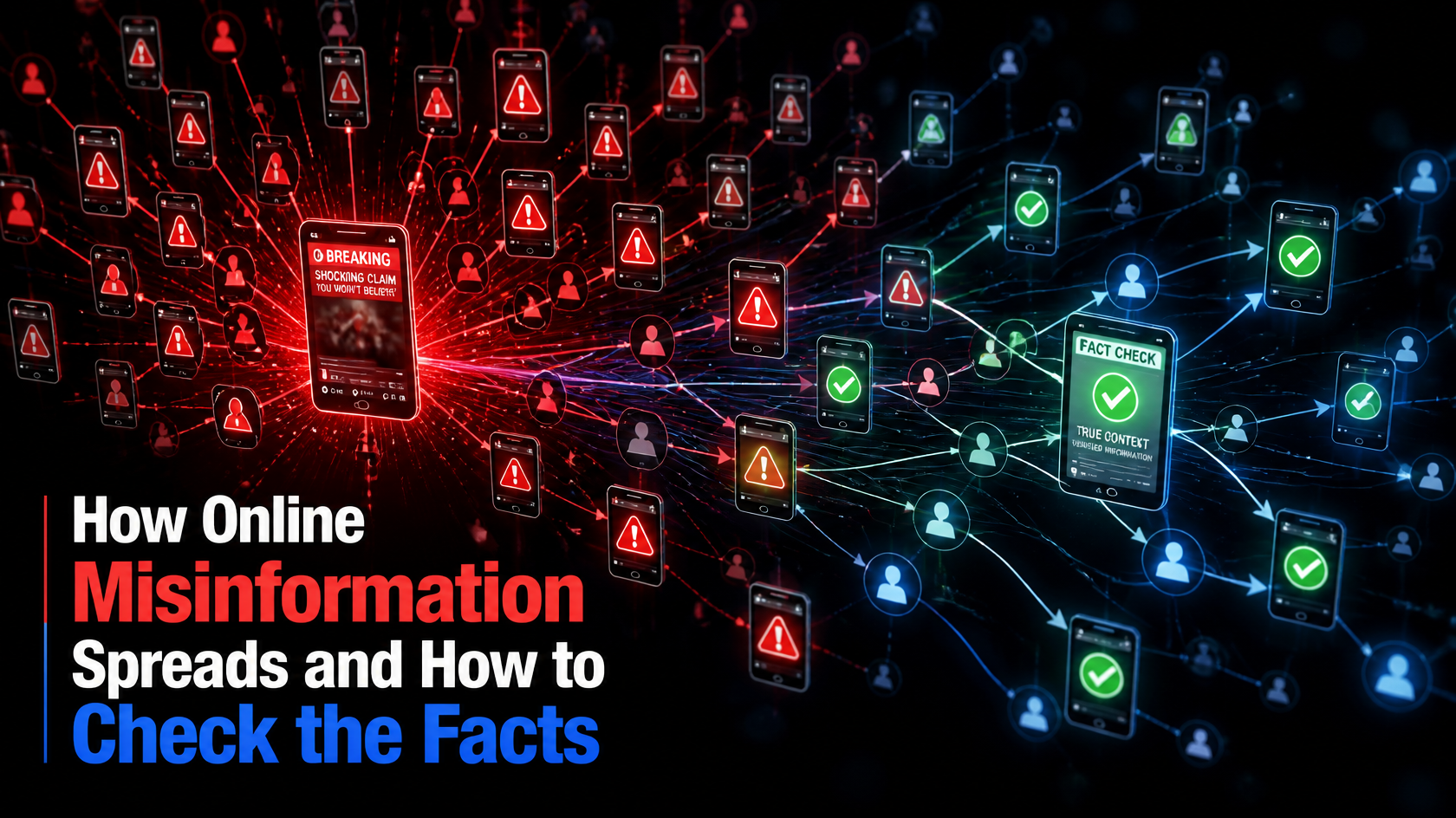
One of the main reasons is that the internet makes sharing extremely easy. A person can forward a message to hundreds of contacts with only a few taps. Social media platforms also allow popular posts to reach people who have no connection to the original creator.
Speed often becomes more important than accuracy. When a dramatic story appears online, many users want to be among the first to share it. They may not stop to ask whether the information has been verified.
Emotions play an important role as well. Content that makes people feel angry, afraid, shocked or excited is more likely to attract attention. A frightening warning or a surprising claim can encourage people to share immediately. This is why misinformation often uses emotional language, dramatic headlines and alarming images.
The decision to share is one of the most important points at which misinformation can either stop or continue. Readers should ask whether they actually know a claim is true, where it originally came from and whether their emotional reaction is pushing them to share too quickly. Online Trust and Safety Hub
The Role of Social Media Algorithms
Social media platforms are designed to show users content that is likely to keep their attention. Posts that receive many likes, comments and shares can become more visible to other users.
This does not mean that every popular post is false. However, popularity is not proof of accuracy. A misleading video can receive millions of views, while a careful explanation from an expert may receive far less attention.
People also tend to follow pages and individuals who share opinions similar to their own. Over time, this can create an “echo chamber,” where users repeatedly see the same ideas and rarely encounter reliable information that challenges them.
When people see a claim repeated many times, they may begin to feel that it must be true. Repetition can create familiarity, but familiarity is not evidence.
UNESCO has also highlighted the importance of better fact-checking habits among digital content creators. A global survey published by the organisation found that many creators did not systematically verify information before sharing it, demonstrating how easily unverified claims can enter the wider online information environment. UNESCO
Messaging Apps and Trusted Networks
Misinformation does not spread only through public social media posts. Private messaging apps and group chats can be especially powerful.
People are naturally more likely to trust information sent by a family member, friend or colleague. However, a trusted person can unknowingly forward false information. The fact that someone you know sent a message does not prove that the original claim is accurate.
For example, a message may begin with one person who misunderstands a story. It is then forwarded from one family group to another. Each person may assume that the previous sender checked the information. Within a short time, an unverified claim can appear to be widely trusted.
Readers should therefore ask not only “Who sent me this?” but also “Where did this information originally come from?”
Misleading Headlines and Clickbait
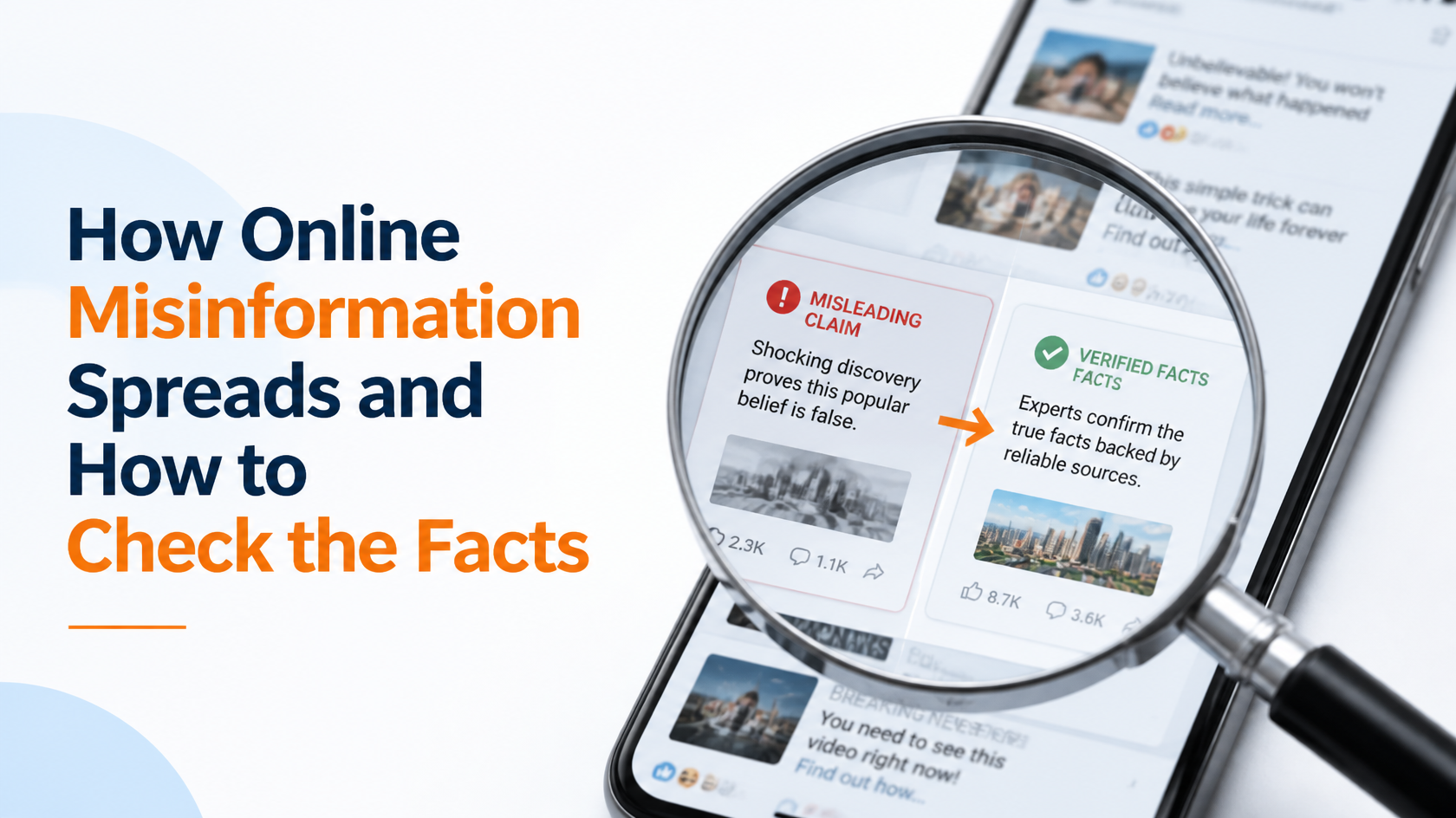
Many people read only the headline of a story before reacting or sharing it. This can create serious problems because headlines are sometimes written to attract clicks rather than explain the full story.
A headline may use dramatic words that make a situation appear more serious than it really is. In other cases, the headline may technically be based on a real event but leave out important details.
For this reason, readers should go beyond the headline. Reading the full article can reveal whether the evidence actually supports the claim being promoted.
Reliable information also requires context. A true photograph can become misleading if it is presented as evidence of a different event. A real statistic can create a false impression if important details are omitted. Information should therefore be judged not only by whether one part is true, but also by whether the complete context is accurate.
Images, Videos and Artificial Intelligence
Visual content can be especially convincing. People often assume that a photograph or video is proof that something happened. However, images can be edited, taken from another location or shared years after the original event.
Modern artificial intelligence has added another challenge. AI can generate realistic images, voices and videos. Deepfakes can make it appear that a person said or did something that never actually happened. AI-driven accounts can also repeat misleading claims at scale, creating the impression that a false story has widespread support. UNICEF Global
This does not mean that readers should distrust every image or video online. Instead, they should develop the habit of checking important visual content before accepting it as evidence.
Reverse image search tools can help users discover whether an image appeared online before and whether it was originally connected to a different event. Tools such as Google Lens and TinEye can be useful starting points for checking images. World Health Organization
How Readers Can Check the Facts
The first and most important step is simple: pause before reacting or sharing.
When people encounter surprising information, they should resist the pressure to make an immediate decision. A few minutes of checking can prevent false information from reaching many more people.
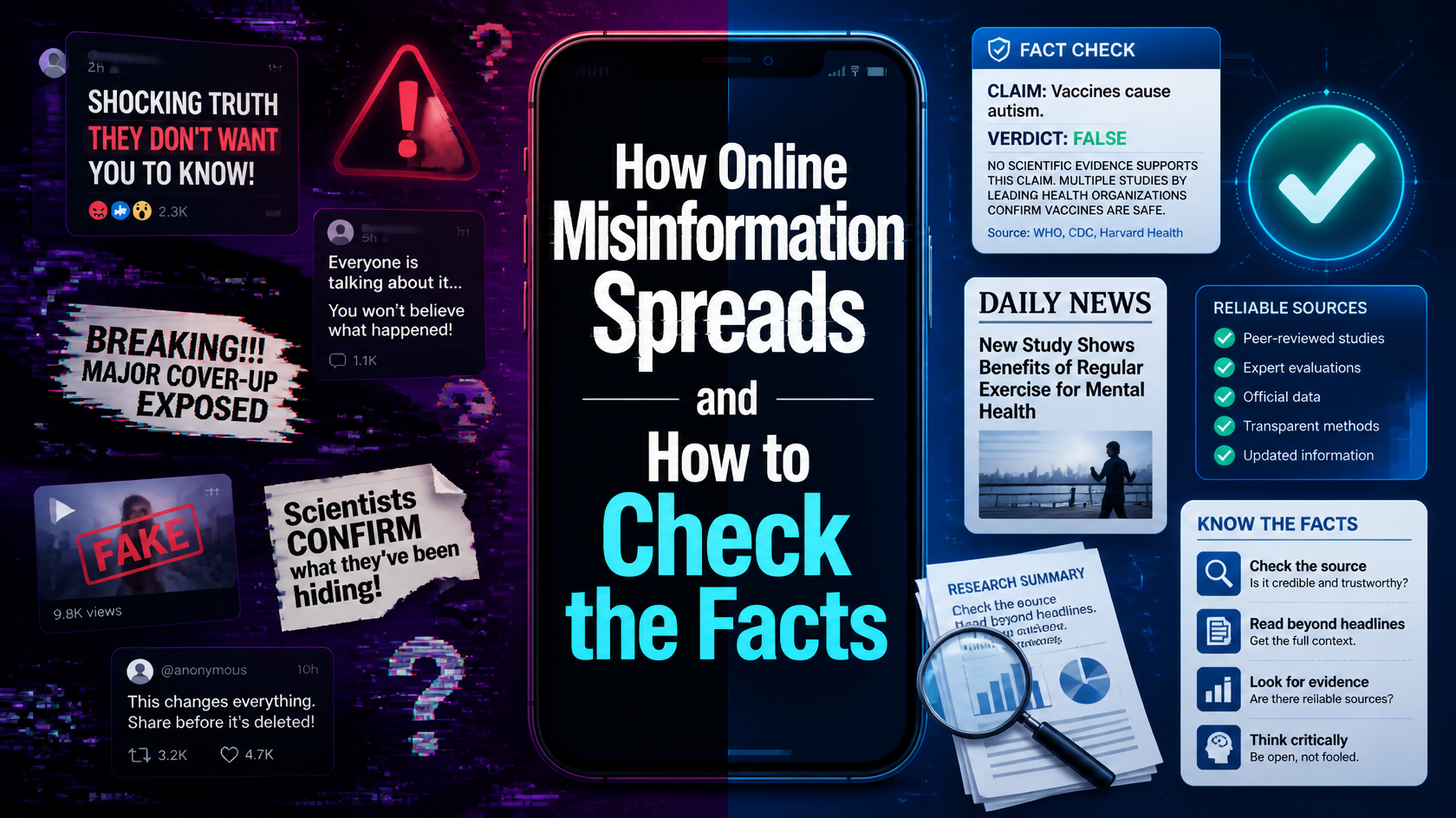
1. Check the Original Source
Look carefully at where the information was published. Is it a recognised news organisation, government institution, university, research organisation or another credible source?
Check the website's background and contact information. Be cautious of websites that provide no information about who operates them.
A professional-looking website is not automatically trustworthy. Modern websites can be created quickly, and misleading pages can copy the appearance of legitimate news organisations.
2. Find Out Who Wrote It
If an article has an author, search for that person's name. Are they a real person? Do they have relevant knowledge or experience?
For specialist topics such as science, medicine or economics, it is especially important to consider whether the author or quoted expert has appropriate expertise.
Readers should also be cautious when content uses vague phrases such as “experts say” without identifying the experts or explaining the evidence.
3. Read Beyond the Headline
Do not judge a story based only on its title, thumbnail or opening sentence.
Read the complete article and ask whether the evidence supports the headline. Look for important qualifications or missing context. A good habit is to ask: What does this story actually prove, and what is it only suggesting?
International organisations such as UNESCO and WHO recommend reading beyond headlines, checking the source, examining evidence and considering whether personal biases are influencing how a claim is interpreted. World Health Organization
4. Check the Date
Old information is often shared as if it were new.
A photograph from several years ago may reappear during a recent event. An old news article may no longer reflect the current situation. Always check when the information was originally published and whether it remains relevant.
5. Look for Evidence
Reliable reporting should provide evidence for important claims. This may include official documents, research, statistics, direct interviews or clearly identified expert opinions.
However, readers should not simply trust a story because it contains links or numbers. Check whether the sources actually support the claim.
A useful question is: Can I trace this information back to an original and reliable source?
Compare Multiple Reliable Sources
One of the strongest ways to check a major claim is to look beyond the original post or website.
Search for the same information through several reliable sources. If a major event has really occurred, established news organisations, official institutions or relevant experts may also report it.
This process is sometimes called lateral reading. Instead of staying on one webpage and deciding whether it looks trustworthy, readers leave the page and investigate the organisation, author and main claim elsewhere. Evaluating accuracy, authority, relevance, transparency and purpose can help readers make more informed judgments. House of Commons Library
However, readers should remember that several websites repeating the same false claim does not make it true. The key is to identify independent and credible sources.
Understand Your Own Biases
Fact-checking is not only about examining websites. It also requires examining our own reactions.
People are often more willing to believe information that supports what they already think. A story that confirms our opinions may feel immediately convincing, while information that challenges our beliefs may be rejected without careful consideration.
Before sharing a claim, ask yourself:
- Do I believe this because I have checked the evidence?
- Or do I believe it because I want it to be true?
- Did the content make me angry or afraid?
- Would I apply the same level of scrutiny if the claim supported the opposite view?
Checking personal bias does not mean abandoning personal opinions. It means separating evidence from emotion and being willing to change an opinion when strong evidence shows that it is wrong.
Use Fact-Checking Organisations
For widely shared claims, professional fact-checkers may already have investigated the issue. Readers can search trusted fact-checking organisations and established news agencies to see whether a claim has been verified or disproved.
Fact-checking should not mean blindly accepting one organisation's conclusion. A good reader should still examine the evidence and understand how the conclusion was reached.
The best approach is to use fact-checking as part of a wider process that includes checking original sources, comparing reliable reporting and looking for evidence.
What Should You Do If You Shared False Information?
Everyone can make mistakes online. Sharing something inaccurate does not necessarily mean a person intended to deceive others.
If you discover that something you shared was false, take responsibility. Delete or correct the original post when possible, and share the correction with the people who received the inaccurate information.
There is no need to feel embarrassed about correcting a mistake. In fact, openly correcting misinformation can help create a healthier online culture.
When correcting another person, it is usually more helpful to stay calm and respectful. Instead of immediately attacking them, ask where the information came from and share reliable evidence. The goal should be to improve understanding rather than win an argument.
The Responsibility of Every Internet User
Governments, technology companies, journalists, educators and fact-checking organisations all have important roles in addressing misinformation. However, ordinary readers also have significant power.
Every person who pauses before forwarding an unverified message can interrupt the spread of misinformation. Every reader who checks a source, reads beyond a headline or shares a correction can contribute to a better information environment.
The internet gives everyone the ability to publish and share information. That freedom comes with responsibility. Being a responsible digital citizen does not mean believing everything from traditional sources or becoming suspicious of every online post. It means developing the skills to ask sensible questions and follow the evidence.
Conclusion
Online misinformation spreads because digital platforms make communication fast, emotional and easy to share. False information can move through social media feeds, private messaging groups, videos and websites long before its accuracy is questioned. Popularity, repetition and the recommendation of a trusted friend can make an unreliable claim appear more convincing than it really is.
The solution begins with a simple habit: pause before you believe and pause before you share.
Readers should check the source, identify the author, read beyond the headline, examine the date, look for evidence and compare information with other reliable sources. They should also recognise their own biases and be especially careful when content creates a strong emotional reaction.
In the digital age, fact-checking is no longer a skill needed only by journalists. It is an everyday responsibility. A more informed internet depends not only on the people who create information, but also on the readers who choose what to believe, question and share. By becoming more careful and curious online, every reader can play a part in slowing the spread of misinformation and building a more trustworthy digital world. OECD
Additional Media