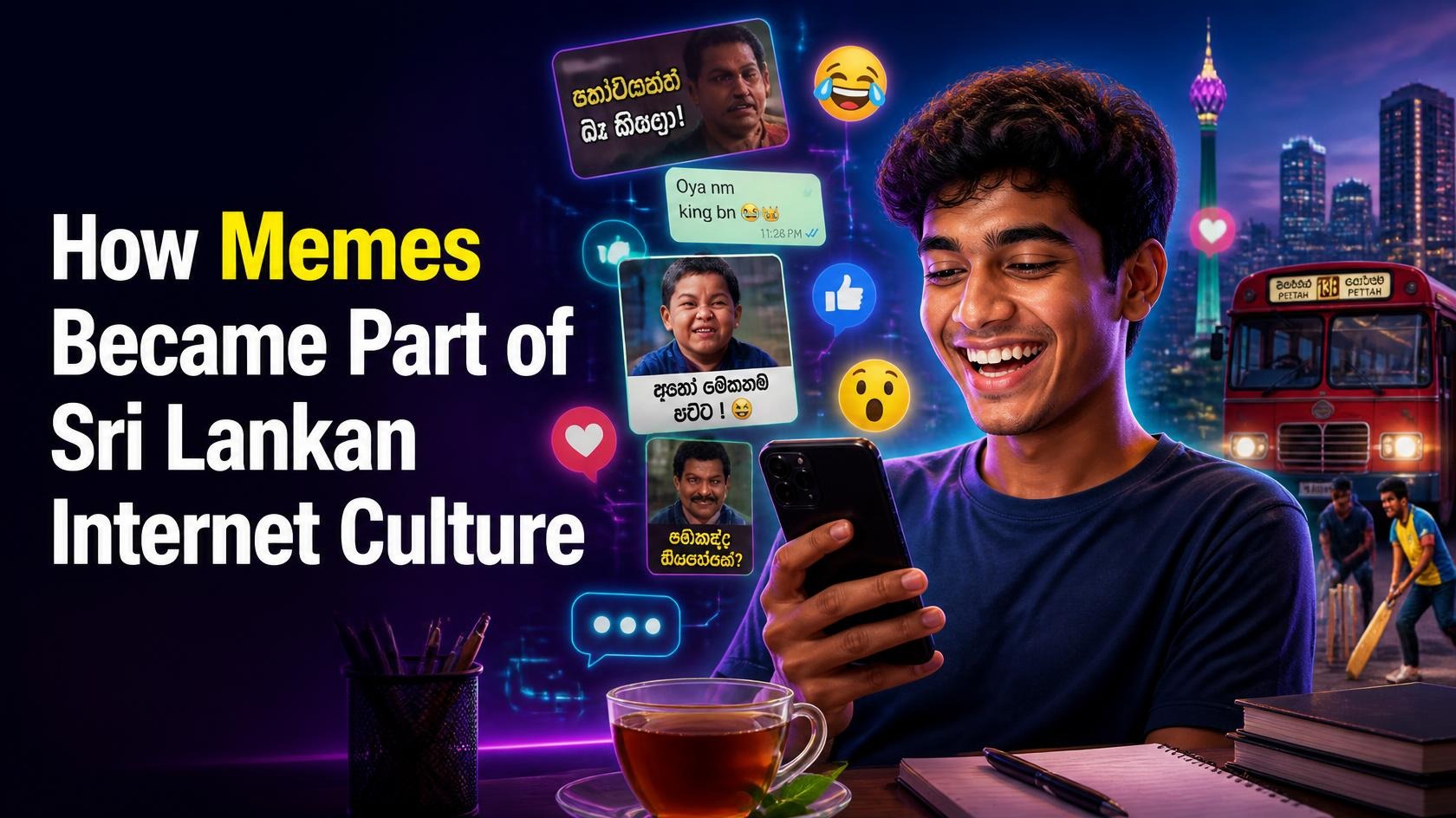
How Memes Became Part of Sri Lankan Internet Culture
Rakshika Rathnayake10/8/20265 min read
Share:Facebook
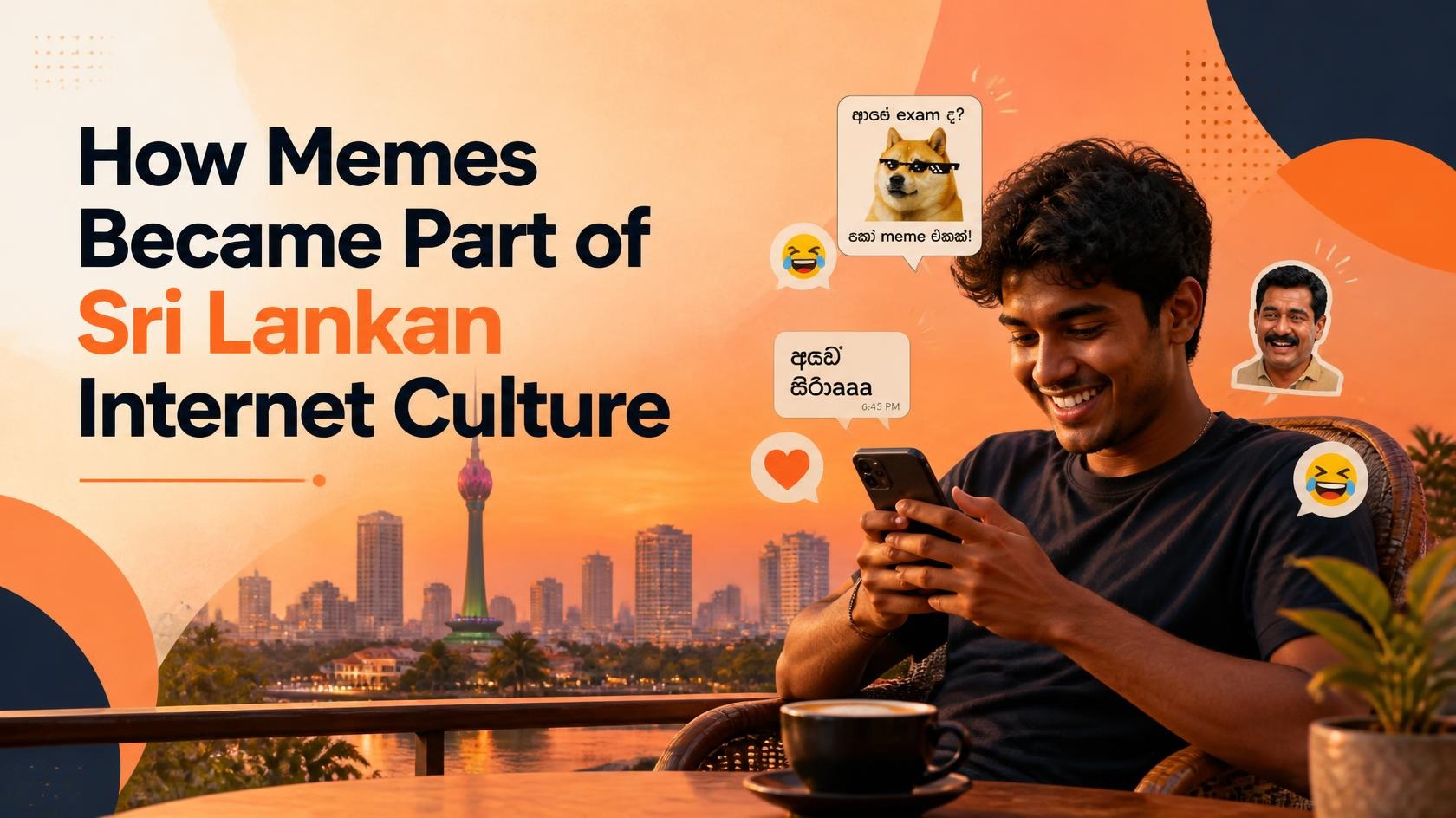
Memes have become a familiar part of everyday internet culture in Sri Lanka. What started as simple funny pictures and short jokes shared among friends has developed into a powerful form of online communication. Sri Lankan users now use memes to comment on politics, education, relationships, work, public transport, cricket, television, family life and even the struggles of daily living.
For many young Sri Lankans especially, memes are more than entertainment. They are a way of expressing feelings, making observations about society and communicating ideas quickly. A single image with a few words can sometimes explain a situation more effectively than a long social media post.
The growth of memes in Sri Lanka is closely connected to the expansion of internet access, smartphones and social media. Platforms such as Facebook, YouTube, Instagram, TikTok and messaging applications have created spaces where humorous content can spread within minutes. At the same time, Sri Lankan internet users have developed their own style of humour, combining Sinhala, English and Tamil with local references that are easily understood by people familiar with Sri Lankan life.
The Early Development of Internet Humour
Internet humour existed in Sri Lanka before memes became a major part of social media culture. During the early years of widespread internet use, people shared jokes through emails, forums, blogs and messaging services. Later, platforms such as Facebook made it much easier for users to create and distribute humorous content.
Facebook played an especially important role in the development of Sri Lankan meme culture. As more Sri Lankans joined Facebook, users began sharing funny photographs, screenshots, jokes and edited images. Some pages started creating content specifically for Sri Lankan audiences.
Many early memes were based on popular films, television programmes, celebrities and everyday situations. Scenes from Sinhala movies could be edited with new captions to create jokes about university life, relationships or family arguments. Famous expressions from actors and comedians could also become reusable meme formats.
This process helped establish an important feature of Sri Lankan meme culture: localisation. Instead of simply copying international memes, users began adapting them to situations that Sri Lankan people understood.
The Importance of Local Language
One of the most interesting characteristics of Sri Lankan memes is the way languages are mixed.
Sinhala is commonly used in memes aimed at Sinhala-speaking audiences, while Tamil-language memes are widely shared among Tamil-speaking communities. English is also frequently used, particularly among younger internet users. However, many memes combine two or even three languages.
Sinhala-English mixing is particularly common in everyday online communication. A meme might contain Sinhala words written in English letters, English phrases alongside Sinhala expressions, or a mixture of Sinhala and English that reflects how many young people communicate online.
Tamil internet communities have developed their own humorous formats and references as well. This demonstrates that Sri Lankan meme culture is not a single uniform culture. Different communities create humour based on their own languages, experiences and cultural references.
The use of local languages also makes memes feel more personal. A translated foreign meme may be funny, but a joke about a Sri Lankan mother, a crowded bus, a school teacher or a university examination often feels more relatable because it reflects real experiences.
Everyday Life Became Meme Material
Almost anything connected to ordinary life can become a meme.
School and university experiences are popular subjects. Students joke about examinations, assignments, lectures, attendance, group projects and the pressure of deadlines. University students may use memes to describe the difference between expectations and reality, while school students often share jokes about homework, teachers and examinations.
Workplace life is another common subject. Office workers create memes about Monday mornings, long working hours, meetings, deadlines and difficult customers. These jokes allow people to laugh about situations that might otherwise be stressful.
Family life is also a major source of Sri Lankan memes. The strictness of parents, questions from relatives, expectations about education and careers, and differences between generations are frequently turned into jokes.
Food is another important part of this culture. Rice and curry, short eats, kottu, tea and other familiar foods can easily become subjects for humour. Memes often work because they take something ordinary and present it in an exaggerated or unexpected way.
Sri Lankan Cinema and Television
Local entertainment has contributed significantly to meme culture.
Scenes from Sinhala films and television programmes are frequently reused because viewers already understand the expressions, characters and situations. A serious scene from an older movie can become humorous when its dialogue is placed into a completely different context.
Actors' facial expressions are particularly useful in memes. A dramatic reaction can be given a new caption about receiving a low examination mark, checking a bank account or seeing a message from someone unexpected.
This gives older entertainment content a new life among younger internet users. Someone who may not have watched the original film might still recognise a particular scene because it has become a popular meme.
In this way, memes can sometimes connect different generations of popular culture. Old movie scenes, television characters and famous public moments can return to public attention through social media.
Cricket and National Events
Cricket has always had a strong cultural presence in Sri Lanka, and it naturally became an important subject for memes.
Match results, player performances, unexpected victories and disappointing defeats can generate thousands of humorous posts. During major tournaments, social media becomes particularly active as supporters react to events almost immediately.
Memes allow fans to express excitement, disappointment, frustration and rivalry without writing long explanations. A single image can capture the mood of supporters after an important match.
Other major national events can also become sources of online humour. Elections, public announcements, price changes, examinations, weather events and other widely discussed topics may quickly appear in meme formats.
This shows how memes have become connected to real-time public conversation.
Memes During Difficult Times
Sri Lankan meme culture became particularly visible during periods of economic and social difficulty.
During the economic crisis that intensified in 2022, social media users created and shared humorous content about fuel shortages, queues, electricity cuts, rising prices and everyday financial difficulties. Humour did not remove the seriousness of these problems, but it gave people a way to express frustration and share experiences.
A meme about waiting in a fuel queue, for example, could communicate a common experience to thousands of people immediately. People who had experienced the same problem could recognise the situation and respond with their own jokes.
This is one of the important social functions of memes. Humour can become a coping mechanism. When people experience stress collectively, sharing a joke can create a temporary feeling of connection.
However, humour during difficult situations can also be controversial. Some people may feel that serious events should not be turned into jokes, particularly when they involve loss, suffering or tragedy. This creates an ongoing debate about where the limits of online humour should be.
The Role of Facebook Groups and Pages
Facebook groups and meme pages helped build communities around shared humour.
Some pages focus on general Sri Lankan memes, while others target specific groups such as university students, school students, sports fans or people from particular regions.
These communities create a sense of belonging. Users may recognise the same jokes, phrases and recurring characters. People who have never met can interact because they share similar experiences.
The comment sections also contribute to meme culture. Sometimes the comments underneath a meme become almost as entertaining as the original post. Users add their own jokes, references and reactions, creating a collaborative form of humour.
This means meme culture is not simply about consuming content. Users are also participants who modify, remix and extend jokes.
The Rise of TikTok, Instagram and Short-Form Content
Although Facebook played a major role in the early development of Sri Lankan meme culture, newer platforms have changed the way humour is produced and consumed.
TikTok and Instagram have increased the popularity of short videos, reaction clips and rapidly edited humorous content. A meme no longer has to be a static image. It can be a short video, audio clip, reaction, screenshot or combination of several formats.
TikTok trends can spread internationally and then be adapted for Sri Lankan situations. A popular audio clip may be used to joke about school, university, relationships, work or family life.
Instagram also provides a space for meme pages and short humorous videos. Because users can quickly share posts through stories and direct messages, jokes can move rapidly between different social circles.
Messaging applications such as WhatsApp also play an important role. A meme that appears on one platform can quickly be forwarded into family groups, friend groups and workplace chats.
The Language of Relatability
Perhaps the strongest reason memes have become popular in Sri Lanka is relatability.
People share memes when they see something that reminds them of their own lives. A student may share a meme because it describes examination stress. An office worker may share one because it captures the feeling of Monday morning. A young person may send a relationship meme to a friend because it describes a familiar situation.
The humour does not always have to be sophisticated. Sometimes the simplest joke works because the situation is so familiar.
This is why local references are important. A meme about a Sri Lankan bus, a tuition class, a family gathering or a roadside food shop may have little meaning to someone unfamiliar with Sri Lankan life, but it can be immediately understandable to a local audience.
Memes as Social Commentary
Memes are also becoming a form of informal social commentary.
People use humour to discuss issues that might otherwise require serious political or social analysis. Memes can comment on education, unemployment, inflation, political behaviour, social expectations, technology and changing lifestyles.
Because memes are short and entertaining, they can attract attention more easily than lengthy explanations.
However, their simplicity can also be a weakness. Complex issues may be reduced to a single joke, sometimes creating misleading impressions. Satire can also be misunderstood when people do not recognise that a post is intended as humour.
For this reason, memes should not always be treated as reliable sources of information. A funny post can express an opinion, but it does not necessarily provide evidence.
The Influence of Generational Differences
Memes have also created differences between generations.
Younger internet users usually understand meme formats, slang, editing styles and online references more quickly. Older generations may see the same content without understanding why it is funny.
At the same time, older adults are increasingly active on social media and messaging platforms. As a result, memes are no longer limited to teenagers and university students. Humorous posts can reach parents, professionals and older family members as well.
Sometimes this creates another source of humour: the difference between how younger and older people use the internet.
Problems and Negative Effects
Despite their entertainment value, memes can have negative consequences.
Some memes make fun of individuals because of their appearance, disability, financial situation, ethnicity or other personal characteristics. What one person considers harmless humour can be deeply hurtful to another.
Misinformation can also spread through memes. Because memes are designed to be quickly consumed and shared, people may forward them without checking whether the information is true.
Political memes can be particularly misleading when an image removes an event from its original context. A humorous caption can change how people interpret a photograph or statement.
There is also the issue of copyright and content ownership. Many memes use photographs, film scenes or other material created by someone else. Internet culture has made copying easy, but the original creators do not always receive recognition.
These problems do not mean that memes are harmful by nature. They show that online humour requires some level of responsibility.
The Future of Sri Lankan Meme Culture
Sri Lankan meme culture is likely to continue changing as technology changes.
Artificial intelligence tools are making image, video and audio creation easier. Users can now create increasingly sophisticated humorous content without professional editing skills. Generative AI may therefore become another tool for Sri Lankan meme creators.
At the same time, short-form video is likely to remain important. Instead of a simple image and caption, future memes may involve AI-generated characters, edited voices, animations and interactive formats.
Even though the technology will change, the basic idea behind memes will probably remain the same: people will continue turning familiar experiences into humour.
Sri Lankan meme culture is ultimately a reflection of Sri Lankan society itself. It contains local languages, family relationships, education, work, entertainment, sports, politics and everyday struggles. Its popularity comes from the fact that it allows people to recognise themselves in a joke.
Conclusion
Memes have grown from simple internet jokes into an important part of Sri Lankan digital culture. Their development has been supported by Facebook, Instagram, TikTok, messaging applications and the increasing use of smartphones and social media.
More importantly, Sri Lankan users have made meme culture their own. They have adapted global formats to local languages, films, cricket, family life, education, work and social issues. Memes provide entertainment, but they also create communities, express opinions and give people a way to cope with everyday difficulties.
At their best, memes show how creative ordinary internet users can be. A familiar situation, a funny photograph and a few carefully chosen words can become a piece of content understood by thousands of people.
As Sri Lanka's digital culture continues to develop, memes will likely remain part of the country's online conversation. The formats may change, the platforms may change and the technology may become more advanced, but the basic reason people share memes is unlikely to disappear: people enjoy laughing at experiences they recognise in their own lives.
Additional Media