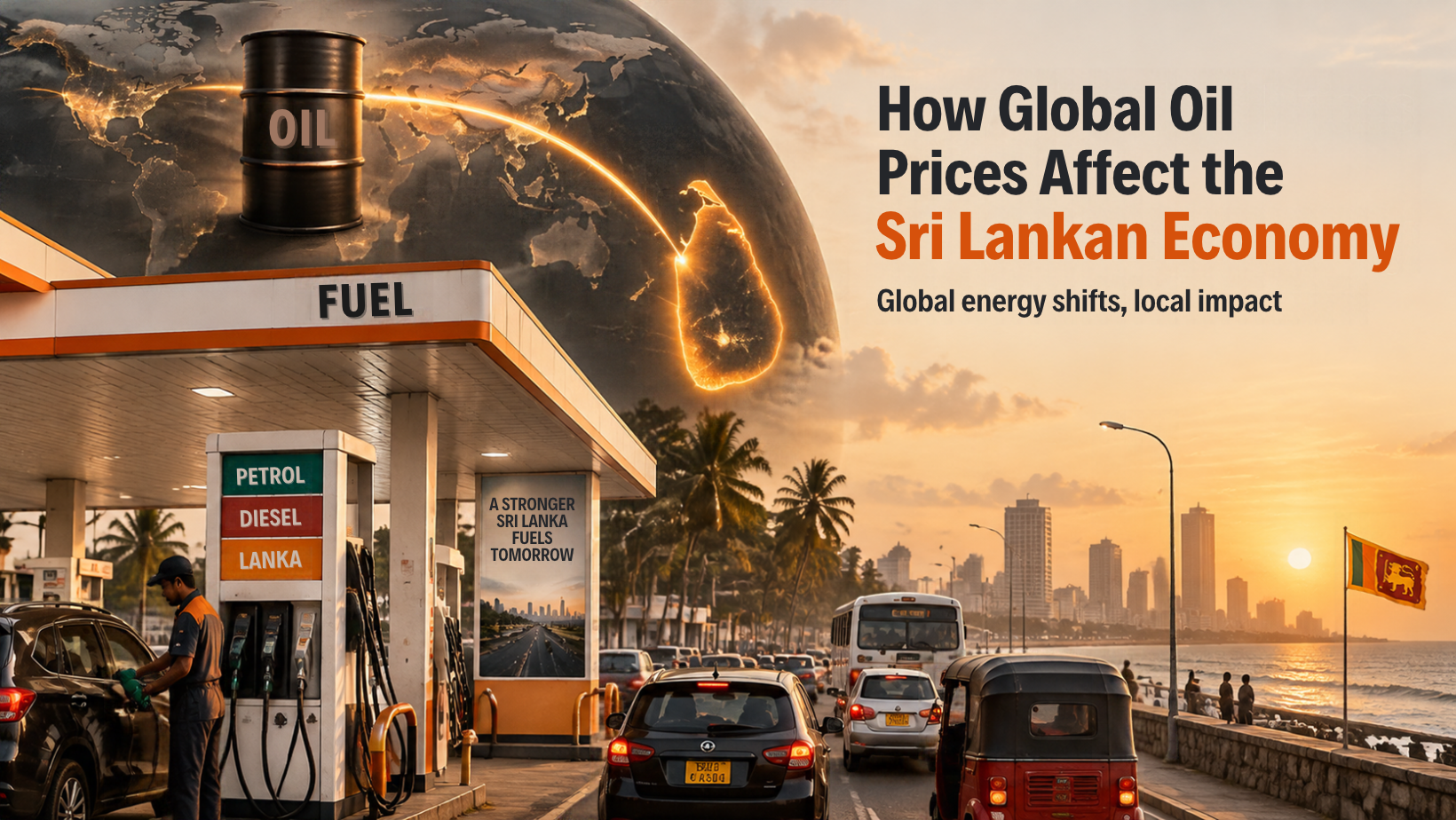
How Global Oil Prices Affect the Sri Lankan Economy
Rakshika Rathnayake11/16/20265 min read
Share:Facebook
Introduction
Global oil prices play an important role in shaping the economic conditions of countries around the world. For a country like Sri Lanka, which depends heavily on imported fuel to meet its energy requirements, changes in international oil prices can have a significant impact on everyday life, business activities, government spending and national economic stability.
Oil is not simply a fuel used by vehicles. It is an essential resource for transportation, electricity generation, industries, agriculture, construction and many other economic activities. When international oil prices increase, the effects can spread throughout the entire economy. Businesses may face higher operating costs, transport fares may rise, food prices may increase and households may have less money available for other expenses.
Sri Lanka has experienced these challenges during different periods, particularly during the economic crisis that began in 2022. Fuel shortages, long queues at filling stations, rising transportation costs and increasing prices of essential goods demonstrated how strongly the country depends on a stable fuel supply.
Understanding the relationship between global oil prices and Sri Lanka's economy is therefore important. It helps explain why international developments can affect local prices and why the country needs long-term strategies to reduce its dependence on imported petroleum.
1. Why Sri Lanka Depends on Imported Oil
Sri Lanka does not produce enough crude oil or petroleum products to meet its domestic energy requirements. As a result, the country depends heavily on imports to supply petrol, diesel, kerosene, aviation fuel and other petroleum products.
These fuels are essential for keeping the country's economy functioning. Public buses, private vehicles, trucks, fishing boats and agricultural machinery all depend on petroleum products. Industries also use fuel for transportation, production processes and backup electricity generation.
Sri Lanka imports fuel from international suppliers, and the cost of these imports is influenced by global market conditions. International crude oil prices, refining costs, shipping expenses, exchange rates and geopolitical developments can all affect the final amount the country pays.
This dependence creates an important economic challenge. When global oil prices rise, Sri Lanka must spend more foreign currency to purchase the same quantity of fuel. When prices fall, the country's import expenditure may decrease, providing some relief to its foreign exchange requirements.
However, lower international oil prices do not always result in immediate reductions in local fuel prices. Government taxes, exchange rate movements, distribution costs and domestic pricing policies also influence the final price paid by consumers.
2. The Impact of Rising Oil Prices on Foreign Exchange Reserves
One of the most important ways global oil prices affect Sri Lanka is through foreign exchange reserves.
Sri Lanka needs foreign currency, particularly US dollars, to purchase imported fuel. When international oil prices increase, the country requires more dollars to import the same quantity of petroleum products.
This can place additional pressure on the country's foreign exchange position, especially when export earnings, tourism income and foreign investment are insufficient to cover import requirements.
For example, imagine that Sri Lanka needs to purchase a particular quantity of fuel every month. If the international price of oil increases significantly, the country must allocate more foreign currency to pay for those imports. This leaves fewer dollars available for importing other essential items, including medicine, food ingredients, machinery and industrial raw materials.
The situation becomes more challenging when the Sri Lankan rupee weakens against the US dollar. Even if international oil prices remain unchanged, a weaker rupee makes fuel imports more expensive in local currency.
This is why international oil prices and exchange rates are closely connected to Sri Lanka's economic stability.
3. How Oil Prices Affect Transportation Costs
Transportation is one of the sectors most directly affected by changes in petroleum prices.
Sri Lanka depends heavily on road transportation to move passengers and goods between cities, towns and rural areas. Buses, three-wheelers, motorcycles, vans and lorries all require fuel to operate.
When petrol and diesel prices increase, transportation operators face higher daily expenses. Private bus operators, delivery services, taxi providers and goods transportation companies may struggle to maintain their existing operating costs.
As a result, higher fuel expenses can lead to increases in bus fares, delivery charges and other transportation-related costs, depending on government pricing decisions and market conditions.
For ordinary people, this creates an additional financial burden. Workers who travel daily, students who depend on public transportation and small business owners who deliver products may all experience higher expenses.
The impact is particularly significant for people living outside major cities. Many rural communities depend on buses and other fuel-powered vehicles to access schools, hospitals, markets and workplaces.
Therefore, an increase in global oil prices can affect not only transportation businesses but also the daily activities and financial decisions of thousands of Sri Lankan households.
4. The Effect on Food Prices and the Cost of Living
The relationship between oil prices and food prices is another important issue for Sri Lanka.
Although food products do not always depend directly on petroleum, their production and distribution require energy. Farmers use fuel to operate tractors, water pumps and other agricultural machinery. Fishing boats require diesel or petrol, while lorries and distribution vehicles transport vegetables, rice, fruits, fish and other food items to markets.
When fuel prices increase, farmers and food suppliers may face higher production and transportation expenses. These additional costs can eventually be reflected in the prices consumers pay.
For example, vegetables produced in areas such as Nuwara Eliya and Badulla must be transported to markets in Colombo, Gampaha, Kandy and other districts. If diesel prices rise, transportation companies may increase their charges. As a result, the prices of vegetables and other agricultural products may also increase.
The same situation can affect fish prices, bakery products, dairy products and packaged food. Businesses that depend on imported ingredients, plastic packaging and fuel-powered machinery may also experience higher costs.
For Sri Lankan families, this means that an increase in global oil prices can make everyday living more expensive. Families with limited incomes are particularly affected because a large portion of their monthly budgets is already spent on food, transportation and other essential needs.
5. The Impact on Industries and Small Businesses
Sri Lanka's industrial and business sectors also depend on petroleum and other energy sources. Manufacturing companies, construction businesses, factories, hotels and delivery services require a reliable energy supply to maintain their daily operations.
When oil prices increase, businesses may experience higher electricity generation costs, transportation expenses and production costs. Companies that operate generators during power interruptions may face additional fuel expenses.
Small and medium-sized businesses are often more vulnerable to these changes because they have limited financial resources compared with large companies.
For example, a small bakery may need fuel to transport ingredients, electricity to operate equipment and delivery vehicles to distribute finished products. If all these expenses increase, the business may have to raise product prices or accept lower profits.
Construction companies may also face higher costs when transporting cement, steel, sand and other materials. These increases can affect building projects, housing developments and infrastructure construction.
Tourism-related businesses are another important example. Hotels, restaurants, tour operators and transport providers depend on fuel for different services. Higher fuel costs can increase the expenses of airport transfers, sightseeing tours and hotel operations.
If businesses cannot manage these additional expenses, they may reduce production, delay expansion plans or limit recruitment. This can affect employment opportunities and slow down economic growth.
6. The Connection Between Oil Prices and Inflation
Inflation refers to the general increase in prices of goods and services over time. Global oil prices can contribute to inflation because petroleum is an important input in many economic activities.
When fuel prices increase, transportation, manufacturing, agriculture and distribution costs may also increase. Businesses often pass at least part of these additional expenses on to consumers through higher prices.
This type of inflationary pressure is sometimes described as cost-push inflation.
Sri Lanka experienced significant inflationary pressure during the economic crisis in 2022. However, it is important to understand that rising oil prices were not the only reason for that crisis. Foreign exchange shortages, currency depreciation, supply disruptions, monetary conditions and domestic policy challenges also contributed.
The International Monetary Fund highlighted that rising global food and oil prices added to Sri Lanka's balance of payments difficulties in 2022. It also identified fuel price increases and currency depreciation among the factors contributing to inflation.
International Monetary Fund+1
The effect of oil prices on inflation can also continue even after international prices begin to decline. Businesses may take time to adjust their prices, while transportation contracts, electricity costs and other operating expenses may not change immediately.
Therefore, controlling inflation requires more than simply monitoring international petroleum prices. Effective economic management, stable monetary policies, reliable supply chains and responsible government decisions are also necessary.
7. Lessons from Sri Lanka's 2022 Economic Crisis
Sri Lanka's economic crisis in 2022 clearly demonstrated the dangers of depending heavily on imported fuel without sufficient foreign exchange reserves.
During this period, the country experienced severe fuel shortages, long queues at filling stations and difficulties in maintaining normal transportation and business activities.
International oil prices also increased significantly following geopolitical tensions and disruptions in global energy markets. According to Sri Lanka's Energy Balance 2022, the average Brent crude oil price increased from approximately USD 70.80 per barrel in 2021 to USD 99.06 in 2022.
The country's net petroleum import bill increased from approximately USD 4.07 billion in 2021 to USD 5.13 billion in 2022.
energy.gov.lk
However, the crisis was not caused by expensive oil alone. Sri Lanka was already facing a serious foreign exchange shortage, debt difficulties and other economic problems. These conditions made it extremely difficult to purchase sufficient fuel from international suppliers.
Fuel shortages affected almost every part of daily life. Public transportation became unreliable, schools and workplaces experienced disruptions, and many businesses struggled to continue their normal operations.
The government later introduced a QR-code-based fuel distribution system to manage limited supplies and reduce unnecessary consumption.
The World Bank reported that Sri Lanka's real GDP contracted by 7.8% in 2022, while shortages of fuel and other essential goods severely affected economic activities.
World Bank
This experience demonstrated that energy security is not simply a matter of purchasing fuel. It is closely connected to foreign exchange management, national planning and overall economic stability.
8. How Global Political Events Influence Oil Prices in Sri Lanka
International political developments can have a direct effect on Sri Lanka even when they occur thousands of kilometres away.
Major oil-producing regions, particularly the Middle East, play an important role in supplying energy to the global market. Political conflicts, military tensions, economic sanctions and disruptions to shipping routes can affect oil production and transportation.
For example, tensions around important international shipping routes can create uncertainty about whether petroleum products will reach their destinations safely and on time.
When traders expect supply disruptions, international oil prices may increase. Even countries that are not directly involved in these conflicts can experience higher import expenses.
Sri Lanka is particularly exposed because it obtains a significant share of its petroleum imports from the Middle East.
The Central Bank of Sri Lanka's 2025 Annual Economic Review also highlighted the country's vulnerability to geopolitical developments and changes in international energy prices.
ANNUAL ECONOMIC REVIEW 2025+1
These developments show why Sri Lanka needs to monitor international energy markets and maintain plans to respond to unexpected supply disruptions.
9. What Can Sri Lanka Do to Reduce Its Dependence on Global Oil Prices?
Sri Lanka cannot control international oil prices, but it can take several steps to reduce the negative effects of sudden price increases.
Develop renewable energy sources
One of the most important long-term solutions is to increase the use of renewable energy. Sri Lanka has considerable potential for solar, wind and hydropower generation.
Encouraging households, businesses and industries to install solar power systems can reduce their dependence on conventional energy sources. Expanding wind and solar projects can also help reduce the need for imported fossil fuels in electricity generation.
Improve public transportation
A reliable public transportation system can reduce unnecessary fuel consumption. Expanding efficient bus services, improving railway facilities and introducing modern transport technologies can encourage more people to use shared transportation instead of private vehicles.
Better public transportation can also reduce traffic congestion and improve productivity.
Promote electric vehicles
Electric vehicles can gradually reduce the country's dependence on imported petrol and diesel. However, their long-term benefits depend on affordable electricity, suitable charging infrastructure and a reliable power supply.
Sri Lanka should also encourage electric buses, motorcycles and three-wheelers where practical.
Strengthen foreign exchange management
Maintaining adequate foreign exchange reserves is essential for purchasing fuel during periods of international price increases. Responsible import planning, stronger exports, tourism development and foreign investment can help improve the country's external financial position.
Improve energy efficiency
Businesses, factories and households should be encouraged to use energy more efficiently. Modern machinery, energy-saving equipment and improved building designs can reduce unnecessary fuel and electricity consumption.
Maintain effective fuel policies
The government needs a transparent and sustainable fuel pricing system. Such a system can help manage international price changes while protecting low-income households through properly targeted assistance.
Strategic fuel storage and better supply management are also important to reduce the risk of shortages during international emergencies.
10. The Future of Sri Lanka's Energy and Economic Stability
The future of Sri Lanka's economy will partly depend on how successfully the country manages its energy requirements.
As the global economy continues to change, competition for energy resources, international conflicts and environmental concerns may influence petroleum prices. Countries that depend heavily on imported fossil fuels will remain vulnerable to these developments.
Sri Lanka has an opportunity to build a more sustainable energy system by investing in renewable energy, improving electricity infrastructure and encouraging energy-efficient technologies.
However, these changes require careful planning and long-term investment. Renewable energy projects need suitable infrastructure, technical knowledge, financial support and effective management. The government, private sector and local communities all have important roles to play.
It is also important to balance economic development with environmental protection. Reducing petroleum consumption can help lower import expenses while supporting the country's efforts to reduce greenhouse gas emissions.
A stronger energy system would provide benefits beyond lower fuel costs. It could create new employment opportunities, attract investment, support local industries and improve the country's ability to manage future economic challenges.
Conclusion
Global oil prices have a significant influence on the Sri Lankan economy because the country depends heavily on imported petroleum to maintain its transportation, industries, agriculture and other essential activities. When international oil prices increase, the effects can spread across the economy through higher import expenses, pressure on foreign exchange reserves, increased transportation costs, rising food prices and inflation.
Sri Lanka's economic crisis in 2022 demonstrated how vulnerable the country can become when international energy challenges combine with domestic financial difficulties. It also highlighted the importance of maintaining sufficient foreign exchange reserves and ensuring a reliable fuel supply.
Although Sri Lanka cannot control international oil markets, it can reduce its vulnerability through better economic management, renewable energy development, improved public transportation and efficient fuel consumption.
Building a stable and sustainable energy system should therefore be considered an important part of the country's long-term economic development strategy. By reducing excessive dependence on imported petroleum and strengthening its energy infrastructure, Sri Lanka can become better prepared to face future global economic uncertainties.
Additional Media