How Artificial Intelligence Is Changing Everyday Life in Sri Lanka
Rakshika Rathnayake9/28/20265 min read
Share:Facebook
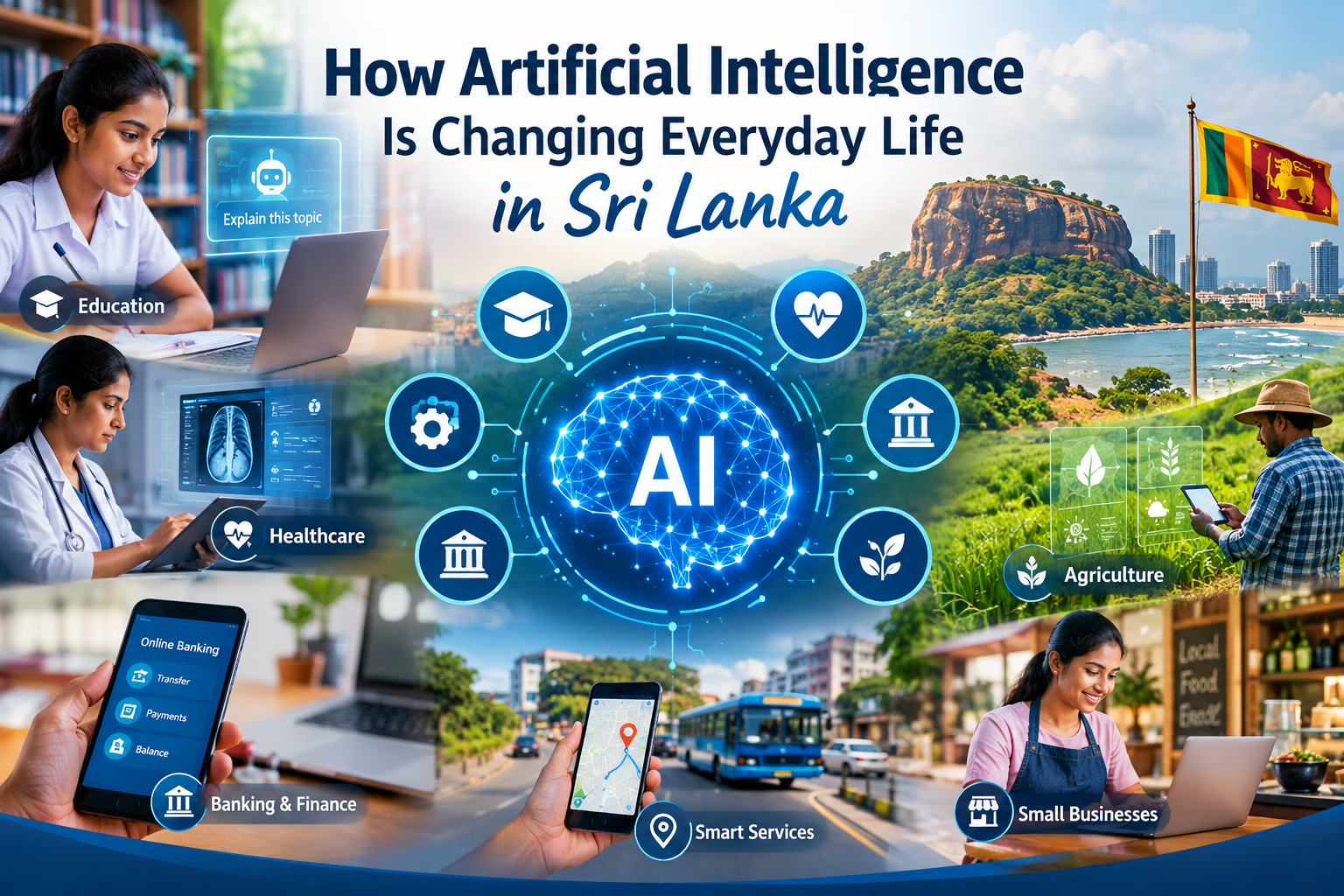
Artificial Intelligence (AI) is no longer a technology that exists only in science-fiction movies or advanced research laboratories. Around the world, AI is becoming part of everyday life, and Sri Lanka is also beginning to experience this change. From smartphones and online banking to education, business, healthcare, agriculture and government services, AI is gradually influencing the way people work, learn, communicate and make decisions.
For many Sri Lankans, AI may already be present in daily activities without them realizing it. When a phone suggests the next word while typing, a social media platform recommends a video, an online shopping site recommends a product, or a banking system identifies an unusual transaction, artificial intelligence may be working behind the scenes.
Sri Lanka has also begun developing a national approach to AI. The country's National AI Strategy aims to promote responsible AI development and adoption, strengthen skills and infrastructure, support research and innovation, and encourage AI use in both the public and private sectors.
What Is Artificial Intelligence?
Artificial Intelligence refers to computer systems that can perform tasks that normally require some form of human intelligence. These tasks can include understanding language, recognizing images, identifying patterns, making predictions and generating content.
Modern AI systems can process large amounts of information much faster than a person. Some systems learn from data and improve their performance over time. Generative AI tools can also create text, images, computer code and other forms of content based on instructions from users.
However, AI is not the same as human intelligence. AI systems depend on data, algorithms and computing infrastructure. They can also produce incorrect or misleading information. Therefore, using AI effectively requires human judgment and verification.
AI and Smartphones in Everyday Life
One of the easiest places to see AI's influence is the smartphone.
Many Sri Lankans use smartphones every day for communication, entertainment, navigation, photography, banking and work. AI can be found in several of these functions.
For example, smartphone cameras use AI-based technologies to recognize scenes, improve lighting, identify faces and process photographs. Voice assistants and speech-recognition systems can convert spoken words into text. Translation tools can help people understand languages they do not speak.
Social media platforms also use algorithms to recommend posts, videos and advertisements based on users' previous activities. Although these systems are not always visible, they influence what people see on their screens.
This means that AI is already affecting everyday digital experiences, even for people who have never deliberately used an AI application.
AI in Education
Education is another area where AI is creating new opportunities in Sri Lanka.
Students can use AI tools to explain difficult concepts, summarize information, practice languages, generate study questions and receive assistance with computer programming. Teachers can potentially use AI to prepare learning materials, organize information and develop classroom activities.
Sri Lanka has already taken steps toward introducing AI education. In 2024, the Cabinet approved a pilot project to introduce AI-related courses into selected schools, beginning around Grade 8, with teacher training included in the initiative.
AI is also becoming an important issue in higher education. In May 2026, an AI Policy Framework for Sri Lanka's state university system was launched, focusing on responsible, ethical and inclusive use of AI within universities.
For university students, AI can therefore become both a learning assistant and an important subject of study. At the same time, students need to understand academic honesty. Copying AI-generated answers without understanding or verifying them can weaken genuine learning.
The future of education is unlikely to be about simply replacing teachers with AI. Instead, AI can support teachers and students while human guidance remains important.
AI and Jobs in Sri Lanka
The workplace is one of the areas where AI may create some of the biggest changes.
Businesses can use AI to automate repetitive tasks such as organizing information, preparing basic reports, answering common customer questions and analyzing large datasets. This can save time and allow employees to concentrate on more complex responsibilities.
Sri Lankan businesses, including small and medium-sized enterprises, are increasingly discussing how AI can improve customer service, productivity and decision-making. ICTA highlighted these possibilities for Sri Lankan SMEs at Scale Up Sri Lanka 2025.
However, AI also creates concerns about employment. Some repetitive tasks may become automated, changing the demand for certain types of work. This does not necessarily mean that all jobs will disappear. In many cases, the nature of jobs is likely to change.
Workers who develop skills in AI, data analysis, digital tools, communication, creativity and problem-solving may find themselves better prepared for changing workplaces.
For Sri Lanka, improving digital and AI literacy will therefore be important. The National AI Strategy specifically identifies skills development as one of the foundations needed for the country's AI future.
AI in Banking and Finance
Sri Lanka's banking sector is also experiencing rapid digital transformation.
People increasingly use mobile banking, online banking, digital payments and other electronic financial services. AI can support these systems by analyzing patterns, detecting suspicious transactions, assessing risks and improving customer services.
The Central Bank of Sri Lanka has highlighted the role of AI, machine learning and automation in transforming banking operations. AI-powered systems can assist with areas such as risk assessment, loan processing, compliance and customer-focused services.
For ordinary customers, the impact may appear simple. Faster digital services, automated assistance and improved fraud detection can make financial services more convenient.
Nevertheless, financial AI systems must be carefully managed. Incorrect decisions, cybersecurity threats and misuse of personal financial data can create serious problems. Strong security and responsible use are therefore essential.
AI in Healthcare
Healthcare is another sector where AI has considerable potential.
AI can help healthcare professionals analyze medical information, identify patterns in medical images, support administrative work and assist with research. It can also help organize large quantities of health data.
Sri Lanka's digital transformation plans have identified modern healthcare services, including e-health and telemedicine, as important areas for technological development. The country's Digital Economy Blueprint has also involved engagement with health-sector officials on digital transformation.
However, AI should not replace qualified medical professionals. A computer-generated recommendation can contain errors, and medical decisions often require knowledge of a patient's complete circumstances.
The most useful approach is to use AI as a supporting technology while doctors and other healthcare professionals remain responsible for important clinical decisions.
AI and Agriculture
Agriculture remains an important part of Sri Lanka's economy and rural life. AI could potentially help farmers make better decisions by analyzing weather information, crop conditions, soil data and market patterns.
For example, AI-based systems can potentially identify plant diseases from photographs or provide recommendations based on environmental conditions. Farmers could also benefit from systems that help forecast demand and improve resource management.
The National AI Strategy identifies agriculture among the sectors where AI can contribute to productivity and development.
However, introducing AI into agriculture requires more than software. Farmers need reliable internet access, affordable devices, useful local-language services and trustworthy information. Technology must be designed around real farming conditions rather than simply imported without adaptation.
AI and Small Businesses
AI is particularly interesting for Sri Lanka's small businesses.
A small business owner may not have a large marketing department, customer-service team or data-analysis unit. AI tools can help with writing advertisements, generating ideas, translating content, organizing information, creating basic marketing materials and responding to common customer questions.
This can reduce the amount of time spent on routine tasks.
For example, a small restaurant could use AI to create social media content, while a travel business could use it to draft multilingual descriptions. A retail business could analyze customer questions and identify common requests.
However, business owners should check AI-generated information before publishing it. Incorrect prices, addresses, product specifications or claims can damage customer trust.
AI and Language in Sri Lanka
Sri Lanka's multilingual environment makes language technology particularly important.
The country uses Sinhala and Tamil as official languages, while English plays an important role in education, business and international communication. AI-powered translation and language tools can potentially make information more accessible across these languages.
This could be especially useful for education, government information, tourism and customer services.
At the same time, language AI needs to improve its understanding of local expressions, cultural context and everyday speech. Direct translations are not always natural translations. Developing better Sinhala and Tamil language technologies could therefore be an important part of Sri Lanka's AI development.
AI in Government Services
AI could also change how citizens interact with government institutions.
Sri Lanka's digital transformation agenda includes the development of smarter government services, while ICTA has conducted initiatives focused on improving public-service efficiency through AI.
AI could potentially assist government agencies with processing documents, identifying patterns in large datasets, responding to common public inquiries and improving administrative workflows.
The benefit could be particularly significant if technology reduces unnecessary paperwork and waiting times.
However, government AI systems require strong safeguards. Citizens should know when automated systems are being used, how their data is handled and how they can challenge an incorrect decision.
The Risks of AI
The growth of AI also brings serious challenges.
One major concern is misinformation. AI can generate convincing text, photographs, audio and video that may not represent reality. This makes it increasingly important for Sri Lankans to check information before sharing it online.
Privacy is another concern. AI systems often depend on large amounts of data. Personal information should not be entered into AI services carelessly, especially when it involves confidential business, financial or private information.
Cybersecurity is also becoming more important. AI can be used for legitimate purposes, but criminals may also use advanced technologies to create scams, manipulate information or automate fraudulent activities.
Sri Lanka's National AI Strategy recognizes concerns including synthetic content, intellectual-property issues, job displacement and environmental impacts. It emphasizes the need for trustworthy and responsible AI development.
The Digital Divide
Not everyone in Sri Lanka has equal access to technology.
Differences in internet connectivity, device ownership, digital skills, language support and affordability can determine who benefits from AI. If AI services are available mainly to people in large cities or those who can afford advanced devices and subscriptions, the technology could increase existing inequalities.
Sri Lanka's AI strategy therefore emphasizes inclusion and public awareness alongside infrastructure, skills and research.
For AI to benefit the whole country, people in rural communities, schools, small businesses and less-connected areas also need opportunities to participate.
Preparing Sri Lanka for an AI-Driven Future
Sri Lanka's approach to AI is developing alongside its wider digital transformation agenda. The national AI strategy seeks to establish foundations in areas such as data, skills, infrastructure, research and public awareness, while encouraging responsible adoption in government and the private sector.
This means preparing for an AI future is not simply about buying new software.
Schools and universities need to teach students how to use AI responsibly. Workers need opportunities to develop new skills. Businesses need to understand both the benefits and risks. Government institutions need appropriate rules and safeguards. Citizens need to develop the ability to distinguish reliable information from AI-generated misinformation.
Most importantly, AI should be treated as a tool rather than a replacement for human judgment.
Conclusion
Artificial Intelligence is gradually becoming part of everyday life in Sri Lanka. Its influence can already be seen in smartphones, education, banking, business, digital services and online communication. In the coming years, its role could expand further into healthcare, agriculture, government services and other important areas.
The impact of AI will not depend only on how advanced the technology becomes. It will also depend on how responsibly Sri Lanka uses it.
AI can save time, improve productivity, support learning and create new economic opportunities. At the same time, misinformation, privacy concerns, cybersecurity threats, employment changes and unequal access must be taken seriously.
Sri Lanka has begun developing policies and initiatives aimed at building an AI ecosystem based on innovation, inclusion, skills and responsible use.
Ultimately, the goal should not be to make everyday life completely controlled by artificial intelligence. The more useful goal is to use AI where it can genuinely help people while keeping human judgment, accountability and fairness at the centre. If Sri Lanka can combine technological innovation with education, responsible governance and equal access, AI could become an important tool in improving everyday life and supporting the country's future development.
Additional Media