AI Tools for Sri Lankans in 2026: The Best Tools for Students, Businesses and Everyday Life
Rakshika Rathnayake10/20/20265 min read
Share:Facebook
Introduction
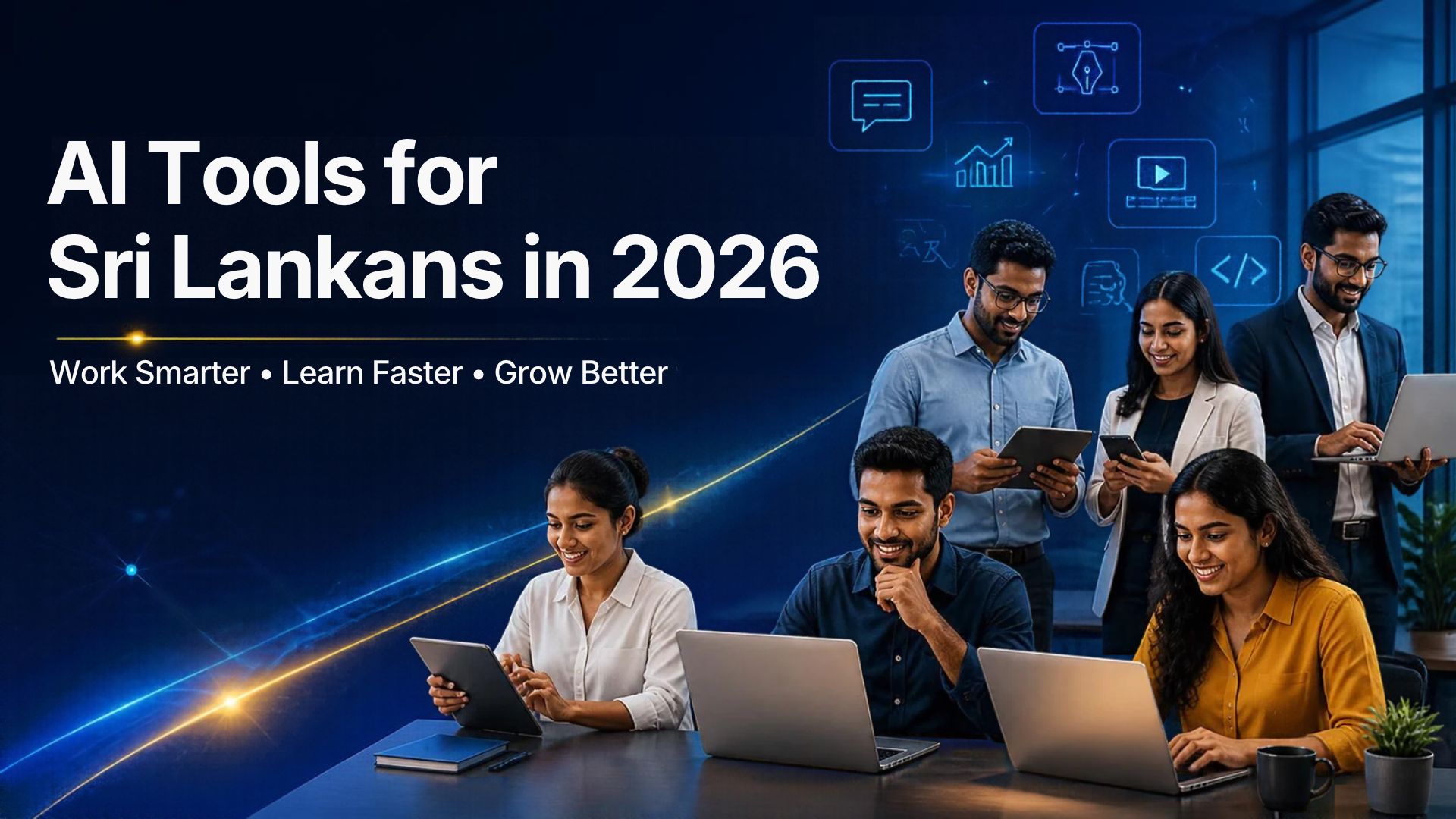
Artificial Intelligence (AI) is becoming an important part of everyday life in Sri Lanka. In 2026, students, business owners, office workers, freelancers, teachers and content creators can use AI tools to save time, improve productivity and develop new skills. Tasks that previously required hours of research, writing or design can now be completed more efficiently with the help of AI.
From writing documents and translating languages to creating marketing content, analysing data and developing websites, AI tools offer practical solutions for people with different levels of technical knowledge. Many tools also provide free versions, making them accessible to Sri Lankans who want to explore AI without immediately paying for a subscription.
However, choosing the right tool is important. Some tools are better for writing, while others specialise in research, image creation, video production or programming. Understanding their strengths and limitations helps users select the most suitable options for their needs.
This article explores some of the most useful AI tools for Sri Lankans in 2026 and explains how students, professionals and businesses can use them effectively.
1. ChatGPT – An AI Assistant for Everyday Tasks
ChatGPT is one of the most versatile AI tools available. It can help users write articles, explain difficult concepts, summarise documents, translate text, generate ideas and solve problems. Depending on the available features and subscription, users can also work with files, images, data and web research.
For Sri Lankan students, ChatGPT can explain lessons in simpler language, generate revision questions and help improve English writing. Office workers can use it to prepare reports, draft emails and organise information. Small business owners can develop product descriptions, customer messages and promotional ideas.
For example, a local shop owner could ask ChatGPT to write a professional Facebook advertisement in English and Sinhala. A university student could request a clear explanation of a complex subject before studying the recommended textbook.
The quality of the result depends on the instructions provided. Users should give clear details about the audience, language, purpose and desired format.
Website: https://chatgpt.com/
2. Google Gemini – AI for Research and Productivity
Google Gemini is an AI assistant that helps users answer questions, explore ideas, summarise information and complete various writing and research tasks. Its usefulness is particularly clear for people who already work with Google's digital services.
Students can use Gemini to understand academic topics, prepare study notes and brainstorm assignment ideas. Professionals can use it to organise information, draft content and assist with tasks involving supported Google Workspace features.
For example, a small business owner planning a promotional campaign could ask Gemini to suggest marketing ideas for a local audience. A student researching environmental issues in Sri Lanka could use it to identify important topics and develop questions for further investigation.
AI-generated answers should still be checked against reliable sources, particularly when dealing with statistics, current events or academic information.
Website: https://gemini.google.com/
3. Claude – AI for Writing and Long Documents
Claude is an AI assistant that can help with writing, reasoning, document analysis and programming. It is especially useful for people who need to work with lengthy documents or develop well-organised written content.
Writers can use Claude to improve article structure, refine sentences and identify unclear explanations. Business professionals can ask it to summarise reports, review proposals or organise information into practical sections.
For Sri Lankan businesses, Claude can help prepare service descriptions, internal documents, business proposals and customer communication. Students can also use it to understand difficult reading materials and improve the clarity of their own writing.
However, users should review important details before publishing or submitting AI-assisted work. The final document should reflect their own understanding, factual research and intended message.
Website: https://claude.ai/
4. Perplexity AI – Research with Sources
Finding trustworthy information online can take considerable time. Perplexity AI offers an AI-powered research experience that provides answers with links to supporting sources.
This makes it useful for students, journalists, business owners and professionals who need to investigate unfamiliar subjects. Users can explore market trends, compare technologies, research industries and identify sources for further reading.
For example, a Sri Lankan entrepreneur considering a new business could research customer trends, competing services and industry developments. A student preparing an assignment could use Perplexity to discover relevant reports and original publications.
Citations are helpful, but they do not automatically guarantee accuracy. Users should open the original sources, confirm the information and check publication dates before relying on the results.
Website: https://www.perplexity.ai/
5. Canva AI – Graphic Design and Marketing
Canva is a popular design platform with AI-powered features that assist with creating visual content. It can help users produce social media graphics, presentations, posters, advertisements and other marketing materials.
This is particularly useful for small businesses in Sri Lanka that need professional-looking promotional content but cannot afford a dedicated graphic designer for every project.
A clothing shop could create a Facebook promotion, a tuition teacher could design an educational poster, and a freelancer could prepare a portfolio presentation. AI-assisted design features can help users generate ideas, adapt layouts and speed up content production.
Nevertheless, users should check spelling, contact details, image quality and design consistency before publishing. Some features and premium assets may require a paid Canva plan.
Website: https://www.canva.com/
6. Grammarly – Improving English Writing
Grammarly helps users improve English writing by identifying grammar issues, spelling mistakes, unclear sentences and opportunities to improve tone. Depending on the plan and feature, it can also assist with rewriting and generating text.
English communication is important for Sri Lankan students, job seekers, office workers and freelancers who communicate with international customers.
For example, a job applicant can use Grammarly to review a cover letter before applying for a position. A freelancer can check a client email, while a business owner can improve the wording of a website page.
Grammarly is most useful as a writing assistant rather than a replacement for language learning. Users should understand suggested corrections and choose wording that communicates their meaning accurately.
Website: https://www.grammarly.com/
7. DeepL – AI Translation and Language Support
DeepL provides machine translation and writing assistance for supported languages. It can help users understand foreign-language content and prepare translations for communication or research.
Sri Lankan businesses working with international customers may find translation tools useful for understanding enquiries, drafting correspondence and preparing multilingual information.
However, language support varies by tool. Users should confirm whether their required language pair, including Sinhala or Tamil, is supported before depending on a translation service.
Translations involving legal documents, medical information, contracts or official communications should receive careful human review. Cultural meaning and local expressions can be difficult for automated systems to interpret correctly.
Website: https://www.deepl.com/
8. NotebookLM – Learning from Your Own Documents
NotebookLM is an AI-powered research and learning tool from Google. It helps users work with supplied source materials, such as supported documents and notes, and generate summaries or answers grounded in those materials.
This can be valuable for university students, researchers, teachers and professionals who need to understand lengthy information.
For example, a student could add lecture notes and ask for a topic summary or revision questions. A business professional could use relevant reports to identify key points before preparing a presentation.
The quality of the results depends on the quality and relevance of the uploaded sources. Users should confirm important answers against the original documents and ensure they have permission to upload any confidential or copyrighted material.
Website: https://notebooklm.google.com/
9. GitHub Copilot – AI for Programming
GitHub Copilot is an AI coding assistant designed to support software development. It can suggest code, explain programming concepts and help developers work through common coding tasks.
For Sri Lankan IT students, software developers and aspiring freelancers, it can be a useful learning and productivity tool.
A beginner learning Python could ask for an explanation of a function. A web developer could use code suggestions to speed up routine tasks or request help understanding an error message.
However, AI-generated code may contain bugs, security weaknesses or incorrect assumptions. Developers should test suggestions, review security implications and understand the code before using it in real projects.
AI coding assistants are most effective when combined with programming fundamentals, logical thinking and practical experience.
Website: https://github.com/features/copilot
10. CapCut – AI-Assisted Video Creation
Video content has become important for digital marketing, online education and social media communication. CapCut offers video-editing tools with AI-assisted features, although availability can vary by region, device and plan.
Sri Lankan content creators can use video-editing tools to prepare short promotional videos, educational clips, product demonstrations and social media content.
For example, a restaurant could create a short video showcasing its menu, while a tutor could produce a lesson introduction for students. Freelancers can also use video content to promote their services.
Users should check subtitles, pronunciation, music licensing and visual accuracy before publishing. AI-generated voiceovers or translations may not always handle Sinhala, Tamil or local place names naturally.
Website: https://www.capcut.com/
11. AI Tools for Small Businesses in Sri Lanka
AI tools can help small businesses improve productivity without immediately expanding their workforce. Retail shops, restaurants, clothing businesses, digital agencies and service providers can use AI in several practical ways.
Marketing: Generate advertising ideas, social media captions, blog topics and promotional messages.
Customer communication: Draft polite responses to common questions and prepare frequently asked questions.
Website content: Write initial drafts for service pages, product descriptions and search engine optimisation content.
Planning: Organise campaign ideas, create task lists and prepare meeting summaries.
Data analysis: Use suitable AI assistants to explore sales spreadsheets, identify patterns and summarise business information.
For example, a small business in Colombo could use ChatGPT to prepare promotional copy, Canva to design an advertisement and an AI-assisted video editor to create a short campaign video.
These tools can reduce repetitive work, but businesses should not assume that AI-generated marketing automatically produces more sales. Results still depend on product quality, pricing, customer service, competition and a clear marketing strategy.
12. How Students Can Use AI Responsibly
AI can support learning when it encourages understanding instead of replacing independent effort.
Sri Lankan students can use AI tools to explain unfamiliar concepts, practise English, create revision plans, generate sample questions and organise notes. Students preparing for O/L, A/L or university examinations should compare AI explanations with their prescribed textbooks, teacher guidance and official syllabus requirements.
One useful approach is to ask an AI assistant to explain a topic in simple language, provide an example and then generate practice questions. Students can attempt the questions independently before checking their answers.
AI should not be treated as an unquestionable source of truth. It can generate incorrect facts, fabricated references and explanations that do not match the Sri Lankan curriculum. Students must also follow their institution's rules regarding AI-assisted assignments and examinations.
The main objective should be to improve knowledge, reasoning and communication skills rather than simply produce work more quickly.
13. Important Safety Tips When Using AI Tools
Although AI offers many benefits, responsible use is essential.
Verify important information: Check facts, dates, statistics and references against reliable sources.
Protect personal information: Avoid sharing passwords, banking details, identification numbers or sensitive personal records.
Respect confidentiality: Do not upload private customer information, confidential business documents or restricted workplace files without proper authorisation.
Review generated content: Check spelling, translations, images, calculations and code before using them.
Understand subscription costs: Free access, usage limits, paid features and availability may change. Review official websites before subscribing.
Respect copyright and ownership: Check the terms of each service before using generated material commercially, particularly when creating images, music or video.
Keep human judgement involved: AI can assist with decisions, but important legal, medical, financial and professional matters require appropriate expertise.
These precautions help users benefit from AI while reducing avoidable risks.
Conclusion
AI tools are creating new opportunities for Sri Lankans in education, business, employment and digital content creation. In 2026, tools such as ChatGPT, Google Gemini, Claude, Perplexity AI, Canva, Grammarly, NotebookLM, GitHub Copilot and CapCut can help people complete tasks more efficiently and develop useful digital skills.
The best tool depends on the user's objective. Students may benefit from learning assistants and document analysis tools. Business owners may prioritise writing, design and marketing. Developers may prefer AI coding assistants, while researchers may benefit from tools that help discover and evaluate sources.
It is not necessary to learn every AI tool at once. Start with one or two that solve a real problem, practise using clear instructions and verify the results. Explore free options first and consider paid subscriptions only when their additional features provide genuine value.
Most importantly, AI should support human creativity, knowledge and decision-making rather than replace them. Sri Lankans who learn to use these technologies responsibly can strengthen their digital skills, improve productivity and prepare for an increasingly technology-driven future.